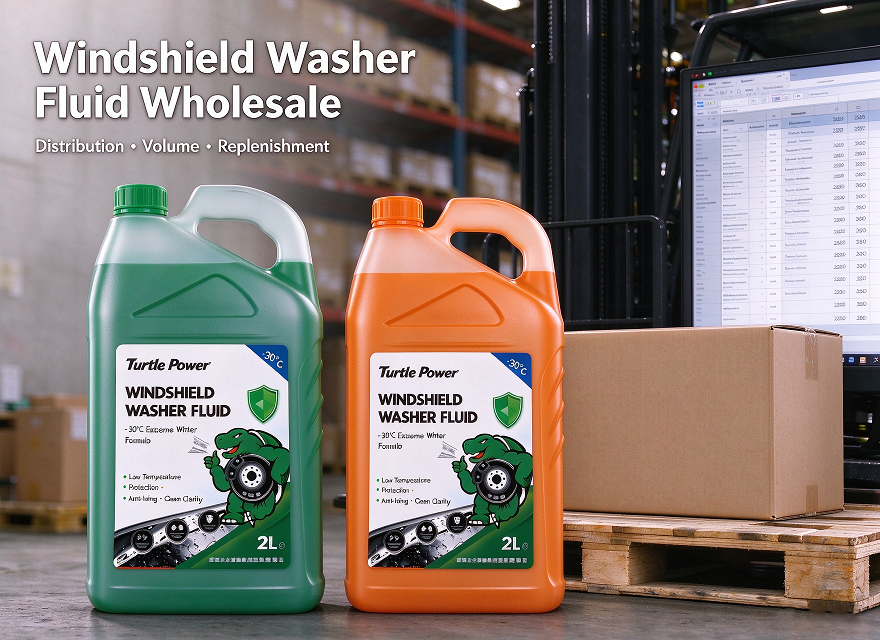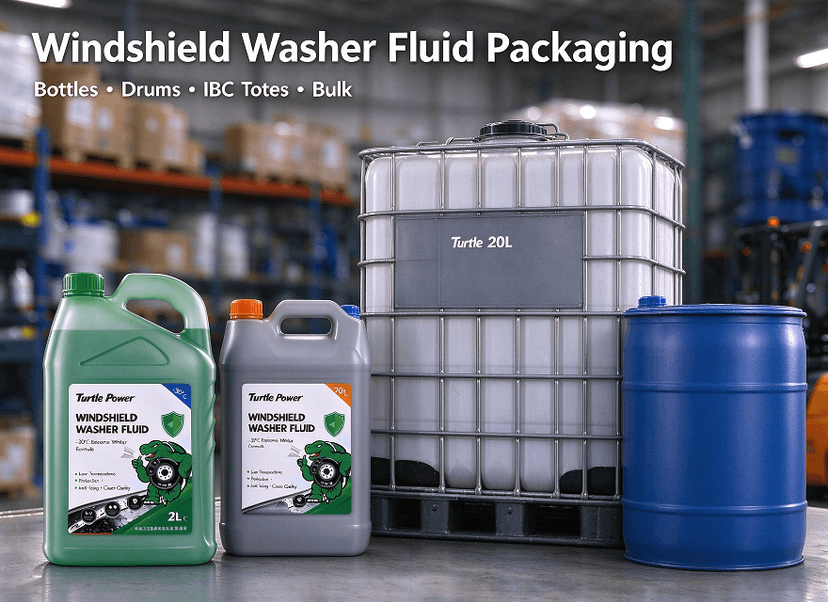
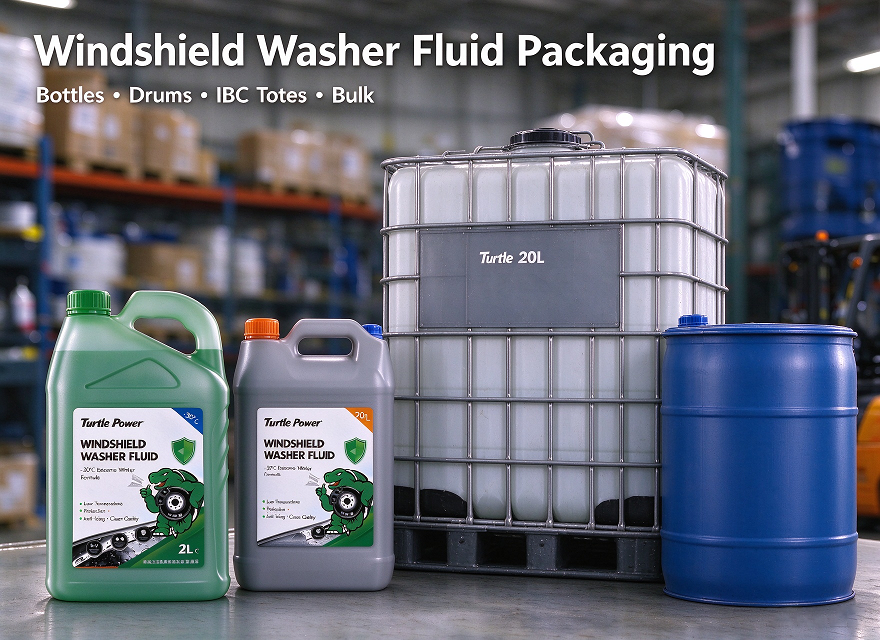
Washer fluid is sold in containers ranging from a 500 millilitre bottle to a road tanker, and the format a manufacturer ships is not a cosmetic choice. It determines which customers can buy the product, how much the packaging costs per litre, how the product is handled at the destination and whether the shipment survives a container journey intact. Buyers sometimes fixate on formula and freeze point while accepting whatever pack size the supplier offers, and then discover that the product cannot reach its intended channel. GAFLE factory produces washer fluid in retail bottles, workshop cans, drums, IBC totes and bulk deliveries, and the format comparison below explains when each one makes sense.
Four packaging families and four channels
Four packaging families map onto four channel types, and each family has its own cost curve and handling logic. Retail packs serve consumers through supermarkets, convenience retail and e-commerce. Workshop packs serve garages, quick-service chains and service stations. Industrial packs serve fleets, distributors with high turnover and contract cleaning operations. Bulk delivery serves the largest users, including blenders, distributors filling their own packs and municipal fleets.
Cost per litre falls as pack size rises, but the relationship is not linear. A step change occurs when you leave consumer packaging, because caps, dosing devices and label complexity are proportionally expensive on small bottles. A second step change occurs when you move from drums to bulk delivery, because packaging disappears from the equation entirely.
The mistake to avoid is choosing a format because the unit price looks low. A 200 litre drum priced beautifully is worthless to a retail chain that needs shelf-ready bottles.
Retail small packs
Retail small packs carry the highest packaging cost per litre and exist because shelf presence and convenience are worth paying for. A one litre, four litre or one gallon bottle is designed to be picked up, carried and poured by hand. That imposes constraints on handle shape, cap design, label area and bottle stiffness.
The retail pack also carries marketing function. It must communicate freeze point, application and brand in a few seconds at shelf distance, and it usually needs a visible liquid colour to signal the grade. This is why retail bottles are the least standardised part of the range.
For private label buyers, retail packs are where custom bottle shapes create the most value and the most cost. A distinctive shape builds recognition, but a new mould requires committed volume.
The 20 litre workshop can
The 20 litre can is the workhorse of the workshop channel, sized to the way technicians actually top up reservoirs. A workshop tops up many vehicles in a day, and a small bottle means repeated trips and wasted packaging. A 20 litre can reduces handling, provides enough fluid for dozens of top-ups and is light enough for one person to lift with a handle.
This format also suits service stations that offer a free top-up with a fuel purchase, since the container sits beside the pump and is decanted into a measuring jug.
The design considerations are practical rather than promotional: a secure cap, a stable base, a visible level and a label that survives contact with washer fluid and workshop chemicals.
Drums and IBC totes
Drums and IBC totes serve industrial and fleet buyers who measure consumption in hundreds of litres and care about handling efficiency rather than shelf appeal. A 200 litre drum suits a mid-sized fleet or a distributor that decants into smaller packs. An IBC tote, typically holding a cubic metre, suits larger operations and is designed for forklift handling.
Both formats need attention to the material and the fittings. The drum body must be compatible with the solvent system, the closure must seal against evaporation, and the valve or tap must allow controlled dispensing without spillage.
Buyers should also confirm the packaging specification for cold transport, since some plastics become brittle at very low temperature and should not be handled roughly during winter loading.
Bulk tanker delivery
Tanker delivery removes packaging from the cost equation entirely, but it requires volume, storage and a customer who can receive it. The economics only work above a substantial annual volume, and they depend on the customer having a suitable tank, a pump and the ability to accept a delivery window.
Bulk delivery also shifts quality control responsibility. The manufacturer must guarantee the composition at the point of delivery, and the customer must keep the tank clean and free of contamination. A tank that previously held a different solvent system can compromise the incoming batch.
For the right customer, bulk is the cheapest possible route to washer fluid. For everyone else, it is an operational burden disguised as a saving.
Export packaging
Export packaging is where cheap packs fail, because strength, pallet pattern and label durability decide whether a container arrives sellable. Bottles must survive stacking pressure and container movement, which is why carton compression strength and pallet configuration matter as much as the bottle wall thickness.
Labels must survive condensation, which is common on containers crossing climate zones. A label printed on the wrong stock lifts at the edges and looks damaged to the end customer, even though the product is fine.
Shipping marks, pack counts, gross weights and barcode placement should be agreed before printing, because a carton that does not scan at the destination creates handling delays for the importer.
FAQ
Q1: Which packaging format is cheapest per litre? A1: Bulk tanker delivery, followed by IBC totes and drums. Retail bottles carry the highest packaging cost per litre because caps, handles and labels are proportionally expensive.
Q2: Can I order a 200 liter drum for a small market test? A2: Yes, but the economics are poor for a trial. Drums suit operations that can consume the volume within the shelf life.
Q3: Do you supply empty bottles for local filling? A3: Bottle supply and contract filling are both possible. Empty bottle supply usually suits buyers with their own filling line and a larger committed volume.
Q4: What label material suits exported washer fluid? A4: A stock that resists moisture and condensation, tested on the actual bottle surface rather than on a flat sample.
Q5: Can different pack sizes be mixed in one container? A5: Usually yes, and mixing often improves container utilisation, provided each SKU reaches its own packaging minimum.
Q6: Are IBC totes returnable? A6: Some programmes use returnable totes, but international shipments normally use single-trip units because return freight rarely justifies the cost.
Welcome to contact GAFLE for more information & cooperation!
peter
ZHEJIANG GAFLE AUTO CHEMICL CO.,LTD
Tel:86-579-8222 1665
Fax:86-579-8246 4690
Cel/Wechart:86-13335993986
E-mail:peter@gafle.net
Web:www.gafle.net