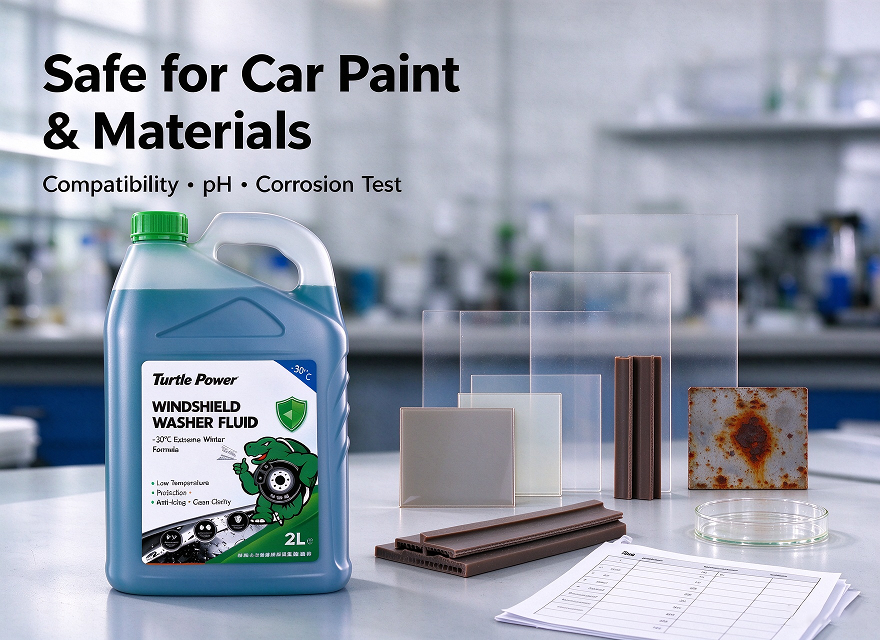
Buyers ask a deceptively simple question about washer fluid: is it safe for the car? The honest answer is that safety is specific. A formula can be safe for clearcoat and aggressive towards polycarbonate, or gentle on plastics and corrosive to a zinc-coated component in the washer circuit. What matters is whether the manufacturer tested the actual materials involved, at the actual concentration, rather than asserting general compatibility. GAFLE factory runs a material compatibility programme for every washer fluid formula it exports, and the mechanisms below explain what that programme is protecting against.
Why "paint safe" is a formulation claim
"Safe for car paint" is a test conclusion rather than a marketing phrase, and it can only be supported by formulation data and compatibility trials. Automotive paint is a multi-layer system: primer, base coat and clearcoat, each with different solvent tolerance. Clearcoat is the layer washer fluid actually contacts, and it is the layer whose appearance the customer judges.
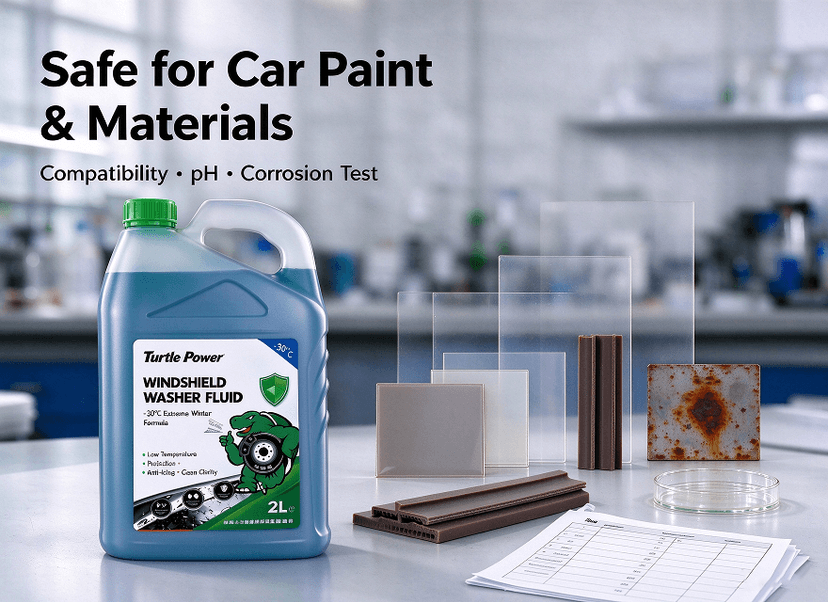
A compatibility trial typically involves immersing or repeatedly wetting coated panels with the fluid at defined concentration and temperature, then assessing gloss change, colour change, hardness and any visible etching. The result is a pass or fail against a defined criterion, not a slogan.
Buyers should ask for the compatibility report rather than accept the statement, and should check that the tested concentration matches the product as sold. A concentrate tested only in diluted form leaves the question of what happens if a customer pours it in neat.
Paint and clearcoat damage mechanisms
Paint and clearcoat damage from washer fluid comes from a narrow set of causes, and most of them are concentration-dependent rather than absolute. Strongly alkaline formulas can attack the clearcoat over repeated exposure. Certain glycol ethers and aggressive solvent blends can soften the coating, which shows up as gloss loss rather than immediate visible damage.
The concentration dependency matters because failure usually appears when the product is used outside its intended dilution, or when it is left standing on a surface in strong sun. A droplet that sits on a horizontal panel and evaporates concentrates the chemistry in one spot, which is why etching often appears as small circular marks rather than as a general dulling.
Good formulation practice keeps the solvent system within the tolerance of clearcoat, keeps pH in a moderate range, and ensures the fluid does not leave a persistent film that concentrates on evaporation.
Polycarbonate components
Polycarbonate components fail differently from painted surfaces, because the risk is stress cracking rather than chemical attack on a coating. Polycarbonate is used for headlamp lenses, some washer covers and certain trim parts. It is tough but sensitive to certain solvents, and when it is under mechanical stress, solvent contact can produce fine cracks that propagate.
The mechanism is environmental stress cracking. A fluid that would be harmless on an unstressed sample can cause crazing on a moulded part with residual stress from injection moulding or assembly.
This is why compatibility testing on polycarbonate should use stressed specimens and realistic contact patterns rather than simple immersion. A manufacturer who tests only flat, annealed coupons may report a pass that does not reflect field performance.
Buyers sourcing for vehicles with polycarbonate headlamps should ask specifically whether the formula was evaluated against stressed polycarbonate.
Rubber and elastomers
Rubber and elastomer performance under washer fluid depends on solvent aggressiveness, and the failure modes are swelling, hardening and loss of elasticity. Wiper blade rubber, reservoir seals, hose elastomers and pump diaphragms are all exposed to the fluid repeatedly.
Swelling is the most visible effect: a seal that absorbs solvent grows, then loses compression set and starts to leak. Hardening is the opposite and slower failure, where the elastomer loses flexibility and cracks under vibration.
Test programmes measure volume change, hardness change and tensile properties after immersion at defined temperature and duration. Results differ by elastomer type, which is why a generic statement that a product is "rubber safe" is not sufficient for a technical buyer.
Corrosion in the washer circuit
Corrosion testing in the washer circuit is less about the fluid alone and more about what the fluid does to the metals it contacts over time. The washer circuit contains the pump motor housing, springs, screen mesh and sometimes level sensor contacts. These are small metal areas, but they are the parts that fail first.
Standard practice is immersion or intermittent wetting tests on steel, aluminium, brass and coated coupons, looking for rust, pitting and discolouration. The fluid should contain an inhibitor package appropriate to the metals present, and the inhibitor must remain effective after dilution.
A subtle point is aeration. Washer fluid in a reservoir is agitated by vehicle motion and mixed with air, which accelerates oxidation of some inhibitor systems. Test programmes that only use static immersion may miss this.
pH specification
pH specification matters because it indicates the chemical balance of the formula, but a single pH number tells you less than the measurement conditions behind it. Washer fluid is typically formulated in a mildly alkaline to neutral range, depending on the surfactant system, and the specification should state the range together with the measurement temperature and method.
A very high pH raises the risk to clearcoat and to aluminium. A very low pH raises corrosion risk in the circuit and can affect some elastomers. Neither extreme is automatically wrong, but both require justification and compatibility evidence.
Buyers comparing two products should compare the measured pH, the surfactant type and the inhibitor package, rather than treat pH as a quality score.
Residue, streaking and complaints
Residue and streaking complaints usually trace back to surfactant balance and drying behaviour rather than to the solvent system itself. A surfactant that cleans well but dries slowly leaves a visible film, especially on dark paint and under low-angle sunlight.
The interaction with wiper blades matters too. A fluid that leaves a persistent film can cause chatter and smear, which customers describe as a bad wiper rather than a bad fluid.
Formulation fixes include reducing high-molecular-weight surfactant fractions, adding a low-residue co-solvent and verifying performance on real windscreens with real blades. A manufacturer should be able to explain which of these was applied, and to show a test result on glass rather than a claim on a label.
FAQ
Q1: Can washer fluid damage car paint? A1: A correctly formulated product does not. Damage usually appears with over-concentrated or strongly alkaline products left to evaporate on the surface, which is why compatibility reports should be requested.
Q2: Is washer fluid safe for polycarbonate headlamps? A2: It can be, but polycarbonate is sensitive to solvent stress cracking. Ask whether the formula was tested on stressed polycarbonate specimens rather than flat coupons.
Q3: What pH should washer fluid have? A3: Most formulas sit in a mildly alkaline to neutral range, but the acceptable range depends on the surfactant system and the materials in the circuit. The specification should state the range and the test conditions.
Q4: Will washer fluid damage wiper blades? A4: Not if the elastomer compatibility was validated. Swelling and hardening indicate an overly aggressive solvent system.
Q5: Why does my washer fluid leave streaks? A5: Usually a surfactant and drying behaviour issue rather than a solvent issue. A low-residue formulation and correct dilution reduce it.
Q6: Is a corrosion inhibitor necessary in washer fluid? A6: Yes for professional products, since pump housings, screens and sensor contacts are small metal areas that corrode quickly without protection.
Welcome to contact GAFLE for more information & cooperation!
peter
ZHEJIANG GAFLE AUTO CHEMICL CO.,LTD
Tel:86-579-8222 1665
Fax:86-579-8246 4690
Cel/Wechart:86-13335993986
E-mail:peter@gafle.net
Web:www.gafle.net