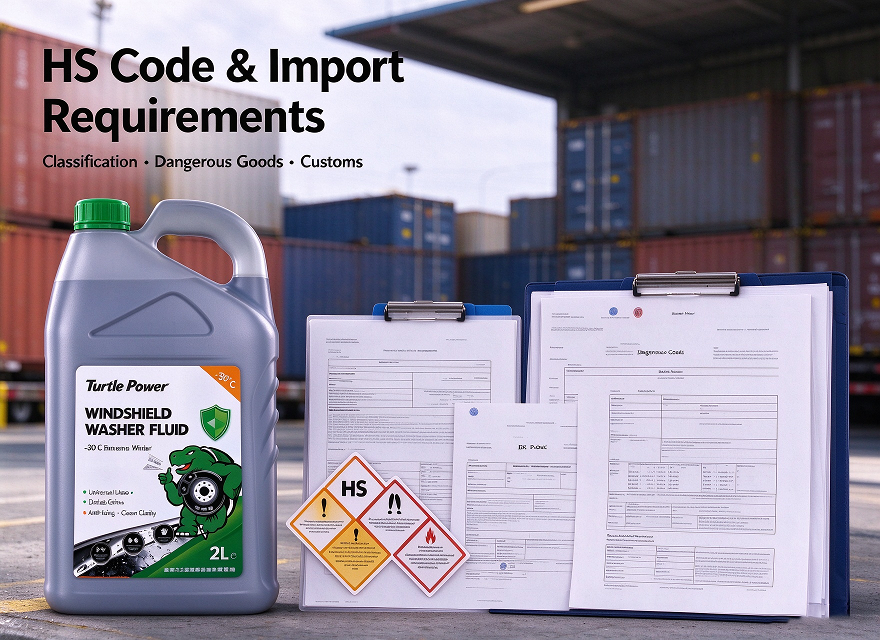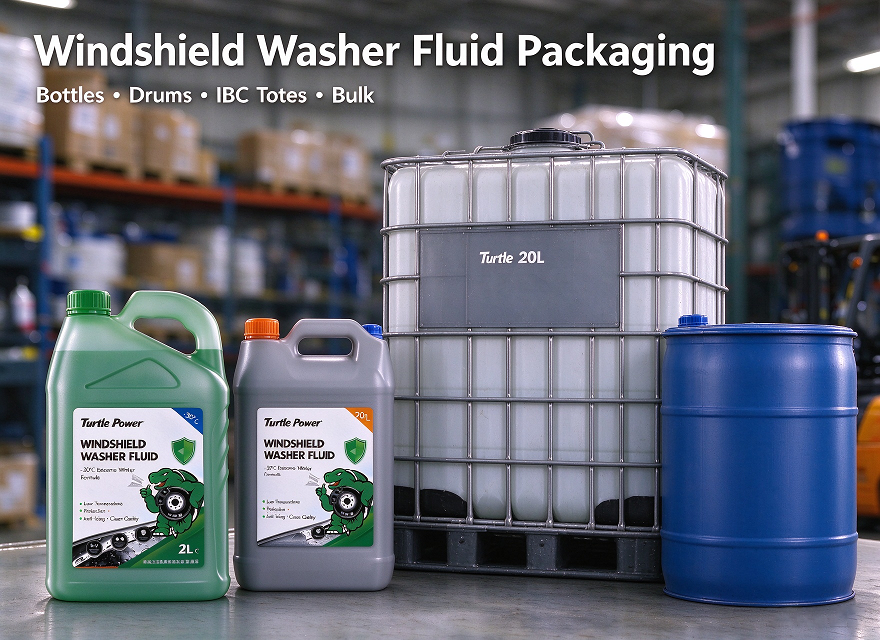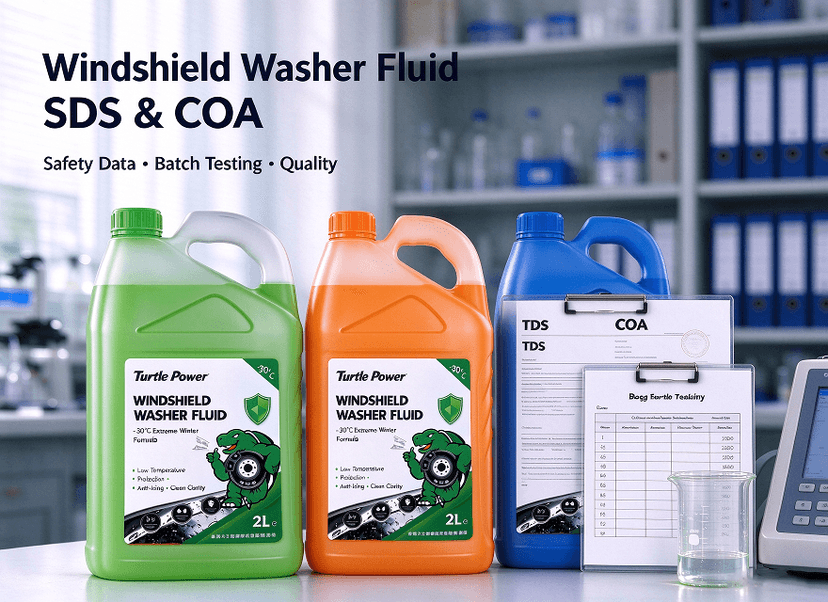
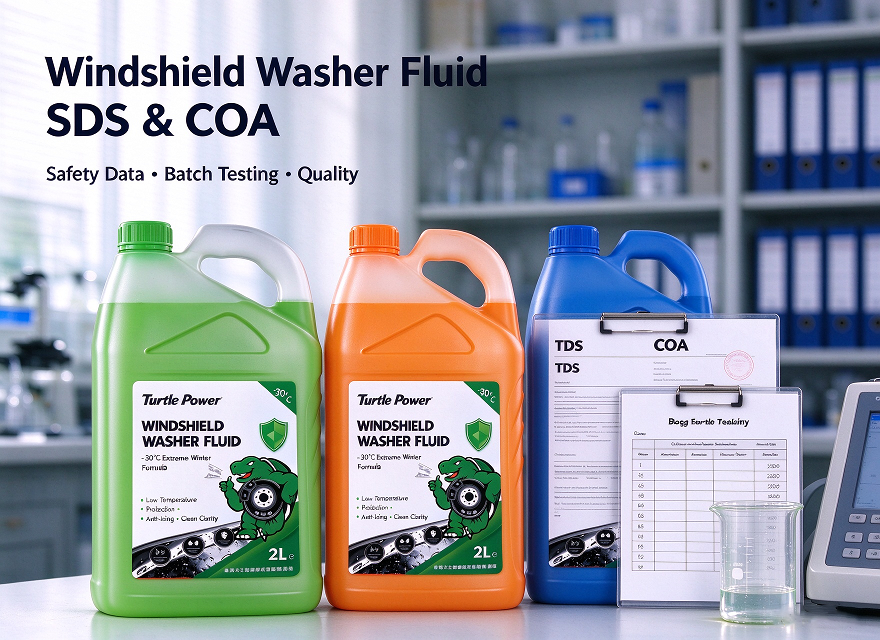
Washer fluid is inexpensive, which is exactly why documentation problems in this category are so expensive. A container held at a port because the safety data sheet names the wrong hazard class costs more in demurrage and lost selling season than the margin on the entire shipment. A retail listing suspended because the certificate of analysis cannot be matched to a batch costs a distributor its shelf space. GAFLE factory issues a four-document set with every washer fluid shipment, and the explanation below covers what each document should contain and where buyers most often get caught.
Four documents, four jobs
Four documents do four different jobs, and buyers who accept a single "specification sheet" in place of all four usually discover the gap at customs. The safety data sheet communicates hazard information to handlers, emergency responders and regulators. The technical data sheet communicates performance and specification to commercial and technical buyers. The certificate of analysis confirms that a specific batch met the specification. The batch test record is the underlying evidence that supports the certificate.
These documents overlap in content but not in purpose. A supplier that provides one combined sheet is usually trying to save effort, and the result often satisfies nobody: the SDS lacks regulatory format, the TDS lacks test values, and the COA cannot be traced.
For export buyers, the four documents should be prepared before the production batch, not after the container is booked. Revisions at the last minute are the most common cause of shipping delays in this category.
The safety data sheet
The safety data sheet must describe the product you actually buy, in the language and classification your market requires. The most frequent error is a generic SDS copied from a similar product, with a hazard classification that does not match the alcohol content of the formula being shipped.
The second most frequent error is language. Several markets require the SDS in an official local language, and an English-only document is not accepted for import clearance or for workplace use.
The third is version control. An SDS must carry a revision date and version number, and the version supplied with the shipment must match the version on file with the buyer. When a formula changes, even slightly, the SDS must be updated and the buyer informed.
Buyers should check three things on receipt: that the product name and composition match the order, that the hazard statements align with the measured flash point and alcohol content, and that the document is in the required language and current format.
The technical data sheet
The technical data sheet is the commercial document, and its numbers are what your distributors, tender documents and retail listings will be checked against. A TDS should state appearance and colour, density, pH range, freeze point for the specific grade, alcohol content where relevant, shelf life, storage conditions and recommended application or dilution.
Vague TDS language creates commercial risk. A freeze point stated as "approximately minus thirty" invites a customer complaint at minus twenty eight. A pH stated as a range without measurement conditions is difficult to audit. A shelf life stated without storage conditions is unenforceable.
The TDS is also the document a tender evaluation will read. Public procurement and large fleet contracts frequently score suppliers on the completeness of technical documentation, and a thin TDS loses points that price cannot recover.
Certificate of analysis and batch testing
A certificate of analysis is only meaningful when it is tied to a specific batch that can be traced and re-tested. The certificate should carry the batch number, production date, the measured values for each specified parameter and the specification limits those values are compared against.
The batch number is the link to everything else: the retained sample, the filling records, the raw material lots and the shipment. A COA without a batch number is a marketing document, not a quality record.
Retained samples matter more than buyers expect. If a customer complains that the fluid left residue or damaged a pump three months after delivery, the retained sample is the only way to establish whether the batch was within specification. Factories producing for export should retain samples for the full shelf life period.
Internal quality standards
Internal quality standards define what the factory tests on every batch, and buyers should know which parameters are measured rather than assumed. A practical washer fluid control programme covers appearance and colour, density, pH, freeze point, alcohol content where applicable and a stability check after a defined storage period.
Some parameters can be measured on every batch; others are verified periodically or on formula change. Compatibility testing with plastics and elastomers is typically done at formula validation rather than per batch, which is why buyers should request the validation report separately from the routine COA.
The distinction matters when a problem appears. A complaint about a cracked reservoir is answered by the compatibility report, not by the batch pH.
Shelf life and stability
Shelf life claims should be supported by stability testing, not by a number copied from a similar product. A typical claim for washer fluid is two to three years in unopened packaging under defined storage conditions, but the figure should come from accelerated or real-time testing of the actual formula in the actual container.
Stability testing should cover freeze-thaw cycling, which is realistic for a product stored outdoors in winter markets, and elevated temperature storage, which is realistic for containers sitting on a wharf. It should also cover container compatibility, since a solvent system that interacts with the bottle can change colour, odour or composition over time.
Buyers importing into markets with long distribution chains should ask for the stability report rather than accept the shelf life statement on the label.
Where buyers lose points at audit
The most common audit failures are mismatched documents, missing translations and inconsistent batch numbering. A retail quality team comparing the label, the SDS and the COA will notice if the product name differs across the three, or if the batch number format changes between shipments.
Missing translations come second. A label in the local language with an SDS in English passes visual inspection and fails regulatory inspection.
Inconsistent batch numbering is the third, and it usually indicates that records are maintained manually without a link to production. Buyers can test this cheaply by requesting the batch records for the last three shipments and checking whether the numbering follows a consistent logic.
FAQ
Q1: What is the difference between SDS and TDS? A1: The SDS covers hazard, handling and emergency information; the TDS covers performance, specification, application and storage. They serve different readers and cannot substitute for each other.
Q2: Is a COA required for every shipment? A2: For professional buyers, yes. The COA should be tied to the specific batch, and a retained sample should exist for that batch.
Q3: Can the SDS be issued in English only? A3: Only if the destination market accepts English. Several markets require the SDS in an official local language for import and workplace use.
Q4: How long should a factory retain batch samples? A4: At least for the declared shelf life, so that a complaint can be investigated with the actual product rather than a substitute.
Q5: What shelf life is typical for washer fluid? A5: Commonly two to three years in unopened packaging under defined storage. The exact figure should be supported by stability testing of the specific formula.
Q6: Does a formula change require new documents? A6: Yes. A composition change normally requires an updated SDS, an updated TDS and re-validation of compatibility and stability.
Welcome to contact GAFLE for more information & cooperation!
peter
ZHEJIANG GAFLE AUTO CHEMICL CO.,LTD
Tel:86-579-8222 1665
Fax:86-579-8246 4690
Cel/Wechart:86-13335993986
E-mail:peter@gafle.net
Web:www.gafle.net