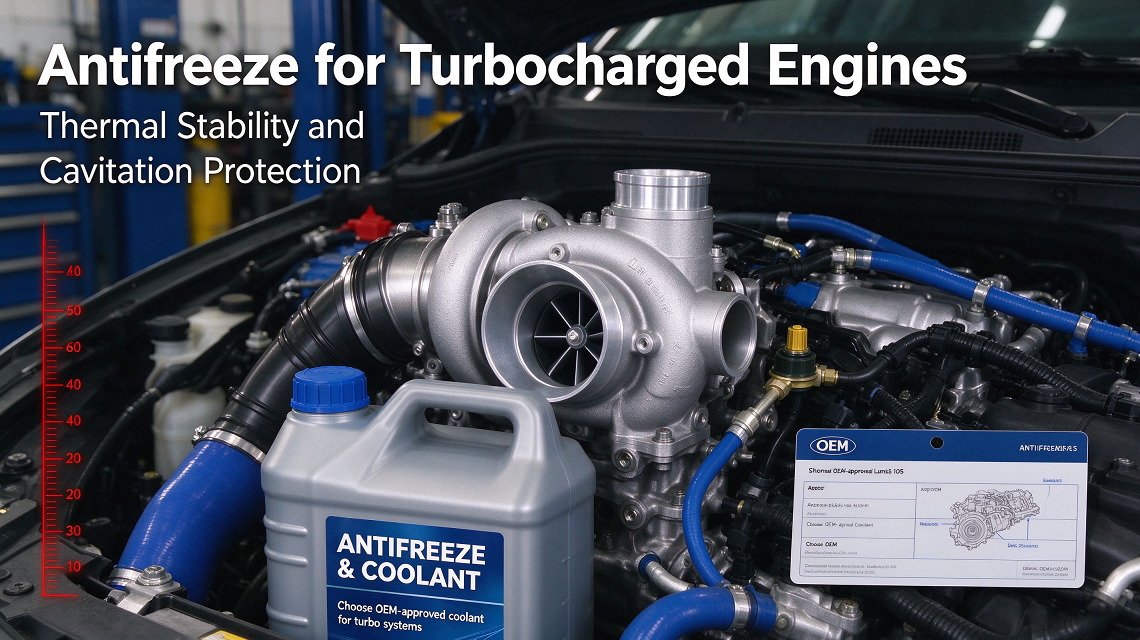
Thermal Loads and Forced Induction: Rethinking Coolant Selection
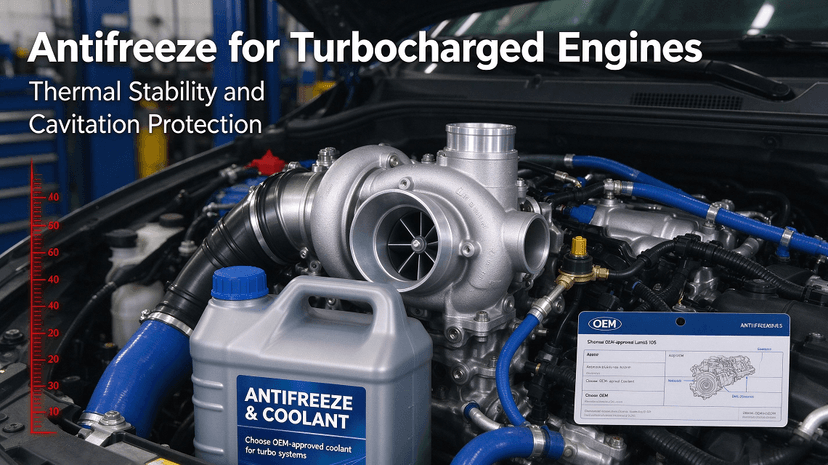
Specifying the best antifreeze for turbocharged engines requires looking past conventional winter freeze ratings and focusing on localized heat rejection. In a modern forced-induction powertrain—whether a downsized direct-injection passenger unit or a heavy-duty commercial turbodiesel—the turbocharger cartridge acts as an intense point-source of heat. When an engine shuts down hot, coolant circulating through the center housing rotating assembly (CHRA) absorbs immense thermal energy, occasionally exceeding 100°C to 120°C in localized passages during thermal soak-back.
Standard light-duty formulations that perform adequately in naturally aspirated blocks often degrade rapidly under these conditions. Choosing an inadequate fluid leads to localized nucleate boiling failure, accelerated additive depletion, silicate drop-out, and eventual bearing housing distress. For fleet operators, powertrain engineers, and maintenance directors, matching the fluid chemistry to the specific operating demands of the turbo system is a baseline reliability requirement.
The Real Coolant Requirements for a Turbo Motor
Turbocharger cooling loops present three specific fluid challenges that standard engine cycles rarely replicate at scale:
- Cavitation and Vapor Pocketing: The rapid acceleration of coolant across high-velocity water jackets in the CHRA can cause localized pressure drops. If the fluid's vapor pressure is reached, micro-bubbles form and violently collapse against metal walls, causing cavitation erosion on thin-walled casting sections.
- Thermal Oxidation of Glycol: Ethylene glycol degrades into organic acids (glycolic, formic, and oxalic acids) when exposed to sustained temperatures above normal bulk coolant ranges. These acids drop the pH, turning the fluid corrosive to aluminum and copper alloy interfaces found in intercoolers and turbo bearings.
- Silicate Drop-Out and Gelling: Traditional formulations relying heavily on inorganic silicates can "cook" inside hot bearing housings. When silicates precipitate out of solution, they form an abrasive gel or grit that prematurely degrades mechanical water pump seals and plugs narrow internal CHRA cooling galleries.
Consequently, the baseline coolant requirements for turbo motor applications prioritize high chemical thermal stability over raw initial corrosion protection that deteriorates after 30,000 miles.
Evaluating Coolant Chemistries: OAT, HOAT, and Si-OAT
Choosing a suitable coolant for turbo vehicle operations usually narrows down to three primary chemical families. Traditional inorganic additive technology (IAT)—the bright green fluid common decades ago—is universally obsolete for modern turbo systems due to rapid silicate breakdown under elevated temperatures.
Organic Acid Technology (OAT)
OAT formulas rely on fully organic carboxylate inhibitors (such as sebacate and 2-ethylhexanoic acid) to protect base metals. Because they contain zero silicates, phosphates, or borates, they are virtually immune to heat-induced gelling inside hot turbo housings. They offer exceptional operational life (typically 5 years or 150,000+ miles). However, they take longer to form a protective layer on fresh metal surfaces and require strict compatibility checks against certain elastomer seal formulations.
Hybrid OAT (HOAT) and Silicated OAT (Si-OAT)
European and many heavy-duty commercial manufacturers favor Si-OAT or nitrite-free HOAT. These formulations combine a robust organic carboxylate base with a precise, stabilized fraction of silicates. The silicate component provides instantaneous surface passivation for aluminum heads and turbo housings, while the organic acids ensure multi-year stability. For applications experiencing extreme localized heat flux, Si-OAT often represents the most reliable compromise between instant surface protection and long-term chemical resilience.
Phosphate Organic Acid Technology (P-OAT)
Commonly specified by Asian OEMs, P-OAT substitutes phosphates for silicates to handle aluminum passivation. While highly effective at suppressing cavitation in high-revving turbo blocks, P-OAT demands the use of deionized or demineralized water. Hard water minerals cause phosphates to precipitate as insoluble calcium phosphate, choking the narrow cooling channels of a performance turbocharger.
Concentration Ratios and Specific Heat Trade-offs
A common mistake in managing turbo antifreeze is running unnecessarily high glycol concentrations under the assumption that more concentrate equals better protection. Pure ethylene glycol has a specific heat capacity roughly half that of pure water (approximately 2.4 J/g·K versus 4.18 J/g·K).
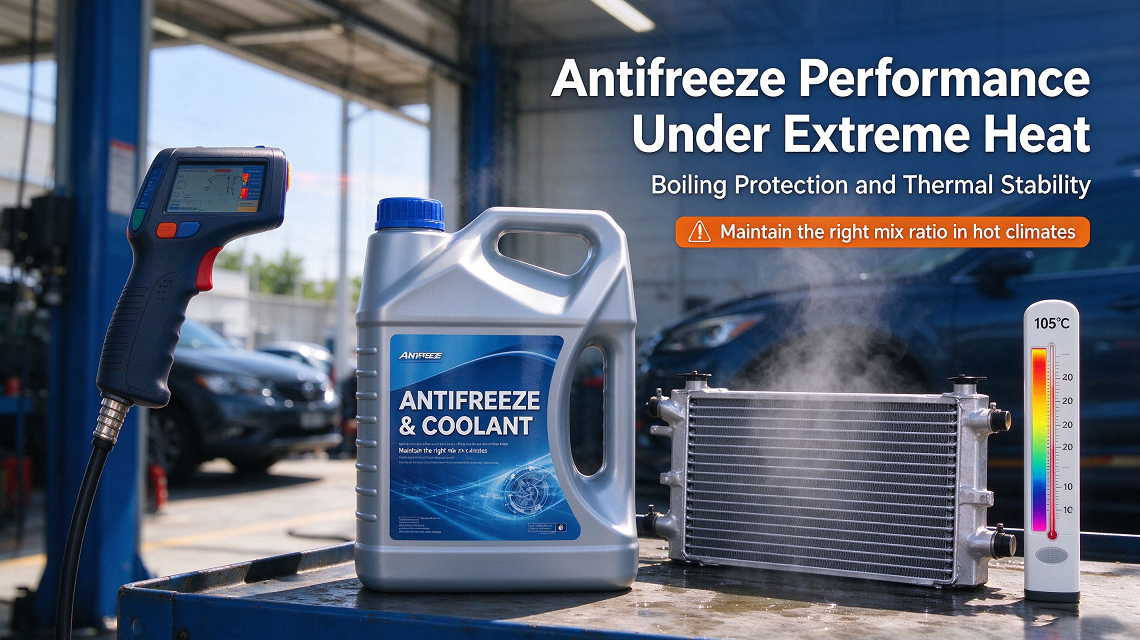
A 50/50 mixture represents the industry standard compromise, delivering a pressurized boiling point of around 128°C (at a 15 psi cap) while retaining sufficient specific heat to pull thermal energy out of the CHRA quickly. Bumping the concentration to 60/40 or 70/30 raises freeze protection for sub-zero climates, but it measurably reduces thermal conductivity and volumetric heat capacity. In severe-duty turbocharged applications, that loss in heat extraction can cause cylinder head temperatures to creep upward and increase post-shutdown soak temps in the turbo bearings. Unless operating in arctic conditions, never exceed a 55/45 glycol-to-water ratio.
Selection Framework: Choosing Antifreeze for Turbo Engines
When selecting or consolidating fluid inventory for turbocharged assets, follow a structured verification process rather than selecting by coolant color:
- Rely on OEM Specifications, Not Dye Color: Antifreeze dye is arbitrary. An amber fluid from one supplier can share chemistry with a magenta or blue fluid from another. Always match the engine manufacturer's engineering specification (e.g., VW TL 774-G/G12++, Cummins CES 14603, or Ford WSS-M97B44-D).
- Verify Water Quality: Never mix concentrate with untreated tap water. Dissolved chlorides, sulfates, and magnesium accelerate scale buildup on the internal heating surfaces of the turbo, reducing local heat transfer coefficients by up to 30%. Use pre-diluted 50/50 mixtures or blend solely with deionized water.
- Account for Auxiliary Electric Coolant Pumps: Many modern turbocharged vehicles feature run-on auxiliary water pumps that circulate turbo coolant for several minutes after key-off to mitigate heat soak. Ensure the selected chemistry resists low-velocity, high-temperature oxidation during this engine-off circulation phase.
Frequently Asked Questions
Can I use waterless coolant in a turbocharged engine?
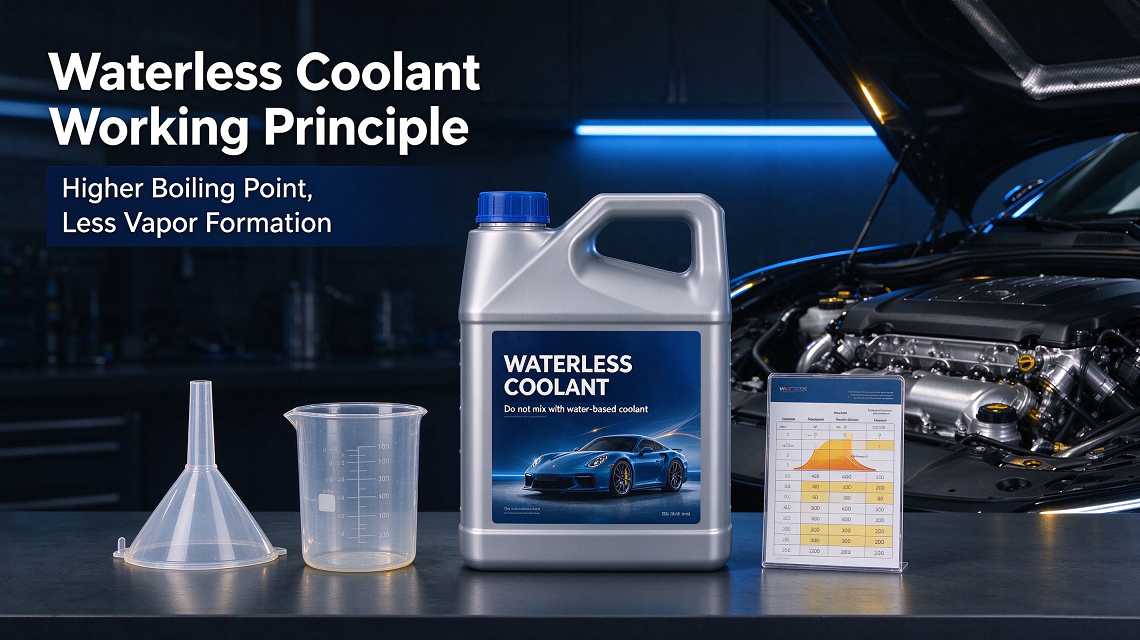
Waterless coolants eliminate vapor boiling issues because their boiling points exceed 180°C at atmospheric pressure. However, propylene-glycol-based waterless fluids exhibit significantly lower specific heat capacities than water-glycol mixtures. While they prevent boiling, the engine and turbo components typically operate at higher metal temperatures. They should only be used if the cooling system was specifically sized or adapted for lower heat-rejection rates.
How often should turbo antifreeze be tested in fleet operations?
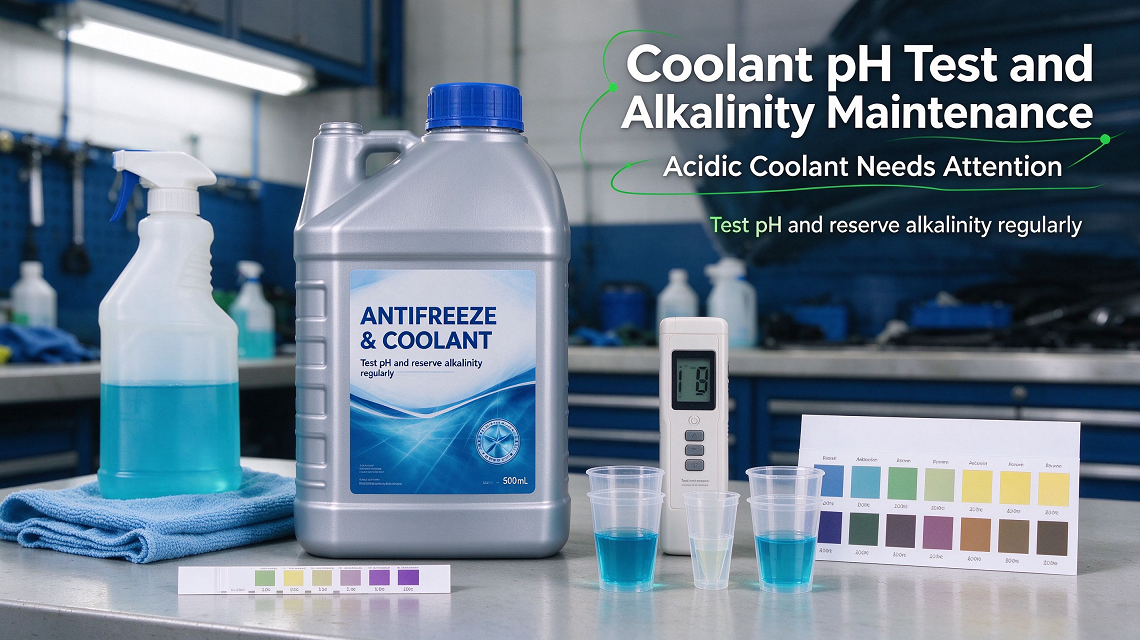
Coolant pH, refractometer concentration, and inhibitor reserve alkalinity should be checked at every major scheduled maintenance interval, or at least twice a year. Because turbocharged engines drive higher thermal cycling, fluid degradation happens earlier than in naturally aspirated baseline engines.
What causes white deposits inside an aluminum turbo water port?
These deposits are typically depleted silicate precipitates or mineral scale resulting from hard water dilution. Once present, they act as an insulating blanket, severely retarding heat rejection and accelerating localized boiling.
Next Steps for Fleet and Product Managers
Audit the current fluid specifications across your fleet or engine product lines. If equipment operates under sustained high-boost regimes, eliminate any legacy high-silicate coolants immediately. Transition toward OEM-certified OAT or Si-OAT formulations that balance thermal transfer efficiency with durable cavitation defense.
Welcome to contact GAFLE for more information & cooperation!
peter
ZHEJIANG GAFLE AUTO CHEMICL CO.,LTD
Tel:86-579-8222 1665
Fax:86-579-8246 4690
Cel/Wechart:86-13335993986
E-mail:peter@gafle.net
Web:www.gafle.net