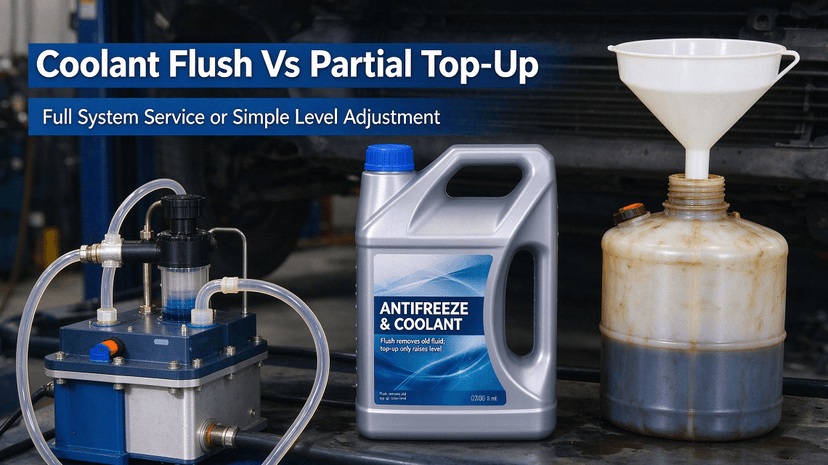
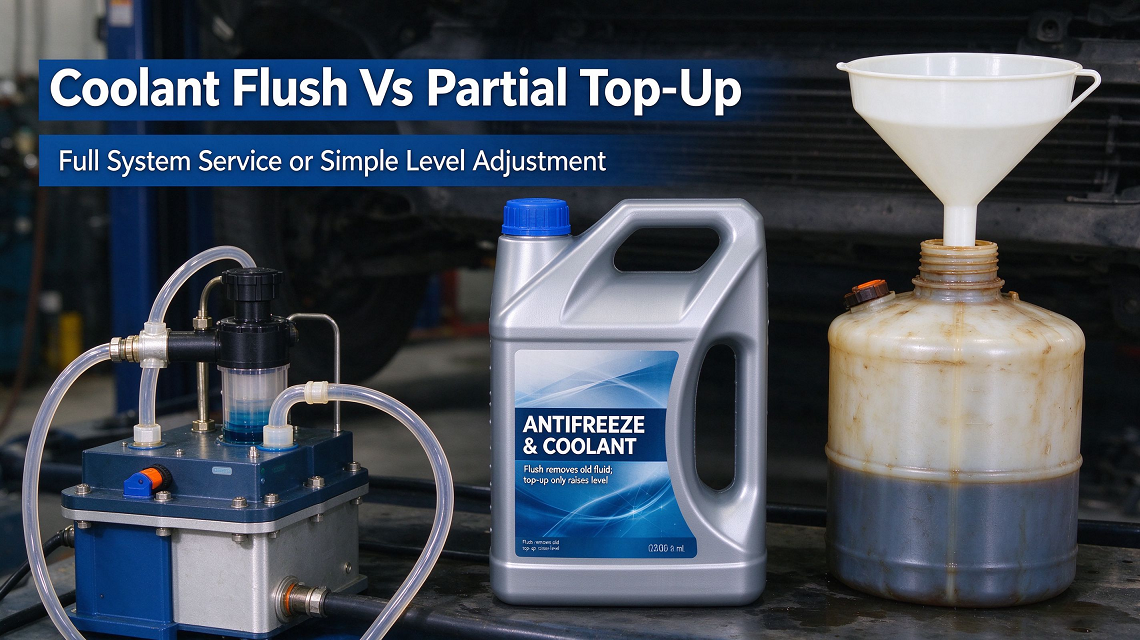
Cooling System Maintenance: Operational Reality vs. Quick Fixes
For fleet operators, plant maintenance supervisors, and equipment technicians, understanding the exact difference between coolant flush and top up procedures is rarely about textbook definitions; it is about preventing unscheduled downtime and avoiding catastrophic cylinder liner pitting or radiator core rot. When an operator notices fluid sitting below the minimum line on an expansion tank, the reflexive response is to grab an open jug and pour until the level recovers. That is an everyday top up. A full flush, by contrast, is an active chemical and mechanical evacuation designed to reset the cooling system chemistry. Conflating the two or substituting routine additions for scheduled flushes is an expensive operational gamble.
Defining the Operations: Coolant Top Up vs. Coolant Flush
A coolant top up is strictly a volume-restoration task. Over hundreds of operational hours, minor evaporation, pinhole weeping at hose clamps, or pressure cap venting inevitably lowers the reservoir level. Topping up introduces a calibrated 50/50 mixture of water and antifreeze to bring the expansion reservoir back to operating capacity. It treats a symptom—fluid loss—without altering the underlying age or contamination level of the fluid circulating across the engine block.
A full coolant flush is a comprehensive restorative process. It involves completely draining the old fluid from the radiator, engine block, and heater cores (or auxiliary heat exchangers), running a dedicated flushing agent mixed with demineralized water to dissolve mineral scale and rust deposits, thoroughly rinsing the circuit, and finally charging the entire cooling system with fresh, virgin coolant. It strips out spent corrosion inhibitors, suspended particulate matter, and dissolved metals that standard draining leaves behind.
Direct Comparison: Flush vs. Top Up
| Parameter | Coolant Top Up | Coolant Flush |
|---|---|---|
| Primary Goal | Restore fluid volume to prevent air pockets and localized boiling. | Restore chemical protection, remove scale, and eliminate degraded fluid. |
| Typical Interval | As needed during pre-trip or weekly maintenance rounds. | Every 2 to 5 years (or 3,000 to 6,000 operating hours, depending on chemistry). |
| Contaminant Removal | Zero. Old sediment and degraded polymers remain trapped. | High. Removes loose rust, scale, degraded silicates, and oil residues. |
| Labor Intensity | Minimal (under 5 minutes, basic PPE). | Moderate to high (requires drain pans, flush cycles, disposal logistics, bleeding air). |
The Real Risks of Only Topping Up Coolant
It is tempting for maintenance teams pressed for time to run machinery purely on top ups. However, the risks of only topping up coolant over prolonged lifespans are well documented in metallurgical failure analyses:
- Additive Depletion and Acidification: Antifreeze base stock (usually ethylene or propylene glycol) does not break down quickly, but the corrosion inhibitors—nitrites, molybdates, phosphates, or organic acids—sacrifice themselves over thermal cycles. Once depleted, the coolant turns acidic, attacking aluminum radiator cores, brass fittings, and cast iron blocks.
- Cavitation Corrosion: In heavy-duty diesel engines, wet cylinder liners flex rapidly under combustion pressure. This creates microscopic vacuum bubbles in the coolant jacket that violently collapse, eroding liner walls until coolant breaches the combustion chamber. Top-up fluids cannot replenish exhausted cavitation-inhibiting packages across the full volume.
- Silicate Dropout and Gel Formation: If shop personnel top up with incompatible formulas (such as mixing traditional high-silicate green coolant with modern OAT/nitrite-free red or yellow coolants), chemical reactions can trigger silicate drop-out. This results in a thick, abrasive gel that plugs heater cores and radiator capillaries, burning out water pump mechanical seals in short order.
Diagnostic Cues: How to Decide Between the Two
A visual check is helpful, but numbers tell a clearer story. Before deciding whether a system just needs fluid or a complete overhaul, pull a small sample from the reservoir or radiator petcock:
First, test with a refractometer. If freeze protection has drifted significantly from the target spec (typically -34°F / -37°C for standard 50/50 ratios), simply pouring concentrated glycol or straight water into the top bottle rarely achieves a stable homogeneous mix without a flush cycle.
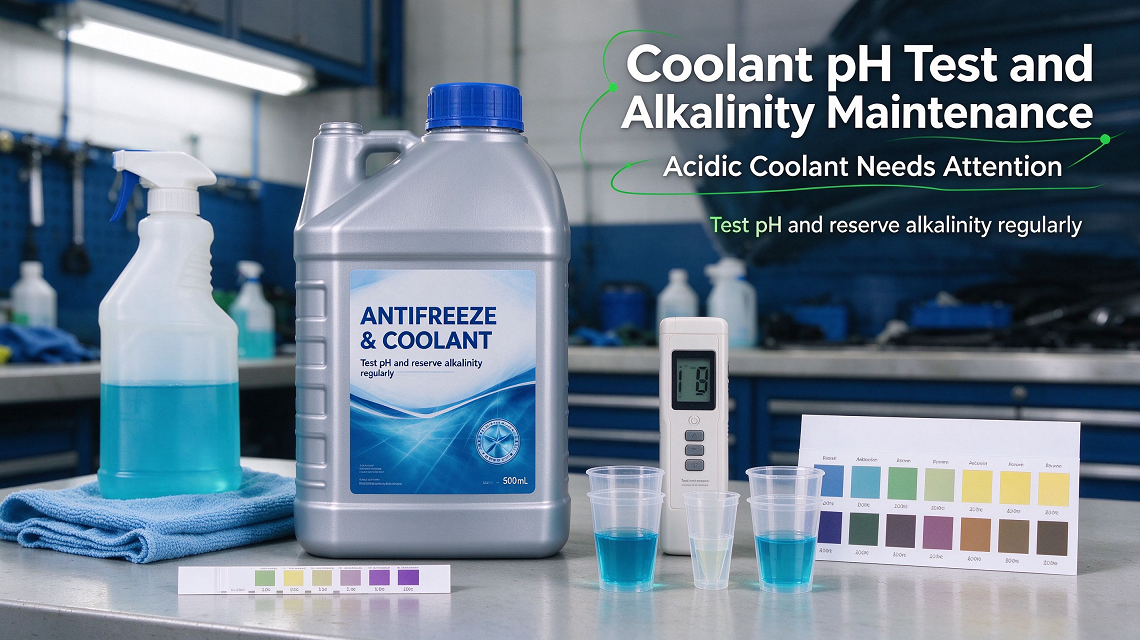
Second, use chemical test strips to read pH and reserve alkalinity. If pH has dipped below 8.0 for conventional heavy-duty coolants (or below OEM limits for organic acid formulas), the chemical buffering capacity is gone. Topping up won\'t save it; you are merely diluting an acidic bath.
Finally, look for turbidity. Murky fluid, oil sheen, rust flakes, or a pungent burned odor indicate physical contamination. At that point, attempting another coolant top up is counterproductive; the machine requires an immediate isolate-and-flush procedure.
Shop-Floor Best Practices
Keep a tight rein on top-up bottles. If technicians are using tap water from municipal supplies or wells to dilute concentrate on the fly, they introduce calcium and magnesium carbonates that bake into insulating scale against hot cylinder walls. Always mandate pre-diluted, ASTM-compliant mixtures or keep dedicated reverse-osmosis/deionized water drums adjacent to your fluid distribution racks.
When performing a flush, do not rush the rinse step. Any chemical cleaner left behind in the heater matrix or engine low spots will actively degrade the fresh charge of coolant introduced right after. Flush with clean water until the discharge runs clear and exhibits neutral pH before the final fill.
Frequently Asked Questions
Can I top up an engine with straight water in an emergency?
In a true field emergency, clean water is better than running an engine dry and warping the cylinder head. However, it must be treated as a temporary patch. Water dilutes freeze protection, lowers boiling point thresholds, and compromises anti-corrosion additives. Drain and correct the balance as soon as the equipment returns to the shop.
Does a low coolant level always mean a system leak?
Not necessarily, but persistent loss should never be ignored. Minor vapor loss occurs over long duty cycles via expansion caps. If an engine requires topping up every week or two, however, inspect for weeping hose junctions, internal head gasket leakage into combustion chambers, or hairline radiator tank fractures.
Review Your Fleet Fluid Protocols
Managing thermal management systems requires separating day-to-day fluid level maintenance from scheduled fluid lifecycle replacements. If your maintenance logs show equipment operating on multiple years of top-ups without an analytical check or drain interval, schedule fluid testing on your next scheduled service window to verify whether an immediate system flush is overdue.
FAQ
Q1: What is the core difference between a coolant flush and a partial top-up?
A1: A coolant flush removes nearly all old fluid and sediment from the entire cooling system, while a partial top-up only adds new antifreeze to bring the liquid level back to normal without removing old coolant.
Q2: Can I just top up coolant instead of doing a full flush?
A2: Short-term top-up works for low coolant level, but it cannot restore depleted corrosion inhibitors. A full flush is required when the coolant reaches its service life.
Q3: How often should I get a coolant flush?
A3: It depends on the antifreeze type. OAT coolant usually lasts 5 years or 150,000 miles, while conventional coolant needs flushing every 2–3 years.
Q4: What risks come with only topping up coolant long-term?
A4: Old coolant loses protective additives, which may lead to rust, scale buildup, overheating and premature water pump failure.
Q5: Will a coolant flush remove all air pockets in the cooling system?
A5: A proper flush procedure includes bleeding air, but technicians still need to double-check air pockets after the service.
Q6: Is a coolant flush more expensive than a simple top-up?
A6: Yes, a coolant flush takes more fluid, labor and time. Most reliable factory and supplier offer transparent pricing for this service.
Welcome to contact GAFLE for more information & cooperation!
peter
ZHEJIANG GAFLE AUTO CHEMICL CO.,LTD
Tel:86-579-8222 1665
Fax:86-579-8246 4690
Cel/Wechart:86-13335993986
E-mail:peter@gafle.net
Web:www.gafle.net