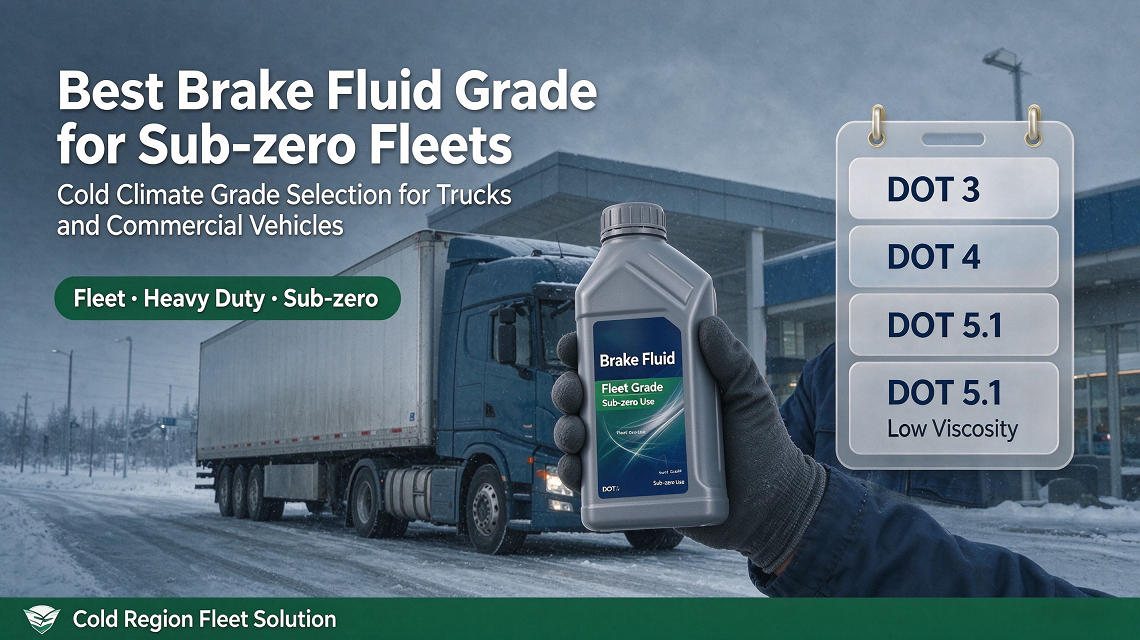
When ambient temperatures drop below -20°C, commercial hydraulic braking systems begin to behave differently. Pedals feel stiff on morning rollouts, electronic stability systems experience subtle response lags, and ABS cycle times can slow down just enough to increase stopping distances on packed snow. Identifying the best brake fluid grade for fleets operating in sub-zero regions is not simply a matter of picking the bottle with the highest dry boiling point; it requires understanding how fluid rheology changes under severe thermal contraction and high shear.
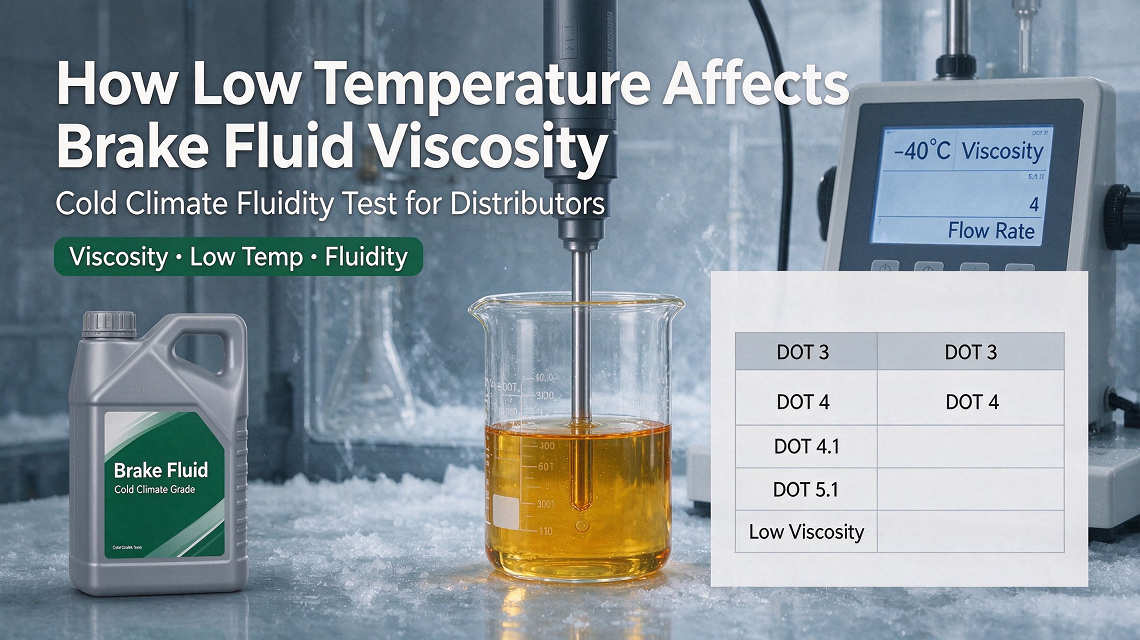
For maintenance managers overseeing cold climate fleets, the critical metric in winter is kinematic viscosity at -40°C, measured in centistokes (cSt). While heavy duty trucks pulling long downhill grades during summer focus heavily on boiling resistance to prevent vapor lock, winter haulers face the inverse problem: hydraulic fluid turning sluggish in microscopic valve orifices.
The Cold-Viscosity Problem in Modern Fleet Hydraulics
Modern commercial vans, vocational trucks, and light-to-medium utility chassis rely heavily on electronic stability control (ESC), traction control, and anti-lock brakes. These systems do not merely clamp pads against rotors; they pulse hydraulic pressure through micro-valves dozens of times per second.
Standard glycol fluids thicken substantially as temperatures plunge. A standard DOT 4 formulation, for example, is permitted under FMVSS 116 specifications to reach up to 1,800 cSt at -40°C. At that thickness, the fluid resists rapid displacement through internal ABS solenoids. The driver might still stop the vehicle, but the automated safety logic that prevents jackknifing or lane departure can see response latencies jump from milliseconds to noticeable fractions of a second.
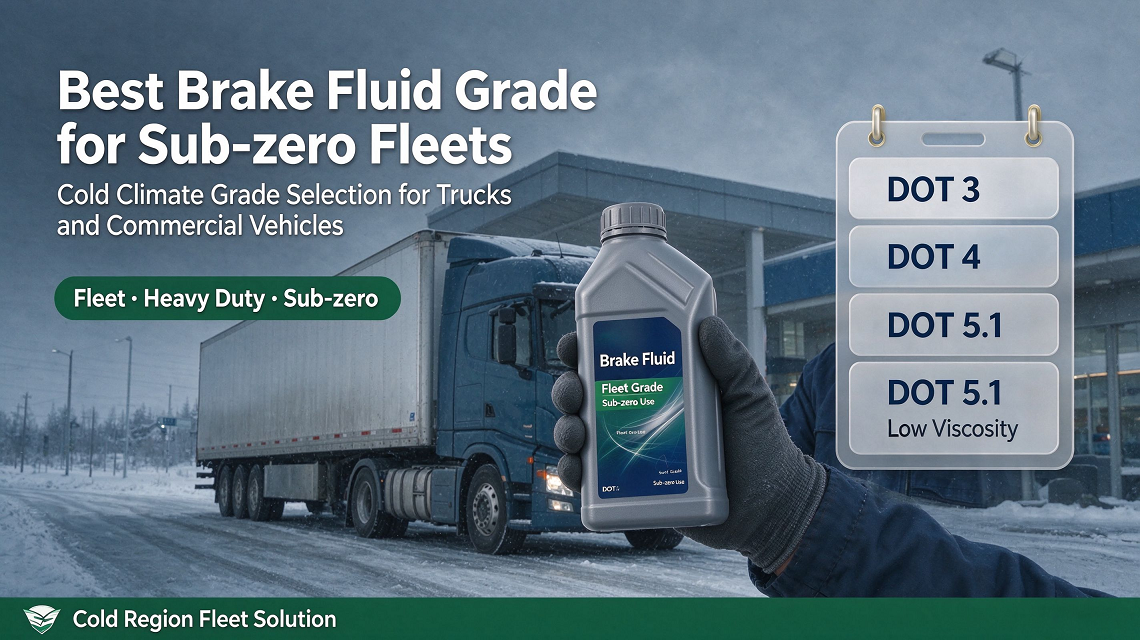
When sourcing brake fluid for truck fleets in freezing areas, the priority shifts toward low-viscosity glycol chemistry that maintains pumpability without degrading elastomer seals across multi-year duty cycles.
Comparing Fluid Grades for Sub-Zero Operations
Fleet shops typically stock one or two bulk grades to avoid cross-contamination. Here is how standard formulations stack up when winter freight routes push into northern corridors:
DOT 3: Reliable Cold Flow, Lower Thermal Ceiling
DOT 3 has a lower maximum cold viscosity limit (1,500 cSt at -40°C) than standard DOT 4, meaning it actually flows slightly better in deep winter than conventional DOT 4. However, its low wet boiling point (around 140°C) makes it vulnerable to heat breakdown once spring arrives or if heavy duty towing builds residual rotor heat. For modern fleet operations carrying sustained payloads, DOT 3 is rarely the ideal choice.
Standard DOT 4: Prone to Winter Sluggishness
While standard DOT 4 delivers an elevated dry boiling point (230°C minimum), its allowable cold viscosity ceiling (up to 1,800 cSt at -40°C) makes it a poor performer in sub-arctic conditions. It thickens noticeably in sub-zero mornings, leading to longer pedal travel and sluggish ABS return valves until the engine bay warms up the master cylinder.
DOT 4 Low Viscosity (ISO 4925 Class 6): The Fleet Benchmark
For most cold climate fleets running modern hydraulic brake systems, DOT 4 LV (often labeled as Class 6 or ESP fluid) represents the best overall balance. ISO 4925 Class 6 caps kinematic viscosity at 750 cSt at -40°C—less than half the flow resistance of traditional DOT 4. This fluid was formulated specifically to maintain near-instantaneous pressure modulation across ESP and ABS valving down to -40°C, while retaining the high thermal resistance required for laden commercial vehicles.
DOT 5.1: High Performance, Variable Cold Flow
DOT 5.1 is a glycol-borate formulation designed to pair high boiling points with improved cold flow. Specifications permit up to 900 cSt at -40°C. While superior to baseline DOT 3 and DOT 4 in the cold, many fleet-grade DOT 4 LV products still beat standard DOT 5.1 in extreme freeze conditions. Additionally, DOT 5.1 tends to carry a higher procurement cost without providing noticeable operational advantages over Class 6 fluids in utility chassis.
A Word on DOT 5 (Silicone)
DOT 5 is silicone-based and does not absorb ambient moisture. While it exhibits decent cold-temperature flow, it should almost never be used in fleet trucks equipped with ABS. Silicone fluid tends to aerate under rapid ABS pulsing, creating compressible foam that causes spongy pedal feel. It is also completely incompatible with glycol systems and will ruin standard seal materials if mixed.
Practical Recommendations for Fleet Maintenance Shops
Selecting the right chemistry is only part of cold-weather uptime. Shop practices must also adapt to winter condensation cycles:
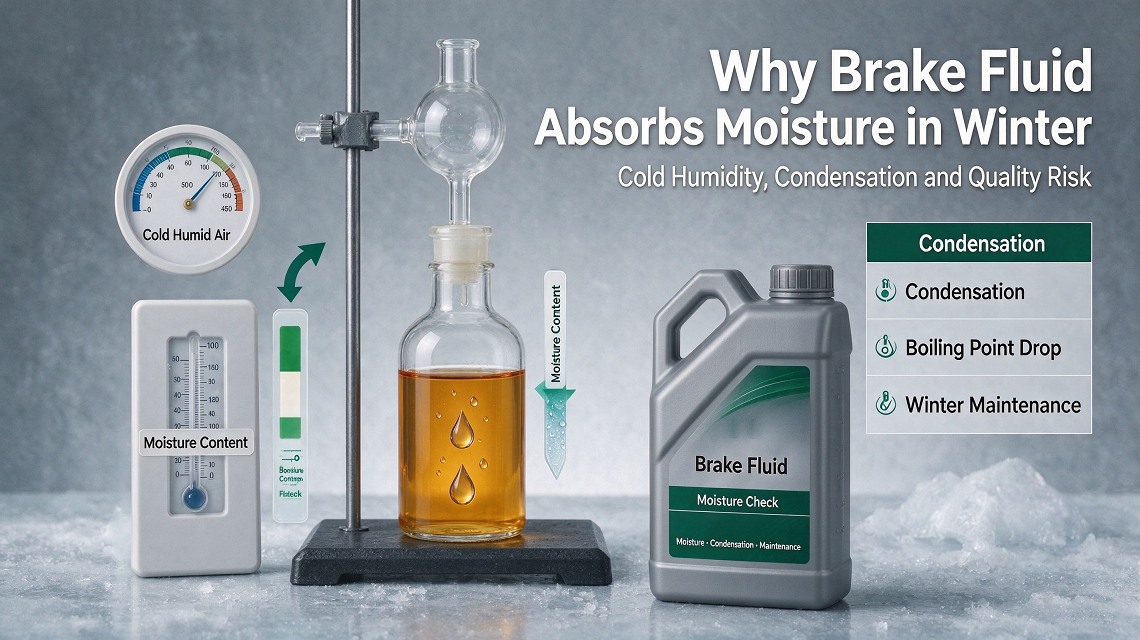
Schedule flushes before the first hard freeze. Glycol fluids are hygroscopic; water ingress drops the boiling point, but worse, free water droplets can freeze inside lines, caliper cavities, or proportioning valves. A fluid tester reading 3% moisture content might survive summer, but that moisture will separate or freeze into slush at -25°C.
Standardize on Class 6 fluids across mixed fleets where possible. Unless an OEM explicitly requires a proprietary fluid, migrating hydraulic-brake medium trucks and light service vans to an ISO 4925 Class 6 / DOT 4 LV specification minimizes inventory complexity and ensures winter-ready pedal dynamics across all assets.
Inspect reservoir seals regularly. In sub-zero yards, rapid temperature cycling between working days and freezing overnight shutdowns pulls humid ambient air past cracked diaphragm caps, accelerating water contamination.
Frequently Asked Questions
Can we mix DOT 4 LV with standard DOT 4 during an emergency top-off?
Yes, chemically they are both polyalkylene glycol ether fluids and are fully miscible. However, adding standard DOT 4 will compromise the low-viscosity characteristics of the system, degrading sub-zero ABS response until the next complete flush.
How often should winter haulers change fluid?
Most fleet duty cycles warrant a full hydraulic flush every 12 to 24 months. For rigs stationed outdoors in high-humidity freeze zones, annual testing prior to November is standard preventive practice.
Review your current fleet PM sheets against supplier spec sheets. If your shops are still dispensing standard high-viscosity DOT 4 into ABS-equipped service trucks operating in sub-zero territories, switching your bulk drums to an ISO 4925 Class 6 formulation is one of the lowest-cost safety improvements you can implement this season.
Welcome to contact GAFLE for more information & cooperation!
peter
ZHEJIANG GAFLE AUTO CHEMICL CO.,LTD
Tel:86-579-8222 1665
Fax:86-579-8246 4690
Cel/Wechart:86-13335993986
E-mail:peter@gafle.net
Web:www.gafle.net