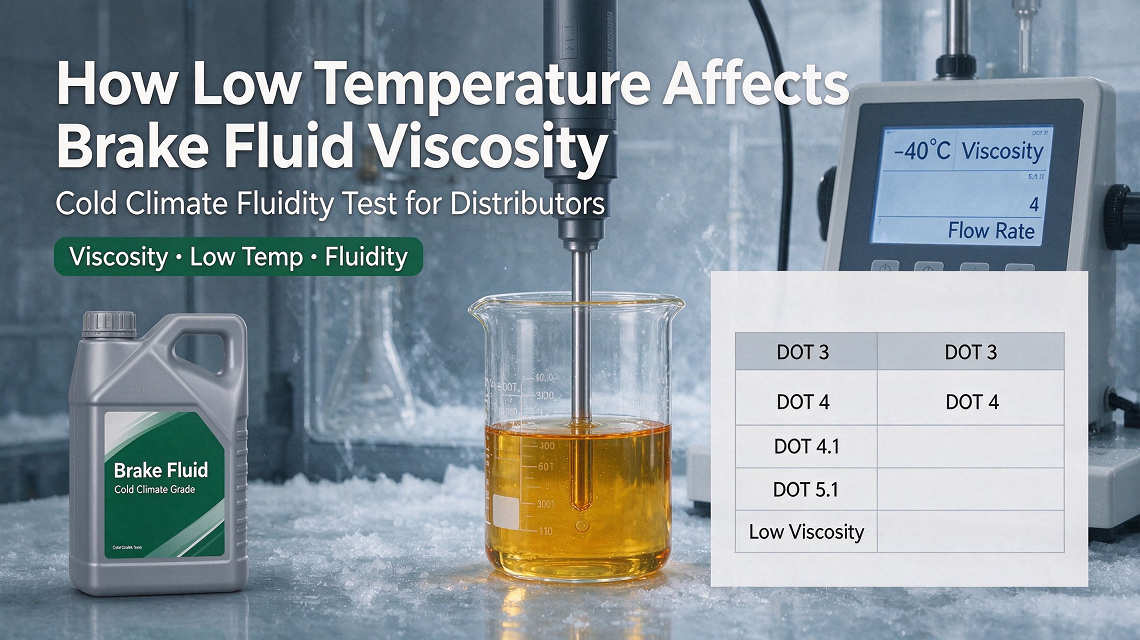
The Dynamics of Hydraulic Fluid at Sub-Zero Temperatures
When winter testing pushes heavy commercial platforms and passenger vehicles into sub-zero proving grounds, automotive engineers pay close attention to pedal feedback and valve actuation. Understanding exactly how cold temperature affects brake fluid viscosity is less about sudden catastrophic mechanical seizure and more about progressive hydraulic lag. While high thermal loads normally dictate fluid selection during track runs or mountain descents, sub-zero ambient conditions introduce an entirely different operational challenge: dramatic flow resistance inside micro-valves, master cylinders, and anti-lock braking system (ABS) modulators.
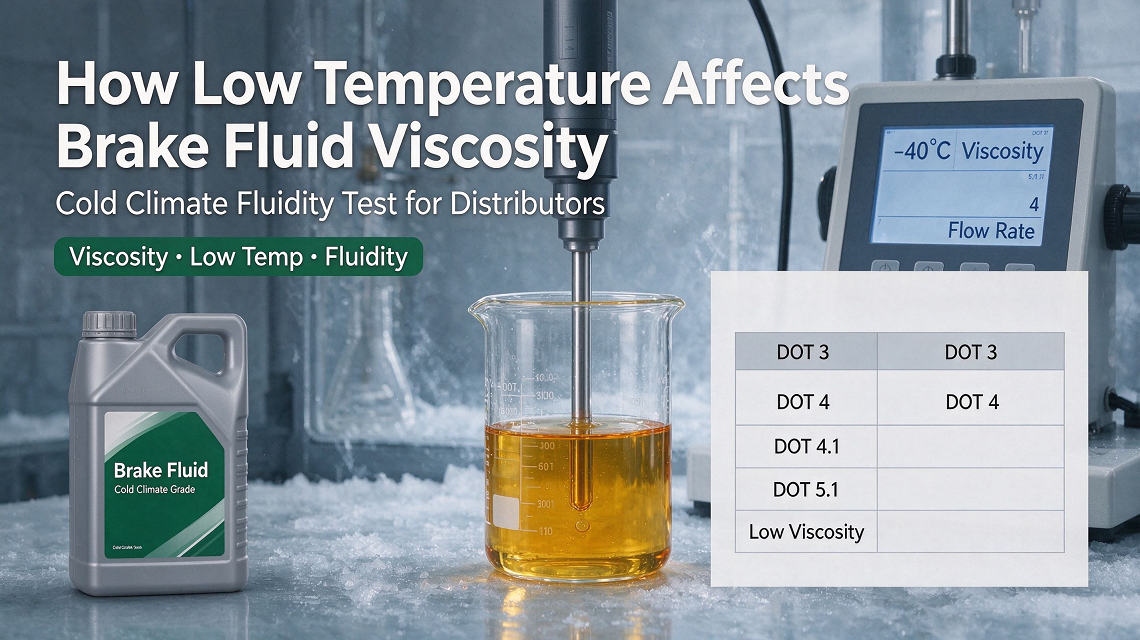
Standard glycol-ether and borate ester hydraulic formulations are designed to maintain Newtonian fluid characteristics across a broad operating window. However, as ambient temperatures plummet toward -40°C (-40°F), molecular movement slows, intermolecular friction increases, and fluid resistance climbs exponentially rather than linearly. In modern electronic stability control (ESC) units where pressure pulses must cycle within milliseconds, a sudden spike in centistokes (cSt) can mean the difference between controlled vehicle yaw and delayed stability intervention.
Viscosity Curves: What the Numbers Actually Tell Us
Fluid viscosity is typically evaluated using kinematic viscosity measured in square millimeters per second (mm²/s), functionally equivalent to centistokes. Standard international specifications, including FMVSS 116 and ISO 4925, establish strict maximum kinematic viscosity thresholds measured at -40°C. While thermal degradation and wet boiling point values dominate baseline safety certifications, cold-flow metrics dictate real-world winter drivability.
| Classification (ISO 4925 / FMVSS) | Max Kinematic Viscosity at -40°C | Typical Target Application |
|---|---|---|
| DOT 3 (Class 3) | 1,500 mm²/s | Conventional hydraulic braking without rapid ESP |
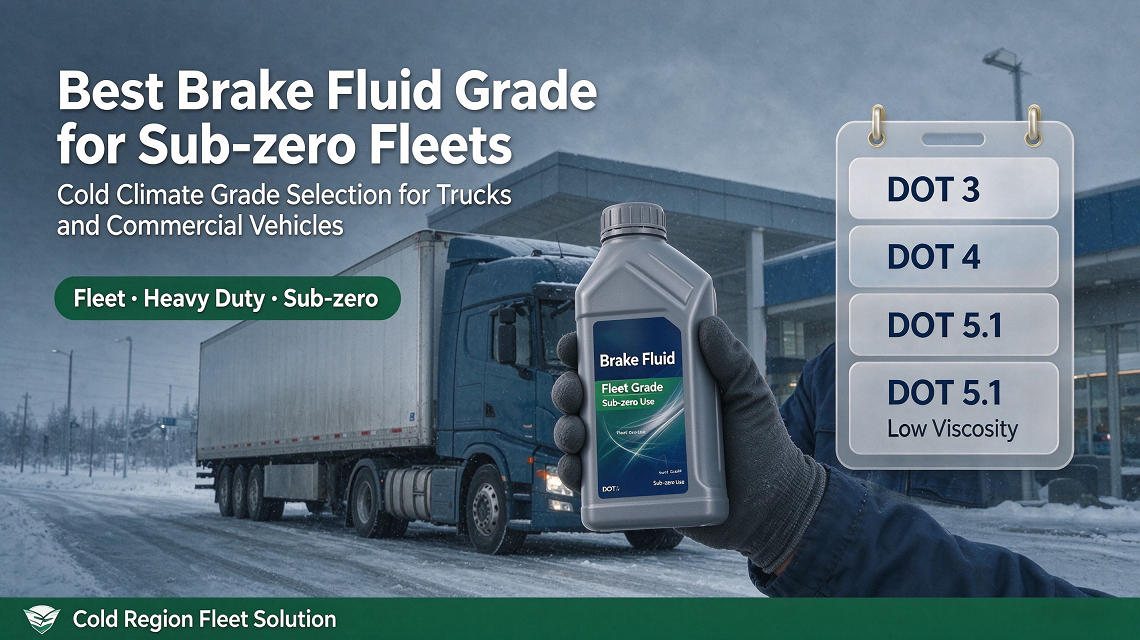
| DOT 4 (Class 4) | 1,800 mm²/s | Standard modern passenger and light commercial vehicles |
| DOT 4 Low Viscosity (Class 6) | 750 mm²/s | High-speed ABS, TCS, and modern dynamic ESC systems |
| DOT 5.1 (Class 5-1) | 900 mm²/s | Performance applications balancing high thermal margins |
Notice the substantial divergence between standard DOT 4 and DOT 4 Low Viscosity (LV). Under temperate conditions (100°C), both variants maintain a kinematic viscosity around 1.5 to 2.1 mm²/s. But at -40°C, standard DOT 4 allows up to 1,800 mm²/s, whereas Class 6 tightens that ceiling to 750 mm²/s. For an ABS solenoid valve cycling up to 15 times per second, forcing a fluid with more than double the thickness through sub-millimeter orifices causes measurable response latency.
Viscous Gelling vs. Solid Freezing
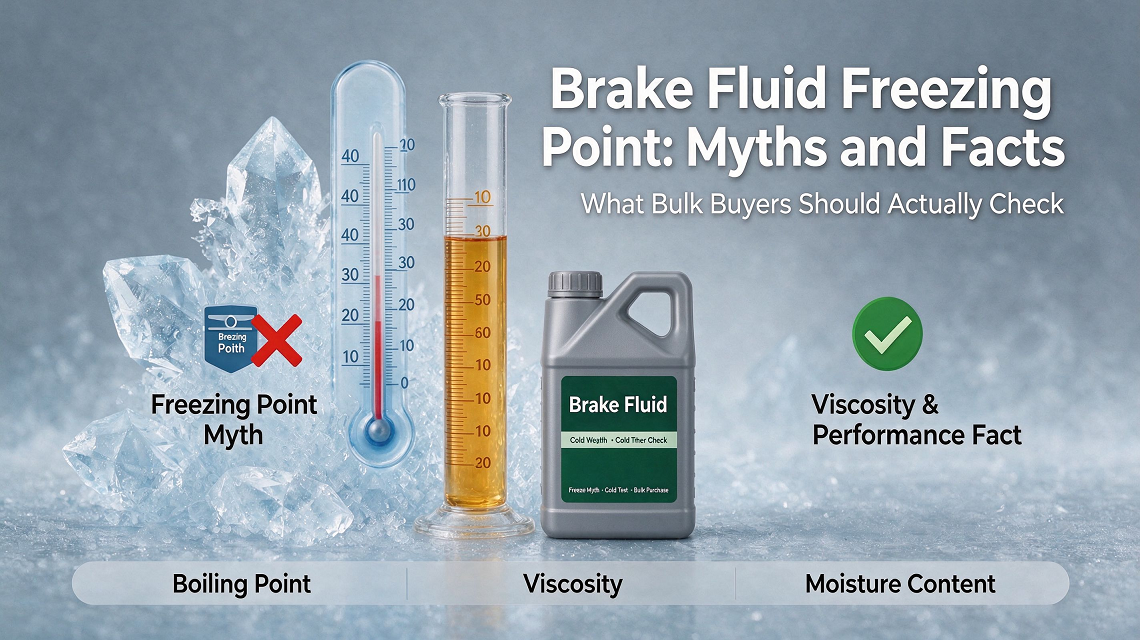
A common misconception among field operators is that glycol blends freeze into a solid block like water. In reality, the risk of actual brake fluid freezing into rigid ice crystals is low under standard circumstances because pure glycol-ether bases lack a single, sharp phase-change point. Instead, polyalkylene glycols experience a continuous transition known as glass transition or viscous vitrification, progressively thickening into a heavy gel.
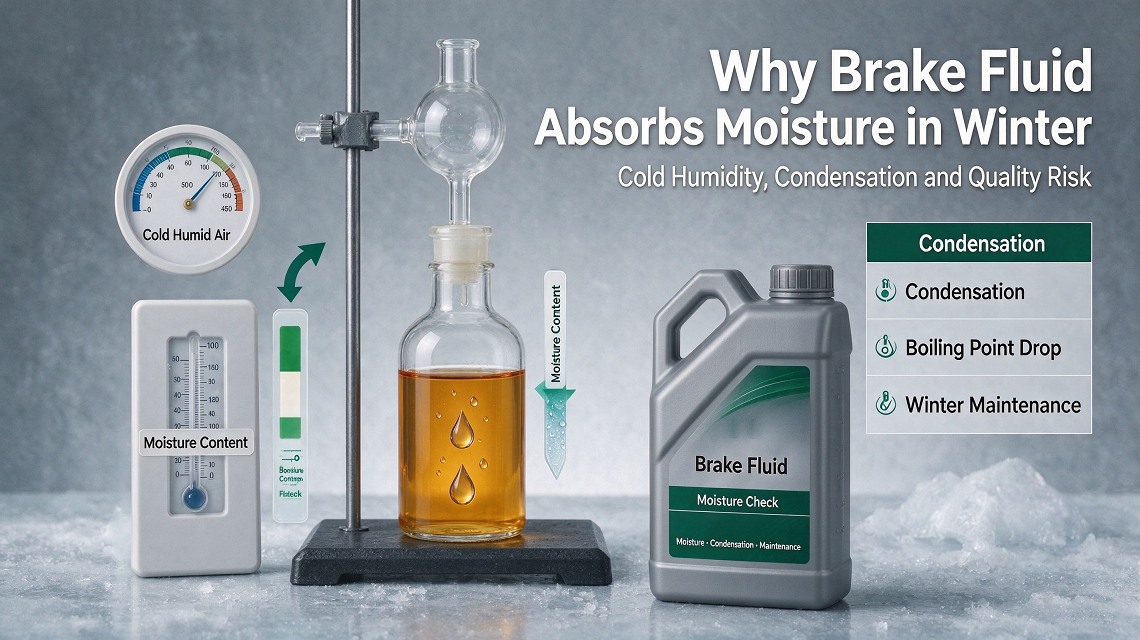
The true complication emerges with dissolved water. Glycol formulations are hygroscopic, naturally absorbing atmospheric moisture over time. Pure moisture pockets do not separate easily, but water contamination depresses and destabilizes the effective freezing point profile of the overall mixture. If entrained water begins forming micro-ice emulsions at -20°C or -30°C, it creates localized flow blockages, clogs return ports, and accelerates internal valve corrosion.
Engineering Trade-offs: Flow vs. Thermal Headroom
Sourcing engineers and vehicle system designers face an inherent chemical compromise when selecting an OE fill. Polyethylene glycol chains with shorter molecular weights offer superior cold-temperature mobility, keeping viscosity low when the thermometer drops. However, shorter chain backbones generally reduce the dry boiling point, lowering resistance to vapor lock under aggressive friction-braking cycles.
To overcome this, modern Class 6 formulations utilize specialized borate ester chemistries that bind free water chemically while preserving rapid flow at sub-zero thresholds. For product developers, validating a supplier's kinematic test data at both extremes is essential. An over-specified fluid that resists high caliper heat but thickens excessively in polar conditions will cause driver complaints about stiff pedals and sluggish return springs during northern winters.
Practical Sourcing Considerations for Product Teams
When selecting bulk fluids for OEM assembly or aftermarket private labeling, procurement teams must look past the basic DOT designation printed on the drum. Inquire specifically about viscosity-index improvers and cold-flow curve stability:
- Insist on -40°C Kinematic Verification: Ensure the supplier provides batch-level certificates of analysis (CoA) detailing rotational or capillary viscometer results at extreme low temperatures.
- Audit Moisture Permeation Barriers: Because moisture degrades cold-temperature flow properties rapidly, packaging quality (metal canisters vs. barrier-treated high-density polyethylene) directly impacts warehouse shelf-life.
- Match Systems to ESC Requirements: If your fleet or vehicle platform relies on autonomous emergency braking (AEB) or lane-keeping torque vectoring, specifying a Class 6 fluid with a maximum 750 mm²/s rating is mandatory rather than optional.
Partnering with a dedicated brake fluid factory that operates in-house climatic testing chambers allows procurement teams to verify these rheological properties firsthand rather than relying on generic commodity specification sheets.
Frequently Asked Questions
Does cold ambient weather permanently damage the hydraulic fluid?
No. Fluid thickening caused by cold temperatures is entirely reversible. Once the vehicle warms up and friction from the caliper assemblies transfers heat through the hydraulic lines, the fluid returns to its normal nominal viscosity without chemical degradation, provided water contamination has not compromised the mixture.
Can you use standard DOT 4 in modern ABS platforms operating in cold regions?
While chemically compatible, standard DOT 4 is not recommended for modern ABS/ESP systems operating in sustained sub-zero climates. The higher viscosity limit (1,800 mm²/s) causes noticeable lag in pressure modulation compared to Class 6 (DOT 4 LV) fluids, which are specifically engineered for cold valve responsiveness.
Next Steps for Fleet and Sourcing Specifications
Selecting the proper grade of brake fluid for cold-weather reliability requires evaluating local climate data against vehicle safety electronics. If your engineering group is standardizing a fluid spec for cold-climate export or severe-duty winter service, request certified low-temperature rheology profiles from your chemical blender to verify that valve transit times remain well within safety margins.
Welcome to contact GAFLE for more information & cooperation!
peter
ZHEJIANG GAFLE AUTO CHEMICL CO.,LTD
Tel:86-579-8222 1665
Fax:86-579-8246 4690
Cel/Wechart:86-13335993986
E-mail:peter@gafle.net
Web:www.gafle.net