What Is Low-Viscosity Brake Fluid, and Why Do Buyers Care?
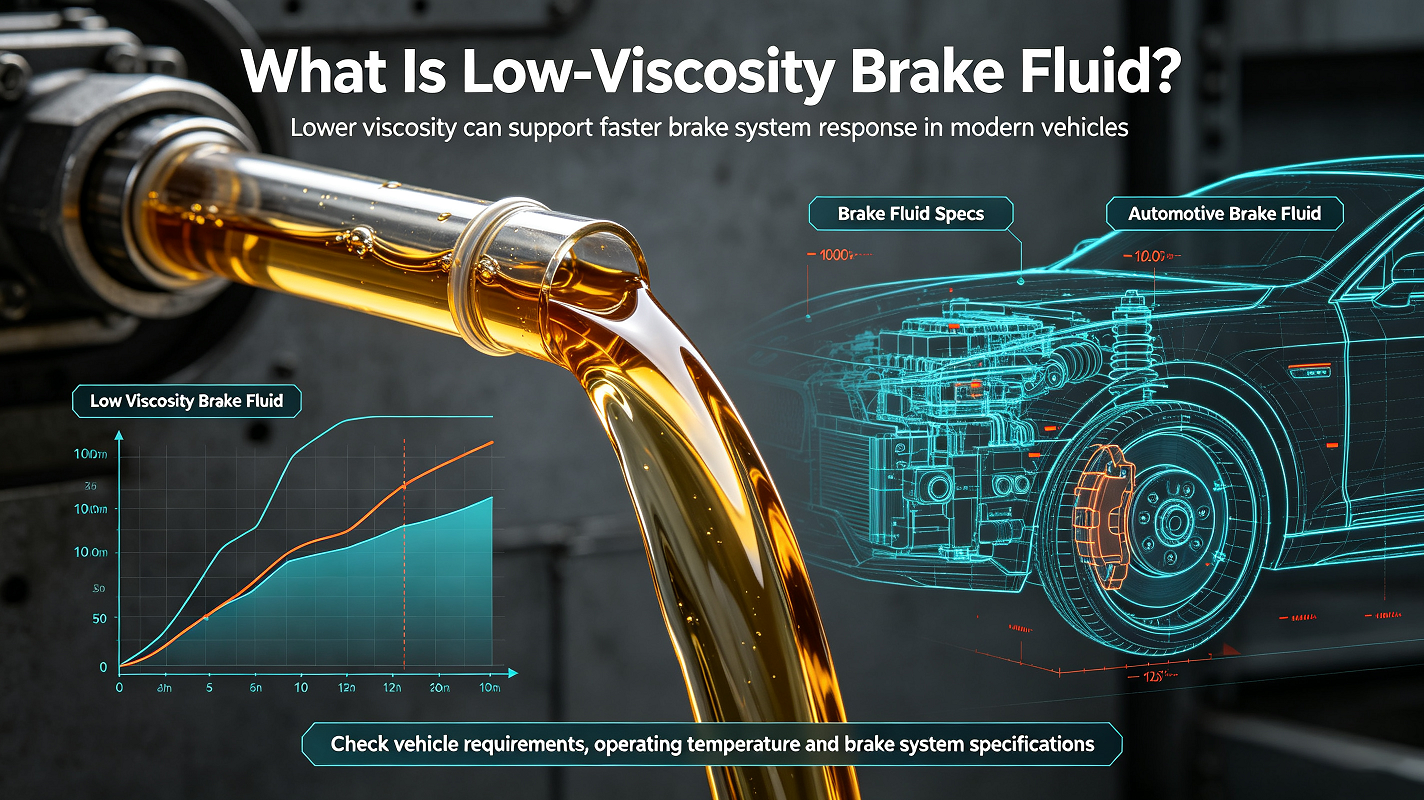
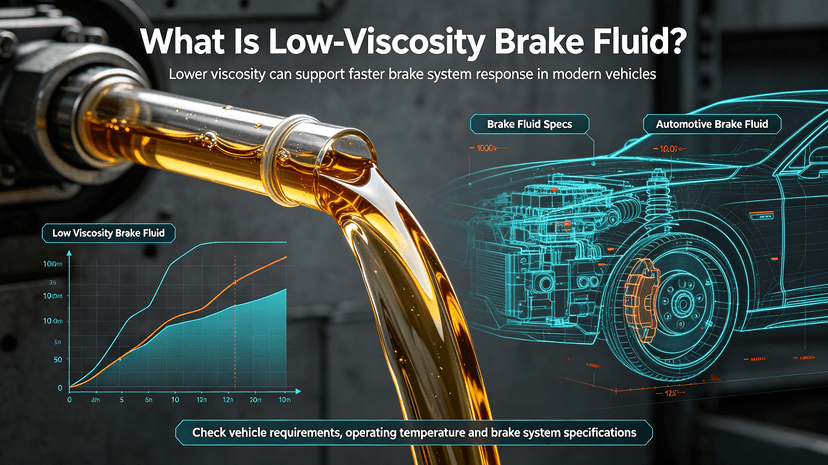
What is low‑viscosity brake fluid, and why does it keep showing up in sourcing conversations for modern vehicles? In practical terms, it is a brake liquid formulated to flow more easily at low temperatures and under demanding hydraulic conditions. That matters because today’s braking systems are not just about stopping power; they also have to support electronic control units, anti-lock braking systems, stability control, and other fast-response hydraulic functions. If the fluid moves sluggishly, the system can lose some of the responsiveness engineers expected when they designed it.
For engineers, procurement teams, and product managers, the question is usually not academic. It is about compatibility, performance in cold weather, system response, and whether the fluid matches the vehicle platform or service requirement without introducing avoidable risk.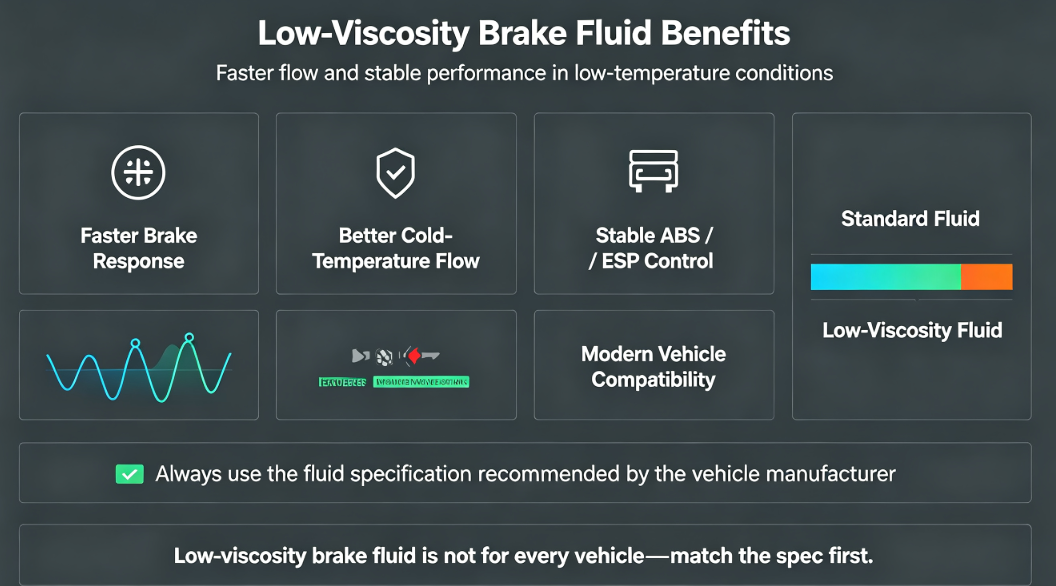
Simple Reference: Low-Viscosity vs. Conventional Brake Fluid
A conventional brake fluid may still meet general hydraulic requirements, but low viscosity brake fluid is designed to stay more mobile across a broader temperature range, especially in cold conditions. That can help the fluid travel through narrow passages in modern brake control modules more quickly.
The main buyer-facing distinction is this: a lower-viscosity formulation is often chosen when the brake system architecture needs faster flow and more predictable response. That does not automatically make it “better” in every application. It simply makes it more suitable for certain systems, especially where electronic braking functions and winter performance are part of the specification.
Benefits of Low Viscosity Brake Fluid in Modern Systems
The benefits of low viscosity brake fluid are usually discussed in engineering terms, but the commercial implications are just as important.
First, improved flow can support faster hydraulic response. In a braking system, milliseconds matter. A fluid that resists movement less can help the system react more consistently when valves open and close rapidly.
Second, low viscosity can be valuable in colder climates. Fluids thicken as temperatures fall, and that can affect pedal feel and actuation behavior. A formulation that remains more fluid at low temperatures is easier on the system, particularly in vehicles expected to operate across seasons and regions.
Third, it can support the performance of advanced safety systems. ABS and stability-control-equipped vehicles rely on quick pressure changes. If the fluid is too thick, those changes can be less efficient than intended.
There is a caution here, though: low viscosity is only one part of brake fluid performance. Thermal stability, moisture behavior, boiling characteristics, and material compatibility still matter. A buyer should not treat viscosity as the only selection criterion.
How to Think About Brake Fluid Selection
When comparing brake fluid options, the spec sheet should be read as a system document, not a marketing sheet.
1. Match the vehicle or equipment requirement
Always start with the OEM or system requirement. If the platform calls for low viscosity, that is usually tied to the design of the hydraulic control components. Substituting a different brake liquid may create a mismatch even if the product seems “close enough.”
2. Consider operating environment
A fleet running in cold regions has different needs from one operating in warm, stable conditions. Low viscosity becomes more relevant when low-temperature flow is a real operating issue rather than a theoretical one.
3. Check service and maintenance realities
In aftermarket or maintenance channels, the challenge is not only performance but also mixed inventory and technician habits. A clear labeling system and proper training reduce the chance of the wrong fluid being poured into the wrong reservoir, which is a far more common problem than most people like to admit.
Common Mistakes Buyers Still Make
One common mistake is assuming all brake fluid performs similarly because they serve the same function. They do not. Even when products appear interchangeable, differences in viscosity, composition, and intended system use can be significant.
Another mistake is focusing only on the word “low” and ignoring the rest of the specification. Low viscosity brake fluid is useful when the system needs it, but a fluid that is too narrowly optimized for one condition may not be the best fit for a broader service environment.
Finally, some buyers overlook documentation. For a B2B purchase, traceability, product labeling, and application notes can matter almost as much as the fluid itself. A technically sound product can still become a supply-chain headache if the paperwork is vague.
Buyer Questions Worth Asking Before You Source
What vehicle or equipment platforms will use the fluid?
What temperature conditions are expected in service?
Does the braking system specify low viscosity, or is that just a preference?
How will the product be stored, labeled, and distributed to avoid mix-ups?
Those questions help separate a routine purchase from a technically responsible one.
Final Practical Note for Engineering and Procurement Teams
If you are still asking what is low‑viscosity brake fluid, the shortest answer is that it is brake liquid engineered to move more easily through modern hydraulic systems, especially when temperatures drop. The longer answer is that it is a selection decision tied to system design, operating climate, and service discipline.
For sourcing teams, the next step is simple: compare the fluid against the actual vehicle or equipment requirement, not just the generic brake-fluid category. That is where most of the real value, and most of the avoidable mistakes, tend to show up.
Welcome to contact GAFLE for more information & cooperation!
peter
ZHEJIANG GAFLE AUTO CHEMICL CO.,LTD
Tel:86-579-8222 1665
Fax:86-579-8246 4690
Cel/Wechart:86-13335993986
E-mail:peter@gafle.net
Web:www.gafle.net