What Is Automotive Brake Fluid?
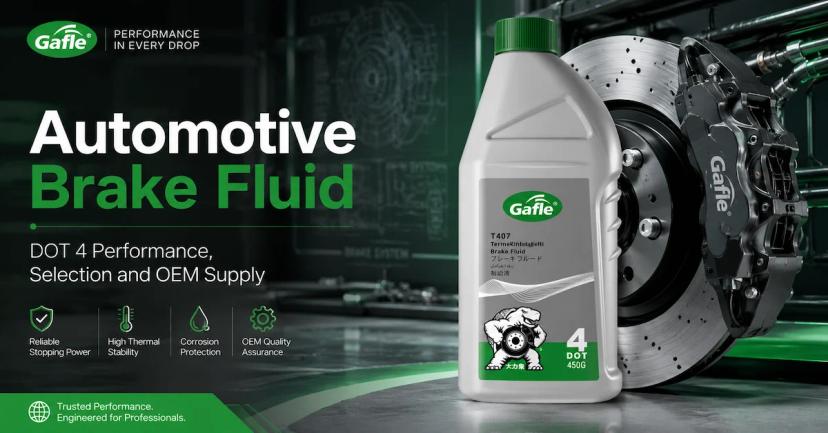
Automotive brake fluid is the hydraulic medium that transfers force from the brake pedal through the master cylinder and brake lines to the braking components at the wheels.
That sounds simple. The purchasing decision is not.
A distributor buying 20,000 bottles is dealing with a very different risk from a driver buying one bottle at a workshop. The distributor has to think about specification, batch consistency, packaging integrity, market labeling, technical documents, shelf handling, repeat supply and, above all, whether the fluid is actually right for the vehicles being served.
Under U.S. FMVSS No. 116, brake fluid is regulated not only for boiling point but also for viscosity, corrosion, stability, water tolerance, compatibility, oxidation resistance, effects on rubber components and packaging requirements.
That is why a useful sourcing question is not:
“What is your DOT 4 price?”
A better one is:
“Which brake fluid grade and performance profile fit our vehicle mix, climate, service channel and target market—and what evidence supports it?”
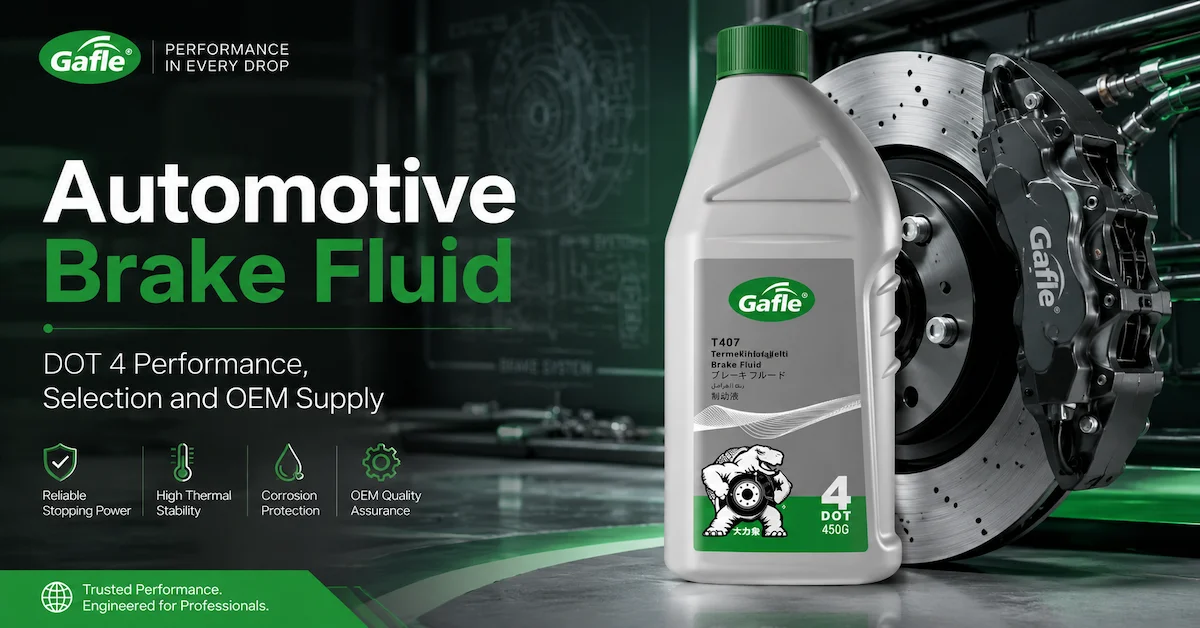
Who Is This Guide For?
This guide is written for commercial buyers, especially:
- Automotive chemical importers
- Brake fluid distributors and wholesalers
- Auto-parts companies
- Workshop and repair chains
- Fleet maintenance suppliers
- Private-label automotive brands
- OEM and aftermarket procurement teams
Their priorities are often different.
A workshop chain may care about reliable service performance and convenient packaging. An importer may focus on documentation, compliance and container loading. A private-label brand may be more concerned about formula positioning, bottle design and long-term consistency.
All of them, however, depend on the same thing: the fluid inside the bottle must repeatedly meet the agreed specification.
How Brake Fluid Works in a Hydraulic Braking System
When a driver presses the brake pedal, the master cylinder converts pedal force into hydraulic pressure.
Brake fluid carries that pressure through the system to the calipers or wheel cylinders.
The fluid therefore has to remain usable across a wide range of conditions:
- Cold morning starts
- Repeated city braking
- Highway driving
- Long downhill braking
- Heavy vehicle loads
- High brake temperatures
- Moisture exposure over time
If the fluid's properties change too much, braking response can be affected.
This is why brake fluid selection involves far more than choosing a higher DOT number.
DOT 3 vs DOT 4 vs DOT 5.1: What Buyers Actually Need to Compare
For most conventional automotive aftermarket sourcing, buyers commonly encounter DOT 3, DOT 4 and DOT 5.1.
FMVSS No. 116 establishes minimum performance requirements for DOT grades. Its current requirements specify minimum equilibrium reflux boiling points of 205°C for DOT 3, 230°C for DOT 4 and 260°C for the DOT 5 grade category; the corresponding minimum wet boiling points are 140°C, 155°C and 180°C. The regulation further distinguishes DOT 5 silicone-base fluid from DOT 5.1 non-silicone-base fluid in labeling.
| Grade | Minimum Dry Boiling Point* | Minimum Wet Boiling Point* | Typical Procurement Direction |
|---|---|---|---|
| DOT 3 | 205°C | 140°C | Conventional applications where specified |
| DOT 4 | 230°C | 155°C | Broad modern passenger-car aftermarket |
| DOT 5.1 | 260°C | 180°C | Higher-performance / defined system requirements |
*FMVSS No. 116 minimum requirements. Always follow the vehicle manufacturer's specified brake fluid grade.
The table is useful, but it does not tell the whole story.
A buyer also needs to consider:
- Low-temperature viscosity
- Moisture behavior
- Chemical stability
- Corrosion protection
- Rubber compatibility
- ABS/ESP requirements
- Actual vehicle specification
A fluid with an impressive dry boiling point can still be the wrong product for the target vehicle population.
Why Dry and Wet Boiling Points Both Matter
Brake fluid buyers often focus on the dry boiling point because it is easy to market.
But professional procurement teams also look at the wet boiling point.
Dry Boiling Point
This represents the boiling behavior of new fluid under the specified test condition.
It is particularly relevant for:
- New product comparison
- High-temperature applications
- Performance positioning
Wet Boiling Point
Many common non-silicone automotive brake fluids are hygroscopic, meaning they absorb moisture over time.
As moisture content increases, boiling performance can decline.
FMVSS 116 therefore sets both dry and wet boiling requirements rather than relying on one headline number.
For a distributor, wet boiling performance is especially important because the customer's vehicle is not operating with freshly opened laboratory fluid for its entire service life.
The Purchasing Lesson
Do not approve a brake fluid simply because the supplier shows:
“Boiling point: 260°C.”
Ask:
- Is that dry ERBP?
- What is the wet ERBP?
- Which test method is used?
- Is the value a minimum specification or a typical batch result?
- Can the supplier provide relevant test documentation?
Those questions quickly separate technical evidence from marketing language.
Why Low-Temperature Viscosity Matters for ABS and ESP
Boiling point gets the attention. Viscosity often gets overlooked.
That can be a mistake.
Modern ABS and ESP systems can rapidly control hydraulic pressure through valves and pumps. Under low-temperature conditions, the fluid still needs suitable flow characteristics for the system it serves.
FMVSS No. 116 includes low-temperature kinematic viscosity requirements, while the current ISO 4925:2026 standard also covers viscosity alongside boiling point, corrosion, water tolerance, rubber effects and other performance areas.
ISO 4925:2026 now covers Classes 3, 4, 5.1, 6 and 7 and includes specifications and test methods for non-petroleum-based brake fluids used in hydraulic brake and clutch systems. The 2026 revision also added lubrication-related test requirements.
For buyers targeting newer vehicles, this means the conversation should not stop at “DOT 4.”
You may need to ask:
Standard DOT 4 or a lower-viscosity formulation for the intended braking system?
GAFLE's current brake-fluid portfolio includes conventional DOT products as well as low-viscosity and more specialized brake-fluid solutions for modern applications.
DOT 5 and DOT 5.1 Are Not the Same Fluid
This is one of the easiest mistakes to make in product descriptions.
DOT 5.1 is not the same as DOT 5 silicone brake fluid.
FMVSS 116 specifically distinguishes:
- DOT 5 SILICONE BASE
- DOT 5.1 NON-SILICONE BASE
The regulation also assigns different color requirements: DOT 3, DOT 4 and DOT 5.1 non-silicone fluids are colorless to amber, while DOT 5 silicone-base fluid is purple.
For private-label buyers, this matters before artwork approval.
A label that casually writes “DOT 5 / DOT 5.1” as though they are the same product can create a serious technical and compliance problem.
Which Automotive Brake Fluid Should a Distributor Stock?
There is no universal answer.
The product mix should follow the market.
DOT 3
DOT 3 can still make commercial sense where the local vehicle population or manufacturer specifications call for it.
Typical buyers may include:
- Conventional passenger-car aftermarket distributors
- Price-sensitive service channels
- Markets with a large installed base of older vehicles
The key is not whether DOT 3 is “older technology.”
The key is whether it is correct for the intended vehicles.
DOT 4
For many automotive distributors, DOT 4 becomes the central volume product.
It offers higher minimum dry and wet boiling requirements than DOT 3 under FMVSS 116 and is widely specified across modern passenger vehicles.
A distributor may build several DOT 4 positions:
- Standard aftermarket DOT 4
- Higher-performance DOT 4
- Low-viscosity DOT 4
- OEM/private-label DOT 4
This often makes more commercial sense than selling one generic product to every customer.
DOT 5.1
DOT 5.1 can serve applications calling for a non-silicone fluid with higher minimum boiling-point requirements.
Buyers considering DOT 5.1 should still verify:
- OEM requirement
- Low-temperature viscosity
- Intended vehicle system
- Product test documentation
A higher grade number alone is not a reason to replace another fluid.
A Better Way to Build a Brake Fluid Product Range
A common distributor mistake is buying too many similar SKUs because each bottle looks slightly different.
A more practical brake-fluid portfolio starts with demand.
For example:
| Market Need | Possible Product Direction |
|---|---|
| Conventional vehicle service | DOT 3 where specified |
| Main passenger-car aftermarket | DOT 4 |
| Modern ABS/ESP applications | Suitable low-viscosity brake fluid |
| Performance/high-temperature segment | Higher-performance fluid |
| Defined advanced applications | DOT 5.1 where specified |
| Own-brand distribution | OEM/private label |
This approach reduces duplicated inventory while giving the sales team a clearer story to tell.
What Should Buyers Check Beyond the DOT Label?
The DOT designation is only the beginning.
FMVSS No. 116 evaluates a much broader set of performance characteristics.
Corrosion Resistance
Brake fluid contacts several metal materials inside the hydraulic system.
FMVSS testing includes:
- Steel
- Tinned iron
- Cast iron
- Aluminum
- Brass
- Copper
The standard specifies limits for material changes and visible corrosion effects.
Rubber Compatibility
Brake-system seals and cups are also part of the fluid environment.
Brake fluid must not cause unacceptable changes to elastomer components.
Water Tolerance
Because moisture exposure matters for common brake fluids, water tolerance is a real performance issue, not just a storage concern.
Chemical and High-Temperature Stability
The fluid needs stable behavior through thermal and chemical stress.
Oxidation Resistance
A supplier should be able to explain how the relevant fluid is evaluated against its required specification.
The useful question is not:
“Is your brake fluid high quality?”
Almost every supplier will answer yes.
Ask instead:
“What tests are performed on this SKU, and what specification does each test follow?”
Why Packaging Is Part of Brake Fluid Quality
Brake fluid is unusually sensitive to contamination and moisture management.
That makes packaging more important than it first appears.
FMVSS 116 requires qualifying containers of 177 mL or more to have a resealable closure, an inner seal resistant to the packaged fluid and a tamper-proof feature. It also requires labeling that tells users to keep the fluid clean and dry and keep the container tightly closed to prevent moisture absorption.
For an importer, packaging qualification should therefore include:
- Bottle material
- Closure quality
- Inner seal
- Tamper evidence
- Filling consistency
- Leakage resistance
- Batch coding
- Label durability
- Export-carton strength
A beautiful bottle with a poor seal is not premium packaging.
It is a quality risk.
Automotive Brake Fluid Quality Control: What Buyers Should Audit
Brake fluid quality cannot be created during final inspection.
It has to be controlled from raw material to shipment.
Raw Material Control
Ask how the manufacturer manages:
- Supplier qualification
- Incoming inspection
- Material identification
- Moisture control
- Storage
- Lot traceability
Formula Control
An OEM supplier may manufacture several grades and formulations.
That makes formula management critical.
Buyers should understand how the factory prevents:
- Wrong raw-material charging
- Incorrect additive ratios
- Grade confusion
- Unauthorized formula changes
Controlled Mixing and Filling
Important production records may include:
- Batch identification
- Formula version
- Processing conditions
- Filling records
- Packaging lot information
Laboratory Verification
Depending on the agreed product and standard,testing may involve:
- Dry boiling point
- Wet boiling point
- Low-temperature viscosity
- pH
- Corrosion
- Water tolerance
- Stability
- Compatibility
- Rubber effects
ISO 4925:2026 similarly includes viscosity, boiling point, pH, stability, corrosion, low-temperature behavior, water tolerance, compatibility, oxidation resistance and effects on rubber among its test areas.
Why a Clean Production Environment Matters
Brake fluid's sensitivity to moisture and contamination means manufacturing environment control has practical value.
GAFLE states that its production is carried out in an airtight environment with automated production lines and monitored manufacturing processes. Its company history notes that a clean-workshop production line came online in 2020.
For a buyer, the useful follow-up questions are:
- How is humidity managed?
- How is contamination prevented?
- How are storage tanks and filling lines controlled?
- How are different formulas segregated?
- Is every commercial batch traceable?
Factory claims become more valuable when they can be connected to an actual control point.
What Certifications Should a Brake Fluid Buyer Review?
Supplier-level certifications help assess whether a manufacturer has established management systems.
GAFLE's current corporate information lists:
- IATF 16949
- ISO 9001
- ISO 14001
- ISO 45001
Its corporate information also identifies the company as Zhejiang Gafle Auto Chemical Co., Ltd., producing DOT 3, DOT 4 and DOT 5.1 brake fluids along with other automotive chemicals.
However, buyers should keep two ideas separate:
factory certification ≠ automatic product certification
A quality-management certificate does not prove that every brake-fluid SKU meets every market standard.
For each product, verify the relevant:
- Specification
- Test report
- Certification
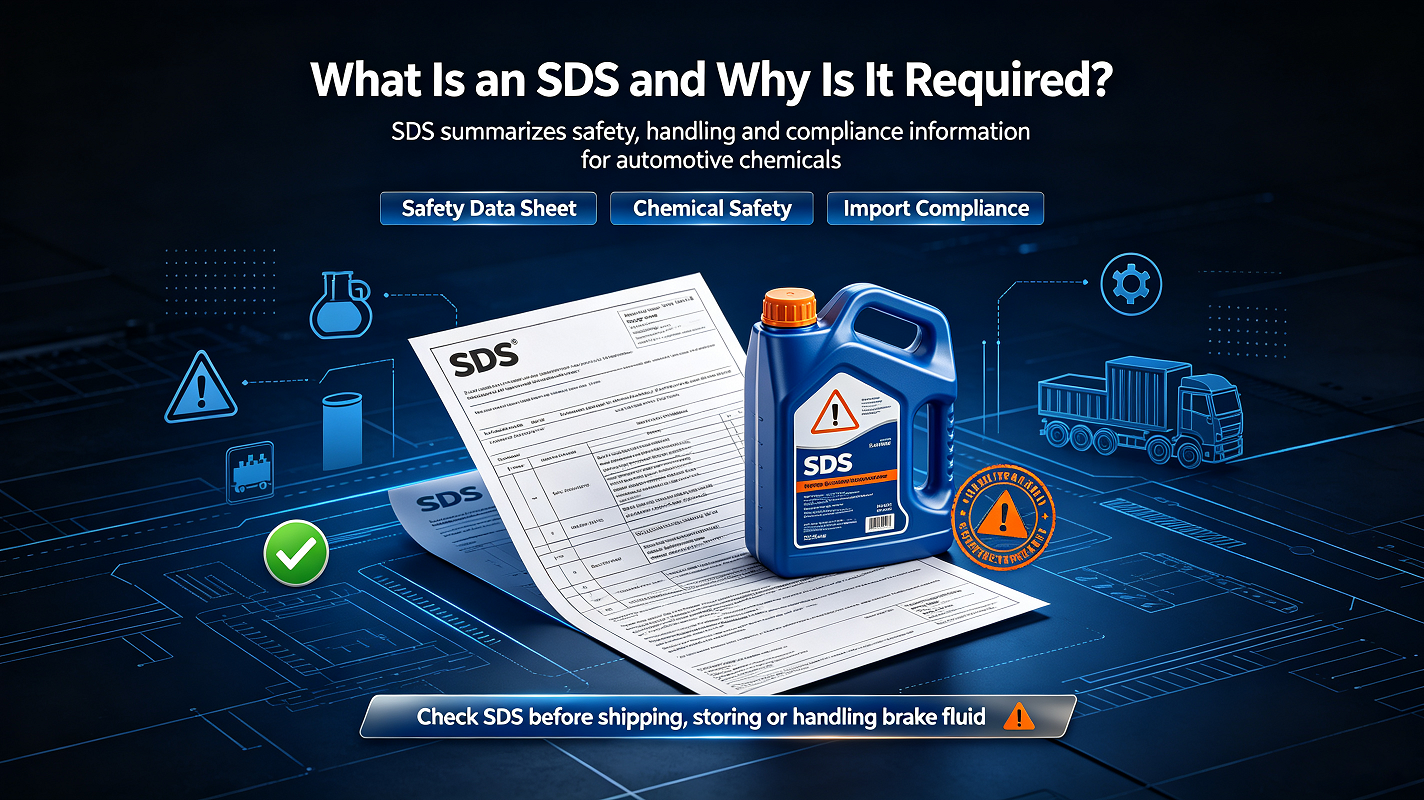
- TDS
- SDS
- COA where required
What Should Be in a Brake Fluid RFQ?
A good RFQ saves time on both sides.
Instead of writing:
“Need automotive brake fluid. Send best price.”
send something closer to this:
| RFQ Item | Buyer Information |
|---|---|
| Destination | Country / region |
| Vehicle market | Passenger, commercial, fleet, etc. |
| Brake fluid grade | DOT 3 / DOT 4 / DOT 5.1 |
| Additional requirement | Low viscosity / performance target |
| Standard | FMVSS / ISO / SAE / local requirement |
| Packaging | Bottle/can size |
| Branding | GAFLE / OEM / private label |
| Label language | Required language |
| Trial quantity | Initial order |
| Annual volume | Forecast |
| Documents | TDS / SDS / COA / test reports |
| Delivery | Destination and target date |
That lets a supplier quote the same product you think you are buying.
Without a normalized RFQ, two quotes that look comparable may represent completely different performance levels.
OEM and Private Label Automotive Brake Fluid
For distributors, brake fluid is well suited to private-label development because customers frequently purchase through established local automotive brands and service channels.
A private-label project can cover:
- DOT grade
- Performance positioning
- Bottle size
- Bottle shape
- Cap and seal
- Label
- Carton
- Brand colors
- Multilingual information
- Barcode
- Shipping marks
GAFLE states that it manufactures brake fluids for global brands and provides private-label packaging, bespoke specifications and packaging solutions through in-house teams. Its About Us page says OEM service for domestic and overseas brands began in 2018.
The company also publicly lists DOT 3, DOT 4 and DOT 5.1 among its brake-fluid capabilities.
Do Not Start With the Bottle
One recurring private-label mistake is approving the bottle before the technical product.
A safer workflow is:
market requirement → grade → performance specification → sample/testing → documentation → packaging claim → artwork → mass production
This order matters.
A beautiful label cannot repair an incorrect technical claim.
How Much Does Automotive Brake Fluid Cost?
There is no meaningful B2B answer without a specification.
Price can change with:
- DOT grade
- Performance level
- Low-viscosity requirement
- Formula
- Packaging material
- Bottle size
- Custom mold
- Label
- Carton
- Order volume
- Testing/documentation
- Destination
A sourcing manager should compare:
product cost + packaging + freight + duties + inventory + compliance risk + quality risk
rather than price per bottle alone.
One Simple Example
Supplier A may offer a lower unit price but require:
- Higher MOQ per packaging design
- More warehouse inventory
- Less efficient container loading
Supplier B may charge slightly more per bottle but offer:
- Better packaging density
- Fewer SKUs
- Stronger technical documentation
- Easier repeat orders
The lower unit price does not automatically create the lower landed cost.
Common Brake Fluid Sourcing Mistakes
Choosing a Fluid Because the DOT Number Is Higher
A higher number is not a universal upgrade.
Better approach: follow the vehicle requirement.
Looking Only at Dry Boiling Point
A high dry value may look impressive on a sales sheet.
Better approach: review wet boiling point, viscosity and the full specification.
Confusing DOT 5 With DOT 5.1
They are not the same category.
Better approach: clearly distinguish silicone-base DOT 5 from non-silicone DOT 5.1.
Ignoring Packaging Moisture Protection
Brake fluid can absorb moisture.
Better approach: review closure, inner seal, filling and storage control.
Accepting “Meets International Standards” Without Evidence
The phrase is too broad.
Better approach: ask which standard, which SKU and which report.
Approving a Sample but Ignoring Batch Control
A good sample proves the supplier can make one good sample.
It does not prove repeatability.
Better approach: inspect manufacturing and batch-traceability systems.
Why Buyers Consider GAFLE for Automotive Brake Fluid
GAFLE's business is closely connected to brake-fluid manufacturing.
Its current corporate information identifies Zhejiang Gafle Auto Chemical Co., Ltd. as a manufacturer of automotive chemicals and lists DOT 3, DOT 4 and DOT 5.1 brake fluids among its principal product areas. The same page reports annual production capacity exceeding 80,000 tons across all product lines and OEM service for more than 90 international brands.
GAFLE also states that its factory uses automated production equipment and controlled manufacturing processes and provides bespoke specifications and private-label packaging.
For buyers evaluating GAFLE, the most relevant internal pages are:
- GAFLE Brake Fluid Products
- GAFLE About Us
- Brake Fluid Quality Control Guide
- OEM Brake Fluid Manufacturer Guide
- Private Label Brake Fluid
- Contact GAFLE
The goal of these links should be to move a buyer naturally from:
product understanding → grade selection → quality verification → OEM evaluation → inquiry
rather than pushing a quotation button before the buyer has enough information.
What Should You Send GAFLE for an Accurate Quote?
A detailed inquiry usually gets a better response than a price-only request.
Send:
- Destination country
- DOT grade required
- Target vehicles or market
- Required FMVSS/ISO/SAE or local standard
- Standard or low-viscosity requirement
- Bottle size
- Packaging material
- Trial-order quantity
- Estimated annual volume
- GAFLE brand or private label
- Label language
- Required technical documents
- Target delivery date
If you do not know the exact grade, provide the vehicle population and market first.
That gives the technical team something useful to work from.
FAQ About Automotive Brake Fluid
1. What is automotive brake fluid?
Automotive brake fluid is a hydraulic fluid used to transmit braking pressure through a vehicle's hydraulic brake system. It also has to meet requirements for temperature performance, stability, corrosion protection and material compatibility.
2. What is the difference between DOT 3 and DOT 4 brake fluid?
Under FMVSS No. 116, DOT 4 has higher minimum dry and wet boiling-point requirements than DOT 3: 230°C/155°C versus 205°C/140°C. The correct grade should still follow the vehicle manufacturer's recommendation.
3. Is DOT 5.1 the same as DOT 5?
No. FMVSS 116 distinguishes DOT 5 silicone-base fluid from DOT 5.1 non-silicone-base fluid.
4. Why is wet boiling point important?
Common glycol-based brake fluids can absorb moisture during service. Wet boiling-point testing provides a more useful indication of how boiling performance changes after moisture exposure.
5. What brake fluid is suitable for ABS and ESP?
The answer depends on the vehicle specification.Modern electronic braking systems may require brake fluid with defined low-temperature viscosity as well as the correct DOT or ISO performance class.
6. Can DOT 4 replace DOT 3?
Do not make the decision solely because DOT 4 has higher minimum boiling requirements. Follow the vehicle manufacturer's specification and confirm system compatibility.
7. What documents should a brake fluid supplier provide?
Depending on the project and market, buyers may request a TDS, SDS, COA, product test data, applicable certifications and supporting compliance documentation.
8. Can GAFLE provide OEM or private-label brake fluid?
GAFLE states that it provides private-label packaging and bespoke specifications and has offered OEM services to domestic and international brands since 2018.
9. What affects the MOQ for OEM brake fluid?
MOQ may depend on fluid grade, bottle size, bottle design, labels, cartons, the number of SKUs and the degree of packaging customization.
10.How should I compare two brake fluid manufacturers?
Send both suppliers the same RFQ, then compare product specification, boiling performance, low-temperature viscosity, testing, QC, traceability, packaging control, OEM support, documentation, landed cost and repeat-order capability.
Conclusion
Buying automotive brake fluid for a distribution or private-label business is not a matter of choosing DOT 3, DOT 4 or DOT 5.1 from a catalogue and asking for the lowest unit price.
A stronger purchasing process looks like this:
target vehicles → required grade → boiling performance → viscosity → standard → QC → packaging → documentation → OEM terms → landed cost
The DOT designation gives buyers an important baseline, but FMVSS No. 116 itself shows why brake-fluid quality cannot be reduced to a single boiling-point number. The standard also addresses corrosion, viscosity, stability, water tolerance, compatibility, rubber effects, packaging and labeling.
For importers and distributors, that broader view reduces product-selection mistakes. For private-label brands, it reduces the chance of printing unsupported claims on a large production run.And for workshops and fleets, it makes the product range easier to use correctly.
GAFLE manufactures automotive brake fluid and offers DOT 3, DOT 4, DOT 5.1 and OEM/private-label solutions for international customers. Buyers can review the GAFLE product portfolio, learn more about its manufacturing capabilities, and contact GAFLE with the target market, required brake-fluid grade, packaging, trial quantity and annual forecast.