What Does Hybrid Coolant Fluid Mean?
For automotive buyers, hybrid coolant fluid most commonly refers to coolant formulated with Hybrid Organic Acid Technology (HOAT) or a related hybrid inhibitor system.
The word “hybrid” is important because it can create two different search intents:
- Hybrid chemistry — a coolant using a combination of organic-acid corrosion inhibitors and selected inorganic inhibitor technologies.
- Hybrid vehicle coolant — coolant intended for HEV, PHEV, or other electrified vehicle thermal-management systems.
These are not automatically the same product.
A HOAT engine coolant does not become suitable for every hybrid-electric vehicle merely because the word “hybrid” appears in its name. Likewise, a coolant intended for an HEV thermal-management loop should not automatically be described as HOAT unless its actual formulation supports that description.
For importers and private-label brands, the safer purchasing sequence is:
vehicle/application → OEM requirement → coolant chemistry → performance specification → concentrate/premix → testing → packaging → supplier
GAFLE currently separates conventional Coolant, Energy Vehicles Coolant, energy-storage thermal-management coolant, non-contact liquid-cooling coolant, and OEM solutions within its Antifreeze/Coolant range. This makes product-level confirmation particularly important when discussing hybrid coolant applications.
What Is HOAT Coolant?
HOAT stands for Hybrid Organic Acid Technology.
It combines organic-acid-based corrosion protection with selected inorganic inhibitors to achieve a balance between:
- Fast surface protection
- Long-term corrosion control
- Aluminum protection
- Cooling-system compatibility
- Extended service potential
However, HOAT is a technology family rather than one universal formula.
Published automotive coolant formulations demonstrate that one HOAT coolant may use a phosphate-based system, while another may be low-silicate and phosphate-free. That means buyers should never assume that two products labeled “HOAT” are interchangeable.
For professional buyers, the important questions are therefore:
- Which inhibitor system is used?
- Which OEM specification does it target?
- Is it silicated or silicate-free?
- Does it contain phosphate?
- Is it nitrite-free?
- Which metals and elastomers has it been designed to protect?
- Is it concentrate or ready-to-use?
- What documentation supports its compatibility claims?
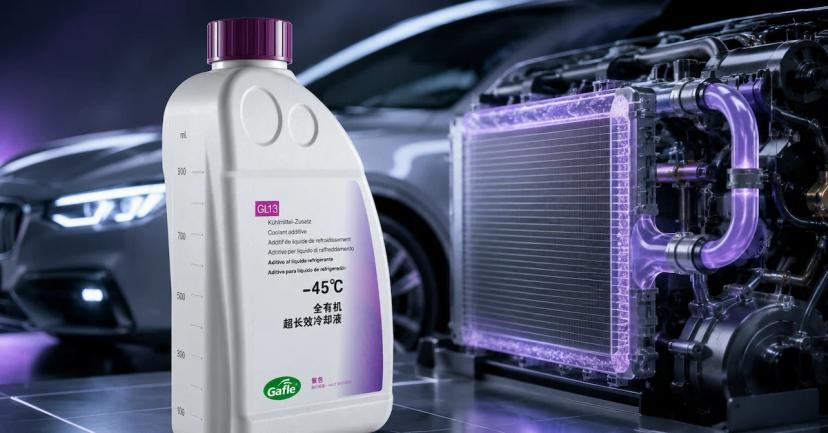
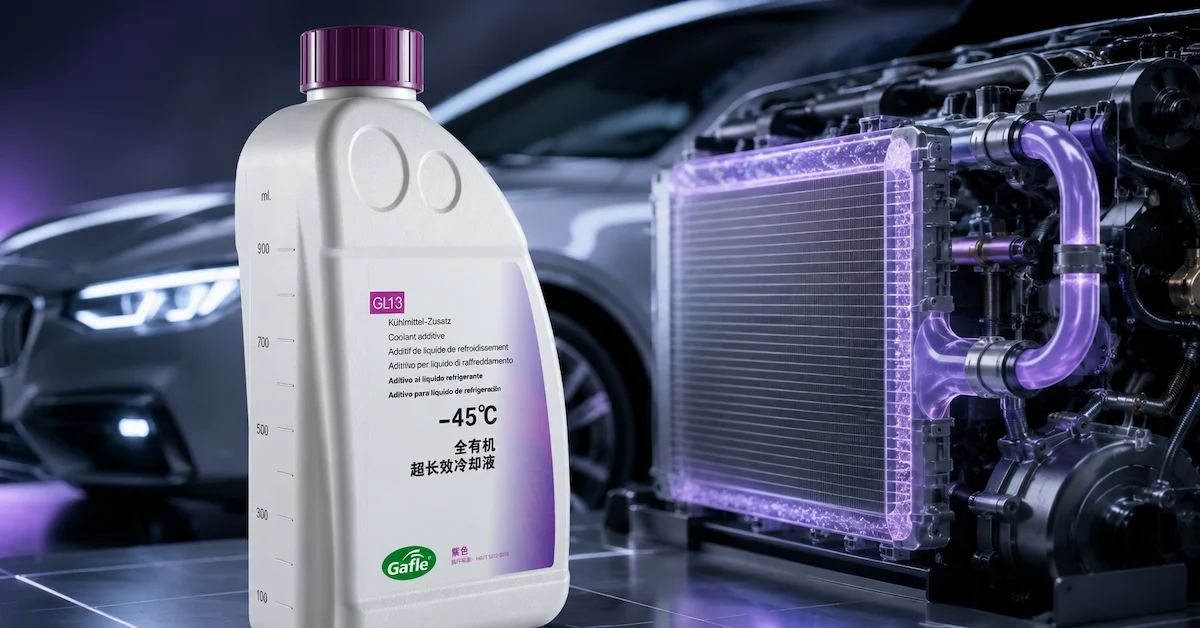
Buyers evaluating an OEM-oriented purple coolant can also review GAFLE's OE-equivalent Coolant (Purple) as part of the product-selection process. Before placing an order, confirm the exact coolant specification, vehicle application, technical data, and compatibility requirements for the target market.
Why Hybrid Coolant Chemistry Matters to Automotive Buyers
Modern cooling systems can contain several materials at the same time.
Typical components may include:
- Aluminum radiators
- Aluminum cylinder heads
- Cast-iron engine components
- Steel parts
- Copper alloys in some systems
- Plastics
- Rubber seals and hoses
The inhibitor package must protect the intended system without creating undesirable deposits or compatibility problems.
Corrosion Protection
Coolant continuously contacts metal surfaces.
Without effective inhibitor chemistry, buyers may eventually face issues such as:
- Rust
- Aluminum corrosion
- Deposits
- Restricted coolant passages
- Component deterioration
For distributors, these are not only technical failures. They can become product returns, warranty disputes, dealer complaints, and brand-reputation problems.
Heat Management
Hybrid coolant fluid must also transfer heat between the engine and radiator while maintaining an appropriate operating range.
It therefore needs to provide protection against:
- Freezing
- Boilover
- Corrosion
- Cooling-system deterioration
ASTM D3306-21 covers glycol-base engine coolants for automobiles and light-duty service.The active specification recognizes both concentrate and prediluted products and addresses protection against freezing, boiling, and corrosion.
Hybrid Coolant Fluid vs IAT vs OAT
For buyers building a coolant portfolio, understanding the basic technology differences is useful.
| Coolant Technology | General Approach | Typical Buyer Concern | Procurement Priority |
|---|---|---|---|
| IAT | Predominantly inorganic inhibitors | Shorter traditional service positioning | Confirm vehicle compatibility |
| OAT | Organic-acid inhibitor technology | Extended-life applications | Confirm OEM chemistry |
| HOAT | Organic acids plus selected inorganic inhibitors | Multiple formulation variants | Verify exact inhibitor system |
| Specialized EV coolant | Application-specific thermal management | Electrical/material requirements | Verify specific EV/HEV specification |
The table should not be used as an interchangeability guide.
Actual compatibility must follow the vehicle manufacturer, equipment requirement, or validated coolant specification.
Why Color Is Not Enough
A common sourcing mistake is specifying:
“We need purple coolant.”
or:
“We need blue hybrid coolant.”
Color is useful for branding and identification, but it does not reliably define:
- HOAT chemistry
- Phosphate content
- Silicate content
- OEM approval
- Vehicle compatibility
A distributor printing an incorrect compatibility statement across thousands of bottles creates a much larger problem than choosing the wrong label color.
Who Buys Hybrid Coolant Fluid in Commercial Volumes?
Automotive Chemical Importers
Importers typically require:
- Market-compatible products
- TDS and SDS/MSDS
- Consistent batches
- Export packaging
- Multi-language labels
- Stable supply
- OEM/private-label capability
For them, technical documentation and repeatability matter as much as first-order pricing.
Coolant and Auto-Parts Distributors
Regional distributors may serve:
- Passenger-car workshops
- Dealerships
- Auto-parts stores
- Fleet service centers
- Wholesalers
A hybrid coolant product may be useful where the distributor needs a formulation matched to a particular vehicle population or OEM specification.
Private-Label Automotive Brands
Private-label brands often need more control over:
- Product positioning
- Formula
- Bottle
- Label
- Carton
- Market language
- Brand architecture
For these buyers, the coolant manufacturer becomes part of the product-development process rather than simply a liquid supplier.
Fleet and Commercial Vehicle Suppliers
Fleet buyers often prioritize:
- Repeatable quality
- Workshop standardization
- Bulk packaging
- Long-term availability
- Correct vehicle compatibility
A formula should be selected around the fleet specification rather than marketing terminology.
Is Hybrid Coolant Fluid Specifically for Hybrid Vehicles?
Not necessarily.
This is one of the most important distinctions in this topic.
A search for hybrid coolant fluid may come from someone looking for coolant for:
- HEV
- PHEV
- EV
- Hybrid Organic Acid Technology engines
These requirements can overlap, but they should not be automatically combined.
Hybrid Vehicles May Have Multiple Thermal Loops
Depending on vehicle design, an HEV or PHEV may have thermal-management circuits for:
- Internal-combustion engine
- Power electronics
- Electric drive components
- Battery system
The required fluid can depend on the specific circuit.
Some commercial EV/Hybrid coolant products also use HOAT chemistry, demonstrating that the two concepts can overlap. But that still does not mean all HOAT coolants are EV/HEV coolants.
For B2B sourcing, ask:
Which thermal loop is the coolant intended for?
before discussing color, HOAT technology, or packaging.
GAFLE separately lists Energy Vehicles Coolant in its product portfolio, so buyers targeting hybrid or electric vehicles should confirm the appropriate product-specific TDS rather than automatically selecting a conventional engine coolant.
Technical Specifications to Confirm Before Buying Hybrid Coolant
A professional RFQ should contain more than the phrase:
“Please quote hybrid coolant.”
Use a specification checklist instead.
| RFQ Item | What the Buyer Should Define |
|---|---|
| Target market | Country or region |
| Vehicle type | ICE, HEV, PHEV, fleet, light-duty, etc. |
| Cooling loop | Engine or specialized thermal-management circuit |
| Required OEM spec | Vehicle/equipment requirement |
| Coolant technology | HOAT or specified chemistry |
| Glycol base | According to product requirement |
| Product format | Concentrate or ready-to-use |
| Freeze protection | Climate/application requirement |
| Inhibitor restrictions | Silicate/phosphate/nitrite etc., if specified |
| Packaging | Bottle, workshop pack, drum, bulk |
| Branding | GAFLE, OEM, private label |
| Documents | TDS, SDS/MSDS, COA, test information |
| Order quantity | Trial quantity and forecast |
| Destination | Country/port |
| Delivery target | Required timing |
This approach produces better quotations because competing suppliers are pricing the same technical requirement.
Concentrate vs Ready-to-Use Hybrid Coolant Fluid
Both formats can work well, but they create different procurement responsibilities.
Concentrated Hybrid Coolant
Advantages may include:
- Reduced transported water
- Flexible final concentration
- Potential logistics efficiency
- Multiple climate positioning
But the buyer must control:
- Dilution ratio
- Water quality
- Mixing procedures
ASTM D3306-21 states that applicable concentrate products are commonly used at 40%–60% concentration by volume in suitable water, with higher concentration up to 70% subject to agreement.
Ready-to-Use Coolant
Prediluted products can reduce downstream mixing errors.
They may be preferable for:
- Workshop chains
- Retail distribution
- Fleet depots
- Service networks
Which Is Better?
For an international buyer:
concentrate may optimize logistics
while
ready-to-use may optimize operational control
The correct decision depends on landed cost and customer capability rather than product format alone.
Why Exact OEM Compatibility Matters More Than “Universal” Claims
Hybrid coolant chemistry can vary significantly between vehicle manufacturers.
This is where procurement risk increases.
A product marketed too broadly can create problems if the package makes unsupported claims such as:
- Universal for all European vehicles
- Suitable for all Asian cars
- Compatible with every HOAT system
- Suitable for all hybrid vehicles
A professional buyer should request documentary support for each compatibility statement.
For buyers looking for a vehicle-specification-oriented coolant solution, GAFLE's OE-equivalent Coolant (Purple) can be reviewed together with the corresponding technical requirements and product documentation. Compatibility should always be confirmed against the intended vehicle or OEM specification rather than coolant color alone.
Better Private-Label Practice
Build packaging claims from:
validated product specification → confirmed application → approved label wording
not:
marketing claim → bottle design → technical verification later
This sequence reduces both technical and commercial risk.
What Quality Control Should a Hybrid Coolant Manufacturer Have?
Supplier qualification should examine the entire manufacturing chain.
Raw Material Control
A manufacturer should control:
- Glycol raw materials
- Inhibitor/additive components
- Incoming inspection
- Material identification
- Storage
- Traceability
Formula Management
Different HOAT products can have different inhibitor systems.
Formula version control therefore matters.
Buyers should understand how the factory prevents:
- Wrong additive loading
- Formula confusion
- Cross-product production errors
- Incorrect labeling
Production Control
Important areas include:
- Metering
- Mixing
- Process records
- Filling
- Cap/seal inspection
- Batch coding
- Packaging inspection
Finished-Product Verification
Testing should be determined by the final specification.
Depending on the product, relevant evaluation may include:
- Freeze protection
- pH
- Density
- Corrosion performance
- Foaming behavior
- Chemical stability
- Material compatibility
- OEM-specific requirements
Do not ask only:
“Do you test the coolant?”
Ask:
“Which tests are performed for this exact SKU, and what specification or acceptance criteria are used?”
That question is much more useful during supplier qualification.
Hybrid Coolant Fluid OEM and Private Label Programs
OEM manufacturing is particularly valuable where distributors need multiple coolant chemistries for regional vehicle populations.
GAFLE currently lists OEM as a dedicated coolant category and states that it provides bespoke specifications and packaging solutions through in-house production capabilities.
Product Customization Can Include
Subject to product validation:
- Coolant chemistry
- Concentration
- Application positioning
- Product color
- Packaging format
Packaging Customization Can Include
- Bottle
- Cap
- Label
- Carton
- Brand identity
- Multi-language information
- Barcode
- Shipping marks
A Smarter Way to Launch a Private-Label Range
A distributor should avoid launching too many coolant SKUs at once.
A better approach is to map the local vehicle population and identify the formulations responsible for the largest addressable market.
For example:
high-volume vehicle specification → primary coolant SKU
then:
secondary OEM groups → additional SKUs
This can reduce:
- Packaging MOQ
- Slow inventory
- Warehouse complexity
- Artwork cost
- Working-capital pressure
Hybrid Coolant Fluid Cost: What Actually Changes the Quote?
The final quotation can be affected by:
- Base fluid
- Inhibitor package
- Technical specification
- Concentrate vs premix
- Packaging
- Number of SKUs
- Labels
- Cartons
- Testing requirements
- Production quantity
- Destination
Therefore two products described simply as “HOAT coolant” may not be commercially comparable.
Compare Landed Cost Instead
Use:
product + packaging + testing/documentation + freight + duties + inventory + quality risk
A cheaper liquid can become a more expensive sourcing decision when:
- Packaging wastes container space
- MOQ creates excess inventory
- Claims need reprinting
- Batch consistency is poor
- Compatibility errors create returns
How to Compare Hybrid Coolant Suppliers
| Supplier Factor | Procurement Question |
|---|---|
| Technical knowledge | Can the supplier explain the coolant chemistry? |
| OEM matching | Can it support your required vehicle specification? |
| Product range | Are multiple coolant technologies available? |
| Documentation | Are TDS/SDS/COA and test records available? |
| QC | How are formula and batches controlled? |
| OEM capability | Can product and packaging be customized? |
| Capacity | Can repeat volume be supported? |
| Export support | Can international orders be handled reliably? |
| Communication | Are requirements documented clearly? |
The best supplier is not necessarily the one with the largest catalogue.
It is the one that can deliver the correct specification consistently.
Why Consider GAFLE for Hybrid Coolant Projects?
Zhejiang Gafle Auto Chemical Co., Ltd. manufactures automotive chemicals and provides coolant/antifreeze solutions as part of its product portfolio.
GAFLE currently provides a coolant portfolio covering:
- Conventional automotive coolant
- OE-equivalent Coolant (Purple)
- Energy Vehicles Coolant
- Energy Storage Battery Thermal Management Coolant
- Non-Contact Liquid Cooling Coolant
- OEM and private-label coolant solutions
Buyers can review the broader GAFLE Antifreeze/Coolant range to compare products for different vehicle, climate, and thermal-management requirements.
Its corporate information reports more than 80,000 tons of annual production capacity across all product lines and OEM service for more than 90 international brands. It also lists IATF 16949, ISO 9001, ISO 14001, and ISO 45001 certifications.
The GAFLE About Us page states that production uses advanced facilities and fully automated production lines and that OEM service for domestic and overseas brands began in 2018.
For procurement teams, these are supplier-level qualifications.
They do not mean every GAFLE coolant automatically carries every HOAT or OEM approval.
For a Hybrid Coolant Fluid project, buyers should confirm the exact:
- Formula
- Inhibitor system
- Target OEM specification
- TDS
- Test requirements
- Packaging
- MOQ
- Lead time
before printing compatibility claims or issuing a purchase order.
Build a Better Coolant Product Matrix
If you are an importer or distributor, a strong coolant portfolio can be organized by actual purchasing need rather than color.
For example:
Core Engine Coolant
Suitable for the largest mainstream vehicle group in the target market.
Hybrid/HOAT Coolant
For OEM requirements calling for the appropriate hybrid inhibitor technology.
OEM-Specific Coolant
For defined European, Asian, American, or manufacturer-specific specifications where validated.
Energy Vehicle Coolant
For HEV/EV thermal-management applications requiring a dedicated fluid specification.
Heavy-Duty Coolant
For trucks, construction machinery, agricultural equipment, or other demanding engines where the required heavy-duty standard differs from light-duty service.
This structure makes distributor conversations easier and creates clearer differentiation between SKUs.
It also provides stronger SEO and sales logic than offering many bottles differentiated only by color.
Common Hybrid Coolant Sourcing Risks
Risk 1: Assuming Every HOAT Formula Is the Same
Problem: HOAT is treated as one universal chemistry.
Better approach: Verify the inhibitor system and target OEM requirement.
Risk 2: Confusing Hybrid Chemistry With Hybrid Vehicles
Problem: A HOAT coolant is marketed as suitable for every HEV/PHEV.
Better approach: Identify the exact thermal loop and vehicle specification.
Risk 3: Selecting by Color
Problem: Bottle color becomes the technical specification.
Better approach: Use validated chemistry and compatibility.
Risk 4: Copying OEM Claims From Another Supplier
Problem: Packaging claims are used without product-level evidence.
Better approach: Verify every claim against the actual SKU.
Risk 5: Comparing Prices for Different Formulations
Problem: A low-cost quotation is compared with a more demanding specification.
Better approach: Standardize the RFQ.
Risk 6: Ignoring Repeat-Batch QC
Problem: Only the first sample is evaluated.
Better approach: Review formula control, batch testing, and traceability.
Risk 7: Launching Too Many SKUs
Problem: Private-label customization creates excessive inventory.
Better approach: Start with vehicle-population and sales-demand analysis.
What Should Buyers Send for a Hybrid Coolant Fluid Quote?
A high-quality inquiry should include:
- Destination country or market
- Vehicle makes/models or application group
- Engine, HEV, PHEV, EV,or other thermal loop
- Required OEM specification
- Required coolant technology if known
- Concentrate or ready-to-use format
- Target freeze protection
- Packaging capacity
- Trial-order quantity
- Expected annual volume
- OEM/private-label requirement
- Label language
- Required documents
- Target delivery schedule
If you do not know which coolant chemistry is required, do not guess from color.
Send the vehicle/application requirements first.
GAFLE can be contacted through its Contact Us page, while buyers can review the broader Antifreeze/Coolant portfolio before discussing a project.
For related procurement topics, also see:
- Engine Cooling Antifreeze Guide
- Antifreeze OEM Guide
- Bulk Antifreeze Supplier Guide
- Antifreeze Factory Direct Guide
FAQ About Hybrid Coolant Fluid
1.What is Hybrid Coolant Fluid?
Hybrid coolant fluid commonly refers to engine coolant using Hybrid Organic Acid Technology (HOAT), which combines organic-acid corrosion inhibitors with selected inorganic inhibitor technologies.
2. Is HOAT coolant the same as hybrid vehicle coolant?
No. HOAT describes coolant inhibitor technology, while hybrid vehicle coolant refers to a fluid used in a hybrid-electric vehicle. Some HEV coolants may use HOAT chemistry, but the terms are not interchangeable.
3. Is every HOAT coolant compatible with every vehicle?
No. HOAT formulations can differ significantly. Buyers should verify the vehicle/OEM specification and actual coolant formulation before use.
4. Can coolant color identify HOAT chemistry?
No. Color is not a reliable specification. Different coolant chemistries can use similar colors, while similar technologies may be sold in different colors.
5. What is the difference between OAT and HOAT coolant?
OAT primarily relies on organic-acid inhibitor technology, while HOAT combines organic-acid protection with selected inorganic inhibitor chemistry. The exact formulation varies by product and OEM requirement.
6. Should I buy hybrid coolant concentrate or ready-to-use?
Concentrate can provide logistics and dilution flexibility, while ready-to-use coolant reduces downstream mixing requirements. The right choice depends on your distribution model, water-quality control, and target customers.
7. What documents should an HOAT coolant supplier provide?
Depending on the project, buyers should request TDS, SDS/MSDS, COA, product specifications, relevant test information, and evidence supporting OEM compatibility claims.
8. Can GAFLE supply OEM or private-label coolant?
GAFLE lists OEM as part of its coolant portfolio and states that it provides bespoke specification and packaging solutions for brand customers.
9. What determines MOQ for private-label hybrid coolant?
MOQ can depend on the formulation, bottle, cap, label, carton, number of SKUs, and customization level. Project-specific MOQ should be confirmed before artwork and production planning.
10.How should an importer compare hybrid coolant manufacturers?
Compare them using the same technical RFQ, then evaluate chemistry expertise, product-level evidence, QC, OEM capability, documentation, capacity, export support, landed cost, and repeat-order consistency.
Conclusion
Buying Hybrid Coolant Fluid requires more technical verification than simply choosing a coolant labeled “hybrid.”
For professional buyers, the correct sequence is:
application → OEM requirement → inhibitor technology → product specification → concentrate/premix → QC → packaging → commercial terms
The most important distinction is that HOAT coolant and coolant for hybrid-electric vehicles are not automatically the same thing. Treating them as interchangeable can create compatibility, labeling, and customer-service risks.
For distributors and private-label brands, the strongest supplier is one that can translate target vehicle requirements into a documented coolant specification and reproduce that specification consistently at commercial volume.
GAFLE provides conventional automotive coolant, energy-vehicle coolant, specialized thermal-management fluids, and OEM solutions within its coolant portfolio. Buyers developing a HOAT, hybrid-vehicle, bulk, or private-label coolant program can review the GAFLE Antifreeze/Coolant range and contact GAFLE with their target market, required specification, packaging, and expected annual volume.