What Is Engine Cooling Antifreeze?
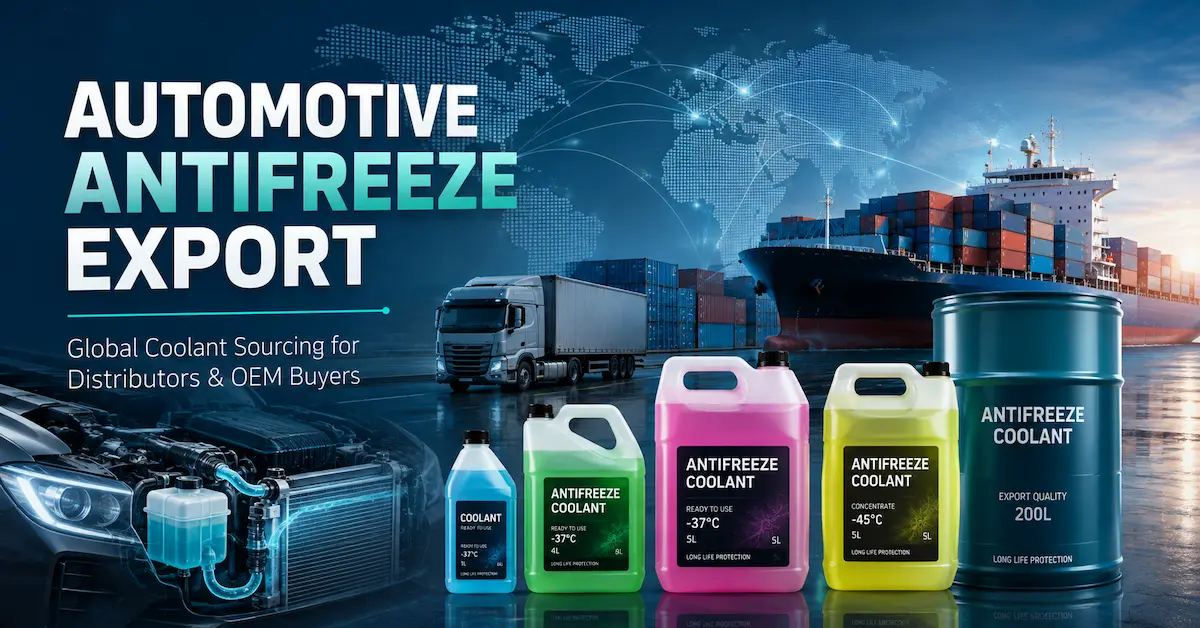
Engine cooling antifreeze is a formulated heat-transfer fluid used in vehicle cooling systems to control operating temperature while protecting against freezing, boiling, corrosion, and other cooling-system damage.
For B2B buyers, this distinction matters.
A distributor is not simply purchasing a colored liquid with a low freezing point. The product must work as part of an integrated cooling system containing the engine block, cylinder head, radiator, water pump, thermostat, hoses, seals, and sometimes additional heat exchangers.
A suitable automotive coolant therefore needs to balance several functions:
- Transfer engine heat efficiently
- Prevent freezing in cold environments
- Increase protection against boilover
- Protect metals from corrosion
- Support water-pump and seal compatibility
- Remain chemically stable during service
- Match the intended vehicle and coolant specification
ASTM D3306 covers glycol-base engine coolant used in automobiles and other light-duty cooling systems. The current D3306-21 scope states that properly formulated concentrates or prediluted coolants provide protection against freezing, boiling, and corrosion.
For an importer, distributor, or automotive brand, the more useful sourcing question is therefore not:
“What is your cheapest antifreeze?”
It is:
“Which engine cooling antifreeze matches my vehicles, climate, specification, packaging channel, and repeat-order requirements?”
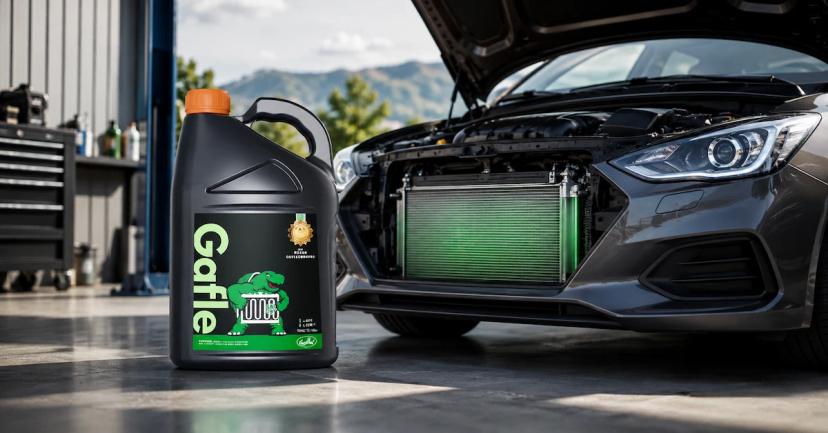
GAFLE's current Antifreeze/Coolant range includes conventional coolant, energy-vehicle coolant, energy-storage battery thermal-management coolant, non-contact liquid-cooling coolant, and OEM options.
Who Is This Engine Cooling Antifreeze Guide For?
This guide is primarily intended for commercial buyers rather than individual vehicle owners.
Automotive Chemical Importers
Importers need products that can be repeatedly supplied with:
- Consistent specifications
- Suitable documentation
- Export-ready packaging
- Stable production
- Market-specific labeling
- OEM/private-label options
Their risk is not one bad bottle. It is one inconsistent batch affecting a regional distribution network.
Automotive Parts and Coolant Distributors
Distributors need to match coolant products to several customer groups, such as:
- Passenger-car workshops
- Auto-parts stores
- Dealer networks
- Fleets
- Commercial vehicle service centers
They may also require different product tiers rather than a single universal coolant.
Fleet and Heavy-Duty Suppliers
Fleet buyers often care more about:
- Vehicle uptime
- Maintenance standardization
- Bulk packaging
- Long operating hours
- Reliable replenishment
- Heavy-duty application suitability
Private-Label Automotive Brands
Private-label buyers usually evaluate both the liquid and the commercial package.
Typical requirements include:
- Coolant specification
- Formula selection
- Bottle size
- Label design
- Carton
- Brand color
- Language
- Technical documents
- Long-term OEM supply
How Engine Cooling Antifreeze Works Inside a Vehicle
The cooling system continuously moves heat away from the engine.
A simplified flow is:
Water pump → engine passages → thermostat → radiator → return to pump
When the engine is cold, the thermostat helps limit radiator flow so operating temperature can rise efficiently. As the engine warms, coolant flows through the radiator where heat is transferred to the surrounding air.
The antifreeze/coolant therefore needs to operate under two opposite conditions:
- Very low ambient temperatures during storage or startup
- High fluid and component temperatures during engine operation
That is why water alone is not sufficient for year-round automotive service.
Why Water Alone Is Not a Complete Engine Coolant
Water has excellent heat-transfer capability, but it also has important limitations for an automotive cooling system.
Water Can Freeze
When water freezes, expansion can damage:
- Radiators
- Engine passages
- Housings
- Pipes
- Other cooling-system components
Glycol-containing coolant reduces the freezing point of the mixture.
Water Can Boil
Cooling systems must also operate above temperatures where plain water at atmospheric pressure would boil.
A formulated glycol-water coolant, together with a correctly operating pressurized cooling system, provides a wider operating range.
Water Does Not Provide a Complete Corrosion-Inhibitor Package
Modern cooling systems contain several materials.
These can include:
- Aluminum
- Cast iron
- Steel
- Copper alloys
- Plastics
- Elastomers
A finished coolant includes corrosion-inhibitor chemistry intended to protect the materials for which the product is designed.
This is why professional buyers should not compare automotive coolant with glycol raw material alone.
Engine Cooling Antifreeze Chemistry: What B2B Buyers Need to Understand
The final performance of coolant depends on more than glycol percentage.
A commercial formulation may involve:
- Glycol base
- Water
- Corrosion inhibitors
- Buffering chemistry
- Anti-foam additives
- Other application-specific components
Ethylene Glycol-Based Coolant
Ethylene glycol is widely used in automotive cooling applications.
It can be found in both:
- Concentrated coolant
- Prediluted coolant
Propylene Glycol-Based Coolant
Propylene glycol-based coolant is another recognized category.
ASTM D3306 identifies ethylene-glycol-, propylene-glycol-, and certain glycerin-containing glycol-base coolant categories for light-duty service.
The correct base should be selected according to the product specification and intended application—not substituted solely on price.
IAT, OAT and HOAT: Why Coolant Technology Matters
B2B buyers commonly encounter terminology such as:
- IAT
- OAT
- HOAT
These refer broadly to different corrosion-inhibitor approaches.
The important procurement principle is simple:
Coolant chemistry should match the intended vehicle or technical requirement.
Do not use bottle color as the specification.
Green, blue, red, pink, purple, or yellow may help with brand identification, but color alone does not prove:
- Inhibitor technology
- OEM compatibility
- Service requirement
- Performance standard
For an importer or private-label brand, this is particularly important because an incorrect compatibility claim printed on thousands of bottles creates a much larger commercial risk than a packaging design mistake.
Concentrated vs Ready-to-Use Engine Cooling Antifreeze
One of the first decisions in bulk sourcing is whether to purchase concentrate or premixed coolant.
| Purchasing Factor | Concentrated Coolant | Ready-to-Use Coolant |
|---|---|---|
| Final dilution | Managed downstream | Factory prepared |
| Water quality | Buyer must control | Factory controlled |
| Freight efficiency | Can reduce transported water | More finished liquid shipped |
| Application convenience | Requires mixing | Direct service use |
| Mixing-error risk | Higher | Lower |
| Typical buyers | Professional distributors/blenders | Workshops, retailers, fleets |
Concentrate Is Suitable When
The buyer has:
- Controlled dilution procedures
- Suitable water quality
- Professional handling
- Strong logistics incentive
- Multiple target concentration requirements
Ready-to-Use Coolant Is Suitable When
The buyer prioritizes:
- Operational convenience
- Controlled final concentration
- Workshop simplicity
- Retail positioning
- Reduced dilution errors
ASTM D3306 recognizes concentrates commonly used at 40%–60% concentration by volume in suitable water, with allowance up to 70% by agreement, as well as qualifying prediluted products.
This is an important reason buyers should not assume that “more antifreeze” always means “better coolant.”
Choose Engine Cooling Antifreeze by Vehicle Application
A high-conversion coolant sourcing decision starts with the application.
Passenger Cars and Light-Duty Vehicles
Typical purchasing priorities include:
- Correct vehicle compatibility
- Stable corrosion protection
- Cold-weather protection
- Ready-to-use convenience
- Retail-friendly packaging
ASTM D3306 is one common industry reference for automobile and light-duty glycol-base engine coolant.
For distributors, this segment may support:
- Standard retail coolant
- Concentrate
- Private-label ready-to-use products
- Climate-specific product lines
Commercial Trucks and Heavy-Duty Engines
Heavy-duty engines introduce different risks.
ASTM D6210-25 covers fully formulated glycol-base coolant for heavy-duty engines. Its scope includes protection against corrosion, cavitation, freezing, and boiling, with requirements relevant to demanding heavy-duty cooling systems.
Typical applications include:
- Trucks
- Buses
- Construction equipment
- Agricultural equipment
- Mining vehicles
- Other heavy-duty fleets
For buyers serving these markets, cavitation protection and engine-manufacturer maintenance requirements can become particularly important.
Construction and Agricultural Machinery
These applications may experience:
- Long operating hours
- High load
- Dust
- High ambient temperatures
- Seasonal cold
- Long periods between service opportunities
A buyer should therefore avoid automatically using a standard passenger-car coolant without checking equipment requirements.
Fleet Maintenance
Fleet buyers usually benefit from reducing unnecessary product complexity.
For example, standardizing suitable coolant across defined vehicle groups can simplify:
- Inventory
- Workshop procedures
- Technician training
- Reordering
- Service records
The correct product still needs to match the vehicles involved.
Climate Is a Purchasing Specification, Not a Marketing Detail
An engine coolant distributor selling into Saudi Arabia does not have the same climate priorities as a distributor supplying Northern Europe or high-altitude winter markets.
Cold Markets
Buyers should define:
- Expected minimum temperature
- Vehicle application
- Concentrate/premix requirement
- Required freeze protection
Hot Markets
Hot climates still require proper engine coolant.
The product must support:
- Heat transfer
- Boiling protection
- Corrosion protection
- Long-term cooling-system stability
“Antifreeze” is therefore not just a winter product.
Mixed-Climate Distribution
If a distributor sells across several countries or regions, it may make more commercial sense to build a coolant matrix rather than force one SKU into every market.
Engine Cooling Antifreeze Specifications to Put in Your RFQ
A high-quality inquiry should make it possible for the supplier to recommend the correct product.
Use an RFQ such as:
| RFQ Field | Buyer Information |
| Destination market | Country/region |
| Vehicle application | Passenger, fleet, truck, equipment |
| Required specification | ASTM/OEM/market requirement |
| Coolant technology | If defined |
| Product format | Concentrate or ready-to-use |
| Freeze protection | Target requirement |
| Packaging | Bottle, workshop pack, drum, bulk |
| Branding | Manufacturer brand/OEM/private label |
| Label language | Required language |
| Documents | TDS, SDS/MSDS, COA, etc. |
| Trial order | Estimated first quantity |
| Annual forecast | Expected yearly demand |
| Delivery | Destination and timing |
An inquiry that simply says:
“Send engine coolant price.”
forces the supplier to guess.
That produces poor quotation quality and makes supplier comparison unreliable.
How to Evaluate an Engine Coolant Supplier Before Ordering
Price should come after supplier qualification, not before it.
Product Fit
Ask:
- Does the supplier understand the target vehicle segment?
- Can it distinguish light-duty and heavy-duty needs?
- Can it explain concentrate versus premix choices?
Technical Documentation
Depending on the project, request:
- TDS
- SDS/MSDS
- COA
- Product specification
- Relevant test data
- Certification information
Manufacturing Control
Ask how the supplier manages:
- Raw materials
- Formula control
- Mixing
- Filling
- Packaging
- Batch identification
Repeat-Batch Consistency
The first sample is not the final test of a B2B supplier.
The real question is:
Can the manufacturer reproduce the approved engine cooling antifreeze repeatedly at commercial volume?
What Quality Control Should Buyers Expect?
A reliable automotive antifreeze manufacturer should be able to explain its QC logic clearly.
Raw Material Management
Buyers should ask how incoming materials are:
- Qualified
- Inspected
- Stored
- Released
- Traced
Formula and Process Control
Important controls may include:
- Formula version management
- Mixing sequence
- Batch records
- Filling parameters
- Packaging checks
Finished-Product Verification
Testing should match the agreed product specification.
Depending on product type, relevant properties may include:
- Freeze protection
- Physical properties
- pH
- Corrosion performance
- Foam behavior
- Stability
- Application-specific performance
Do not assume every SKU has every test or approval.
Ask for evidence relating to the exact product you intend to purchase.
Why Manufacturing Systems Matter for B2B Coolant Buyers
GAFLE's current corporate information identifies the company as Zhejiang Gafle Auto Chemical Co., Ltd. and states that its business covers research, development, and manufacturing of automotive chemicals, including advanced engine coolant/antifreeze solutions. It reports annual capacity exceeding 80,000 tons across all product lines and service to more than 90 international brands through OEM services.
The same corporate information lists:
- IATF 16949
- ISO 9001
- ISO 14001
- ISO 45001
GAFLE's About Us page also states that manufacturing uses advanced facilities and fully automated production lines, with processes monitored under quality requirements.
For a procurement team, these credentials are supplier-level evidence.
They do not replace product-level verification.
Before ordering, buyers should still confirm:
- Exact coolant SKU
- Technical specification
- Required testing
- Packaging
- MOQ
- Production arrangement
- Documentation
OEM and Private Label Engine Cooling Antifreeze
OEM capability is one of the strongest commercial reasons for an importer to work directly with a manufacturer.
GAFLE currently lists OEM directly within its Antifreeze/Coolant product structure.
Its About Us page states that the company began providing OEM services to brands at home and abroad in 2018 and describes bespoke specifications and packaging solutions.
Product-Side Customization
Depending on the project, discussions may cover:
- Coolant type
- Concentration
- Application positioning
- Target specification
- Product color
Packaging-Side Customization
Typical requirements include:
- Bottle
- Cap
- Label
- Carton
- Brand colors
- Local language
- Barcode/product identification
- Shipping marks
Why This Matters to Distributors
Private label allows a distributor to build:
- Its own coolant brand
- Different pricing tiers
- Regional packaging
- Dealer-specific product lines
- Workshop ranges
But customization also affects:
- MOQ
- Lead time
- Packaging inventory
- Cost per SKU
For higher conversion and lower launch risk, buyers should decide which customization actually contributes to market value.
Standard Product vs Private Label vs Custom OEM
| Supply Model | Best For | Customization | Buyer Advantage |
| Manufacturer brand | Distributors wanting quick launch | Low | Faster sourcing |
| Private label | Established regional distributors | Medium | Own branding |
| OEM coolant | Brands with defined market/spec needs | Medium–high | Product + packaging control |
| Specialized development | Technical applications | High | Application-focused solution |
The best option depends on:
- Annual volume
- Target market
- Distribution channel
- Technical requirement
- Brand maturity
A new importer does not always need a fully custom formula.
An established brand may need far more control.
What Determines Engine Cooling Antifreeze Cost?
For professional buyers, unit price alone is an incomplete metric.
The real sourcing cost includes:
coolant + packaging + customization + QC/documentation + freight + inventory + quality risk
Important cost variables include:
- Formula
- Concentrate vs premix
- Raw materials
- Specification
- Packaging size
- Bottle design
- Number of SKUs
- Label/carton customization
- Volume
- Destination
- Technical-document requirements
A Better Cost Question
Instead of:
“Which supplier is cheapest?”
ask:
“Which supplier gives us the lowest sustainable landed cost for the required specification?”
That shifts the procurement decision from cheap product to commercial value.
Common Sourcing Risks—and How to Reduce Them
Risk 1: Buying by Coolant Color
Problem: Color is treated as proof of chemistry.
Better approach: Verify specification and vehicle compatibility.
Risk 2: Using One Coolant for Every Vehicle
Problem: Light-duty and heavy-duty applications can have different requirements.
Better approach: Segment products by application where necessary.
Risk 3: Buying the Lowest Quote Without Normalizing Specifications
Problem: Suppliers may be quoting different concentration, chemistry, packaging, or testing.
Better approach: Send one standardized RFQ to all candidates.
Risk 4: Approving Only a Sample Bottle
Problem: A sample does not prove repeat production consistency.
Better approach: Review QC process and batch documentation.
Risk 5: Over-Customizing the First Order
Problem: Too many bottles, colors, labels, and SKUs increase MOQ and inventory.
Better approach: Build the first product matrix around validated demand.
Risk 6: Printing Claims Before Verifying Them
Problem: Compliance or compatibility claims may be placed on packaging without supporting evidence.
Better approach: Verify claims for the exact product before artwork approval.
A Practical Supplier Qualification Checklist
Before issuing a purchase order,confirm:
-
Target vehicles and market are defined
-
Required coolant specification is defined
-
Concentrate or premix is confirmed
-
Climate requirement is documented
-
Product sample is reviewed
-
Technical documents are reviewed
-
QC requirements are agreed
Packaging artwork is approved
-
MOQ is confirmed by SKU
-
Production timing is confirmed
-
Shipment requirements are confirmed
-
Repeat-order capability has been discussed
This checklist is particularly useful for importers comparing several engine coolant manufacturers.
Why Consider GAFLE for Engine Cooling Antifreeze Supply?
GAFLE combines an established automotive chemical manufacturing base with a coolant portfolio extending beyond conventional engine antifreeze.
Its current product structure includes:
- Coolant
- Energy Storage Battery Thermal Management Coolant
- Energy Vehicles Coolant
- Non-Contact Liquid Cooling Coolant
- OEM
This allows B2B buyers to discuss both traditional automotive engine coolant and emerging thermal-management requirements within a broader supplier relationship.
For supplier due diligence, buyers can review the GAFLE About Us page, explore the complete product portfolio, and compare GAFLE's Antifreeze/Coolant range.
Existing procurement-focused resources can also be used in the buyer journey:
- Bulk Antifreeze Supplier Guide
- Antifreeze OEM Guide
- Antifreeze Bulk Order Guide
- Antifreeze Made in China
- Antifreeze Factory Direct
These pages naturally move a buyer from technical selection → supplier qualification → OEM/bulk sourcing → inquiry.
What Should You Send GAFLE for an Accurate Coolant Quote?
To reduce back-and-forth communication, send:
- Destination country
- Passenger/light-duty or heavy-duty application
- Vehicle or equipment type
- Required standard/OEM requirement
- Concentrate or premix preference
- Target freeze protection
- Preferred packaging
- Trial-order volume
- Expected annual demand
- Private-label/OEM requirement
- Required label language
- Required documents
- Target delivery date
If you do not yet know the exact formula, provide the target market, vehicle application, and climate first.
That gives the manufacturer a much better starting point than a generic price request.
FAQ About Engine Cooling Antifreeze
1. What is engine cooling antifreeze?
Engine cooling antifreeze is a formulated coolant used to transfer engine heat while helping protect against freezing, boiling, and corrosion in the vehicle cooling system.
2. Is engine antifreeze the same as engine coolant?
The terms are frequently used interchangeably in the automotive market, but “antifreeze” can also refer to a concentrated product while “coolant” often refers to the finished fluid used in the system. Buyers should confirm whether a product is concentrate or ready-to-use.
3. What specification is used for passenger-car coolant?
ASTM D3306 is a widely referenced specification for glycol-base engine coolant used in automobiles and light-duty service. Vehicle/OEM requirements should also be checked.
4. What specification is used for heavy-duty engine coolant?
ASTM D6210 covers fully formulated glycol-base coolant for heavy-duty engines and includes protection requirements related to corrosion, cavitation, freezing, and boiling.
5. Is concentrated antifreeze better than premixed coolant?
Not universally. Concentrate offers logistics and dilution flexibility but requires controlled water quality and mixing. Ready-to-use coolant offers factory-controlled concentration and simpler downstream handling.
6.Can coolant color tell me which antifreeze I need?
No. Color alone is not a reliable indicator of coolant chemistry or vehicle compatibility. Use the product specification and vehicle/OEM requirements.
7. What documents should an engine coolant supplier provide?
Depending on the destination market and product, buyers may request TDS, SDS/MSDS, COA, technical specifications, relevant test information, certifications, and export documents.
8. Can GAFLE provide OEM engine cooling antifreeze?
GAFLE lists OEM within its antifreeze/coolant range and states that it provides bespoke specification and packaging solutions for brand customers.
9. What affects the MOQ for private-label engine coolant?
MOQ can be influenced by formula, bottle, cap, label, carton, number of SKUs, and customization level. It should be confirmed for the specific project rather than assumed from another order.
10. How do I compare two engine coolant suppliers?
Compare the same technical specification and packaging configuration, then assess QC, documentation, OEM capability, production capacity, export support, landed cost, and repeat-order reliability.
Conclusion
Choosing engine cooling antifreeze for a B2B market is a technical procurement decision as much as a commercial one.
A distributor or importer should confirm:
vehicle application → climate → specification → coolant technology → concentrate/premix → QC → packaging → supplier capability → landed cost
before negotiating a final order.
This approach reduces the most common sourcing risks: incorrect compatibility, inconsistent quotations, excessive customization, weak batch control, and unreliable repeat supply.
GAFLE manufactures automotive chemicals and provides conventional coolant, specialized thermal-management coolant, and OEM solutions for international customers. Its corporate information reports more than 80,000 tons of annual production capacity across all product lines and OEM service to more than 90 international brands.
If you are evaluating a passenger-car, fleet, heavy-duty, bulk, or private-label coolant project, review GAFLE's Antifreeze/Coolant products and contact GAFLE with your target market, required specification, packaging, and expected order volume.