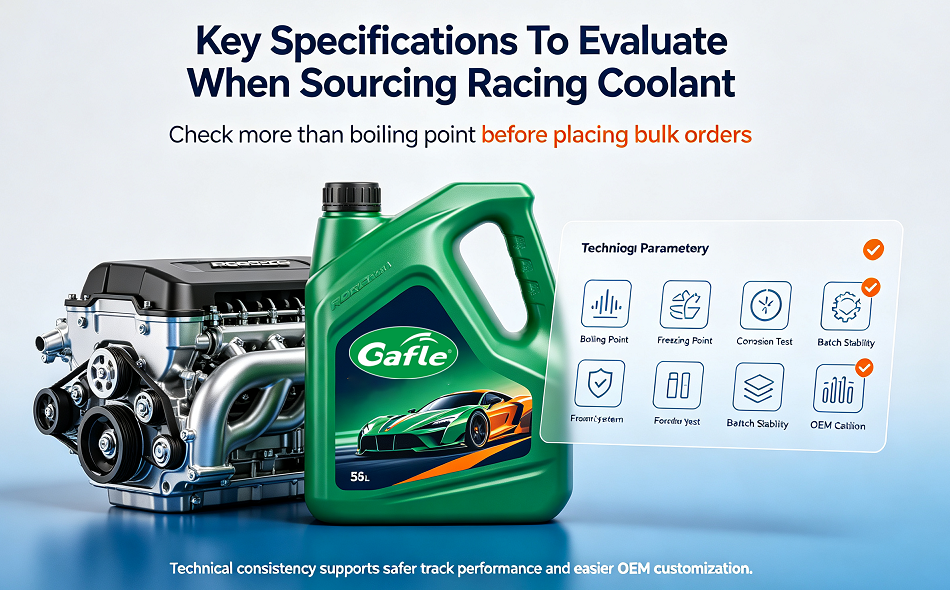
What buyers really mean when they ask for key specifications for sourcing racing coolant
When sourcing racing coolant, the phrase key specifications for sourcing racing coolant usually signals a practical problem: the buyer needs a product that will perform consistently under heat, fit the rules of the application, and arrive in repeatable batches. That sounds straightforward until you start comparing datasheets. One supplier emphasizes thermal performance, another highlights compatibility, and a third focuses on packaging or private-label support. For engineering teams and procurement managers, the real job is to separate marketing language from race coolant technical parameters that can actually influence trackside reliability.
In motorsport and performance applications, coolant is not just a fluid for heat transfer. It sits inside an operating system that includes aluminum heads, mixed-metal radiators, water pumps, seals, hoses, and sometimes long storage periods between events. A coolant that looks acceptable on paper can still cause issues if its additive package is unstable, if its freezing point is too high for winter storage, or if it creates corrosion concerns over repeated use. That is why sourcing decisions should start with the specifications that are measurable, comparable, and repeatable.
The specification set that deserves attention first
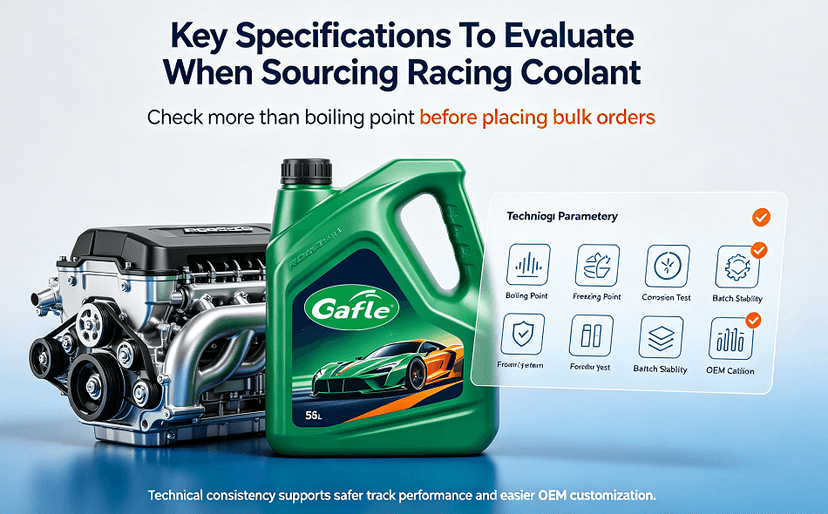
There are many ways to describe a racing coolant, but a few data points matter more than the rest.
Boiling point
For performance use, boiling point is often the first number buyers look for. Higher heat rejection margins matter when engines spend long periods near peak load, especially in endurance racing or hot-weather events. Still, a single boiling point number should not be treated as a guarantee. It depends on concentration, system pressure, and the actual cooling circuit. A supplier should be able to explain the test basis, not just quote a headline figure.
Freezing point
Freezing point is easy to overlook if the race season is warm, but storage and transport conditions can make it relevant. Shops in colder regions, or teams that trailer equipment across climates, need to know whether the fluid protects the system during off-season downtime. The important thing is to confirm the concentration and test method used to establish the freezing point. Without that, comparisons can be misleading.
Corrosion test performance
A corrosion test is one of the most useful indicators of long-term system health. Racing coolant may run hard, but it still has to protect metals, solder points, and mixed materials common in modern cooling systems. Buyers should ask which metals were included in the test and how the result was reported. A vague “anti-corrosion” claim is not enough when the fluid is going into expensive engines and radiators.
Why batch stability matters in bulk sourcing
For distributors, race teams, and private-label buyers, batch stability for bulk order is more than a quality-control phrase. It affects how confidently you can re-order the same product season after season. If the additive balance drifts from batch to batch, the product may still meet a broad description but behave differently in service.
This becomes especially important when a buyer is planning OEM customization or a branded program. A custom label is not the hard part. The harder part is keeping the physical and chemical profile aligned across production runs so the customer receives the same fluid every time. For bulk buyers, that usually means asking for lot traceability, routine incoming checks, and a clear document trail for race coolant technical parameters.
How to compare suppliers without getting lost in datasheets
A useful comparison does not require twenty data points. It requires the right ones, stated clearly.
Start by asking whether the coolant is intended for road, track, or competition-only use. That distinction matters because some fluids are optimized for freeze protection and broad vehicle compatibility, while others are built around track temperatures and system cleanliness. Then compare the boiling point, freezing point, and corrosion test results using the same concentration basis. If one supplier quotes ready-to-use fluid and another quotes concentrate, the numbers are not directly comparable.
It also helps to ask for packaging flexibility. Bulk drums, pails, and private-label formats may all be available, but not every supplier handles them equally well. For sourcing managers, that is often where the real cost sits: not in the fluid itself, but in filling consistency, labeling accuracy, and freight handling.
Common buyer mistakes that cause avoidable problems
The most common mistake is treating racing coolant like a commodity with one universal spec. It is not. A product that works well in a sprint application may not be the right choice for endurance use or for fleets that need storage stability. Another common error is relying on one impressive metric while ignoring the rest. A strong boiling point is useful, but if corrosion protection is weak, the system may pay for it later.
Buyers also sometimes skip the boring questions. What is the base chemistry? Is the coolant meant to be mixed or used as supplied? How is quality verified between batches? These are not glamorous questions, but they determine whether the product is easy to support after the purchase order is signed.
Practical sourcing advice for engineering and procurement teams
If you are narrowing suppliers, ask for a simple, apples-to-apples packet: product description, key specifications, test method references where available, batch traceability approach, packaging options, and any customization support. That package will tell you more than a polished brochure.
For OEM customization projects, make sure the supplier can talk through formulation consistency, label control, and change management. For bulk programs, focus on batch stability for bulk order and how deviations are handled. And if a supplier cannot explain how its corrosion test relates to mixed-metal cooling systems, that is a warning sign, even if the rest of the presentation looks neat.
FAQ: quick answers buyers usually need
Is the highest boiling point always the best choice?
Not necessarily. It has to be considered alongside system pressure, cooling design, and the intended use case.
Why does freezing point matter for racing applications?
Because storage, transport, and off-season conditions can expose the cooling system to low temperatures even if the car is not running.
What should I request first from a supplier?
Ask for race coolant technical parameters, test basis, batch consistency information, and available packaging or customization options.
A sensible next step
If you are sourcing for a team, distributor, or private-label program, start by comparing the small set of specifications that affect real-world performance: boiling point, freezing point, corrosion protection, and repeatability from batch to batch. Those are the numbers that help you make a defendable buying decision instead of a hopeful one. From there, the conversation can move to packaging, labeling, and commercial terms with far less noise.
Welcome to contact GAFLE for more information & cooperation!
peter
ZHEJIANG GAFLE AUTO CHEMICL CO.,LTD
Tel:86-579-8222 1665
Fax:86-579-8246 4690
Cel/Wechart:86-13335993986
E-mail:peter@gafle.net
Web:www.gafle.net