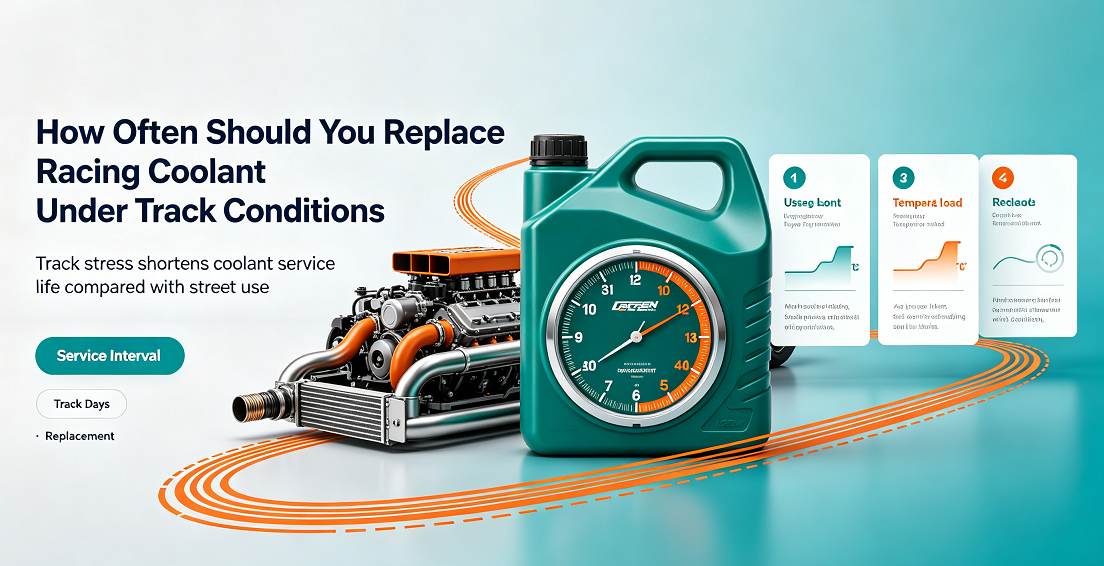
Why the Racing Coolant Service Interval for Track Use Matters
The racing coolant service interval for track use is one of those maintenance questions that sounds simple until a car starts running hot on a long session. For engineers, team managers, and serious weekend racers, the issue is not just whether coolant is “still in it,” but whether it is still doing three jobs well: transferring heat, protecting the system, and staying chemically stable under repeated high-load cycles. On track, those jobs get harder fast.
Street driving is one thing. Track driving is a different thermal environment altogether. High rpm, extended wide-open-throttle operation, high ambient temperatures, heat soak in the paddock, and rapid cooldowns all take a toll on the fluid and the cooling system. That is why race track coolant service cannot be treated like ordinary passenger-car maintenance. The right replacement cycle depends on the car, the coolant chemistry, the amount of track time, and even how often the system is opened for repairs or bleeding.
What Track Use Does to Coolant
Coolant does more than raise boiling point. It also carries corrosion inhibitors, helps protect aluminum and mixed-metal systems, and supports consistent heat transfer. Under racing conditions, those additives can degrade faster than many buyers expect. Repeated heat cycling can shorten service life, and contamination from top-offs or poor water quality can alter performance. If a car uses a water-based racing coolant blend, the service schedule may be very different from a factory street-car fill.
There is also a practical truth that gets ignored: the coolant itself is only part of the system. Hoses, caps, radiator cores, pump seals, and bleed points all affect whether the system can maintain stable pressure and flow. A fresh fill will not rescue a weak cap or a partially blocked radiator. That is why replacement cycle planning should always be paired with a broader inspection.
Quick Reference: How Often to Replace
There is no universal answer to how often to replace racing coolant, but buyers can use a sensible framework:
Heavy track use
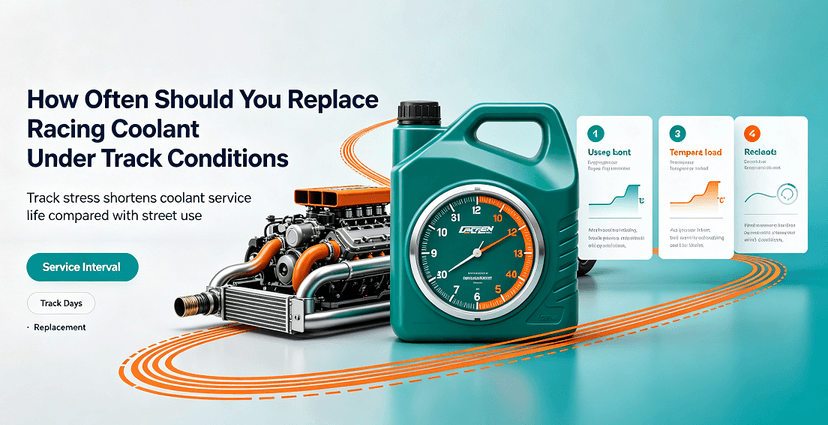
If the car sees frequent track days, sprint racing, endurance-style sessions, or long hot-weather runs, coolant should be checked regularly and replaced more often than a street car. Some teams treat the fluid as a seasonal maintenance item, while others replace it after a set number of events. The exact interval depends on the product and the operating environment.
Occasional track use
For cars that visit the track only a few times per year, the service interval may be longer, but not infinite. Even low-mileage race coolant can age through time, contamination, and exposure to air if the system has been opened. A calendar-based replacement cycle often makes more sense than odometer mileage alone.
After system work
Any time the cooling system is drained, repaired, or mixed with a different product, it is worth reassessing the fill. Mixing coolant chemistries can create compatibility issues, and that is especially risky in a performance engine that already runs near its thermal limits.
What to Look for When Setting a Replacement Cycle
A useful maintenance plan starts with the coolant manufacturer’s guidance, then adjusts for actual use. That may sound obvious, but in the field it is where many teams drift into guesswork. A racer who spends half the season in cool weather will not need the same interval as one running turbocharged laps in August heat.
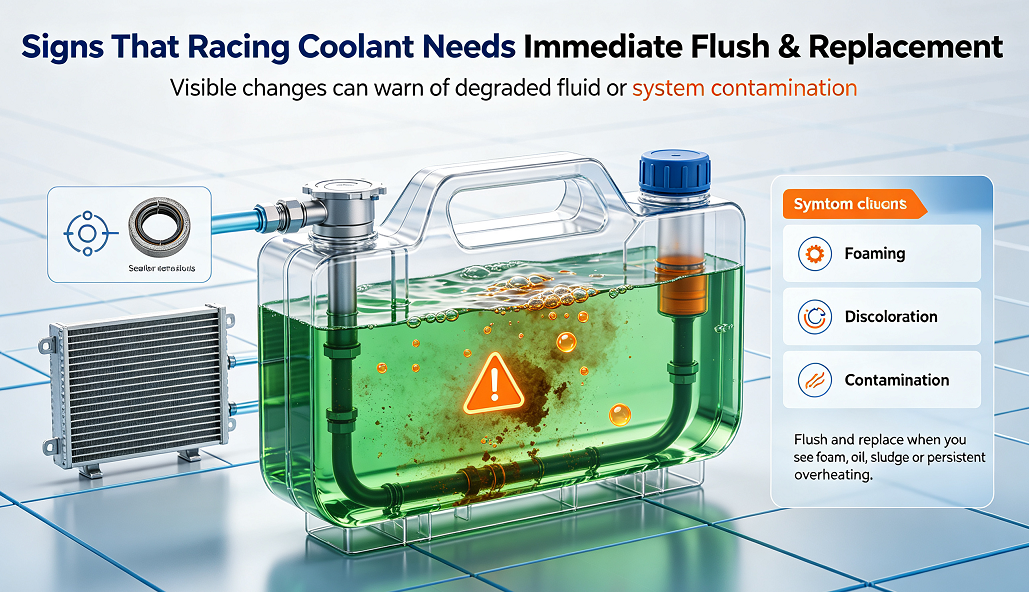
Watch for changes in color, debris, unexpected pH shift if testing is part of your routine, or a visible drop in system performance. Rising operating temperatures over time can be a warning sign, although they may also point to airflow or component issues. Do not assume the fluid alone is guilty; race engines are rarely that cooperative.
Common Mistakes Buyers Make
One common mistake is copying a friend’s service schedule without considering the actual application. Another is treating racing coolant like a “fill it and forget it” consumable. Track cars rarely live that easy life. A third mistake is overlooking water quality when mixing products. In performance cooling systems, the wrong water can leave deposits or reduce inhibitor effectiveness.
There is also a tendency to focus on the fluid and ignore the system’s cleanliness. If the radiator has been contaminated by sealant residue, corrosion, or old debris, a fresh coolant fill may only delay the problem. That matters to sourcing teams and builders who want repeatable thermal performance, not just a clean invoice.
Practical Buyer Advice
If you are selecting or scheduling race track coolant service, start with three questions: How hard does the car run, how often does it see track time, and what does the coolant supplier recommend for that exact product? Then add your own operating history. If temperatures have been drifting upward or the system has needed frequent top-offs, shorten the interval and inspect the hardware.
For engineering teams, it helps to document each fill date, fluid type, dilution ratio if applicable, and any coolant-related repairs. That record turns service from a vague habit into something closer to a maintenance control item. It is not glamorous, but it saves troubleshooting time later.
FAQ
Is racing coolant the same as regular antifreeze?
Not usually. Track-focused products may be formulated differently, and some are designed specifically for motorsport operating conditions rather than everyday street use.
Can I just top off instead of replacing?
Top-offs are fine in a pinch, but they do not reset additive life or remove contamination. If the system needs frequent makeup fluid, that deserves attention.
Should I follow mileage or time?
For track use, time plus event count is often more useful than mileage alone. Heat cycles do the damage, not just distance.
What to Do Next
If you are setting a racing coolant service interval for track use, use the product guidance as the baseline, then tighten the schedule based on heat load and event frequency. Keep the cooling system clean, inspect the hardware, and treat fluid service as part of overall thermal management rather than a standalone chore. That approach gives engineers and buyers a better chance of avoiding the kind of overheating problem that shows up at the worst possible moment: halfway through a session, with no margin left.
Welcome to contact GAFLE for more information & cooperation!
peter
ZHEJIANG GAFLE AUTO CHEMICL CO.,LTD
Tel:86-579-8222 1665
Fax:86-579-8246 4690
Cel/Wechart:86-13335993986
E-mail:peter@gafle.net
Web:www.gafle.net