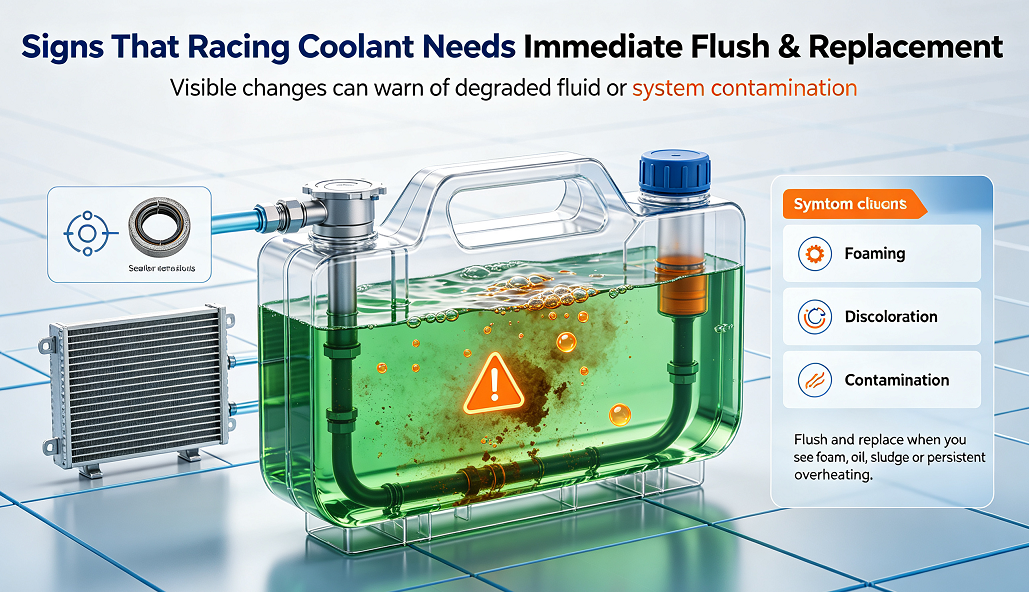
Why racing coolant deserves closer attention than street coolant
When a car is pushed hard on a circuit, the cooling system is not just supporting the engine; it is helping protect lap time, reliability, and in many cases an expensive build. That is why the signs racing coolant needs immediate replacement should be taken seriously rather than treated as routine maintenance trivia. In motorsport, a cooling issue can start as a small change in fluid condition and end as a failed session, a warped component, or a frustrated teardown in the paddock.
Most teams and performance-minded owners already know coolant is not “fit and forget.” Heat cycling, contamination, corrosion products, and contamination from oil or seal residue all change how the fluid behaves. The question is not whether coolant ages; it does. The real decision is when the condition has crossed the line from acceptable to risky.
Quick reference: what usually tells you the coolant is past its best
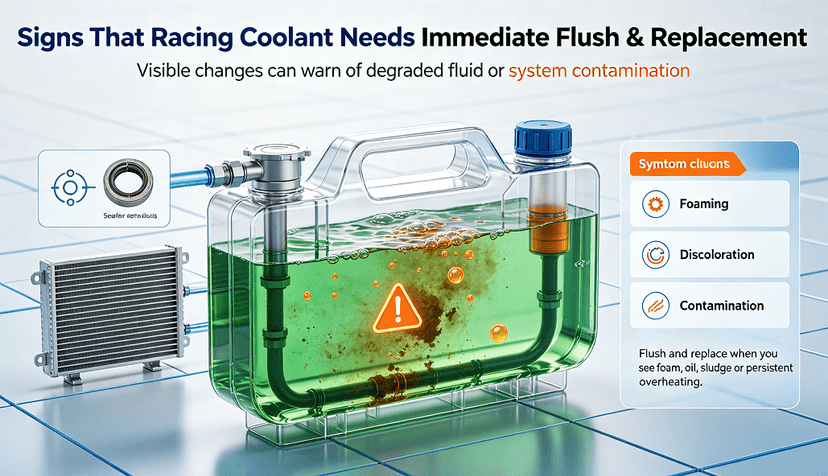
There are a few practical warning signs that stand out. A coolant that has shifted from clear and bright to muddy or rusty, one that smells burnt or oily, or one that leaves deposits in the header tank is asking for inspection. So are unexplained temperature swings, pressure irregularities, and any visible foam after hard running.
These are not cosmetic concerns. They can point to impaired heat transfer, trapped air, chemical breakdown, or contamination that reduces the cooling system’s margin. If you are trying to decide whether to keep running or schedule a racing coolant flush, those cues matter more than mileage alone.
Common contamination and failure symptoms to watch for
Visual changes in the fluid
One of the most useful racing coolant contamination symptoms is a simple visual check. Healthy coolant is typically uniform in appearance, while degraded fluid may show discoloration, suspended particles, or oily film. A brown tint can suggest corrosion or scale. A milky look often raises concern about cross-contamination, though it is worth remembering that not every cloudy sample means a head gasket problem. Sometimes it is just old fluid and residue from a neglected system.
Temperature behavior that does not make sense
Motorsport coolant failure signs often show up on the gauge before they show up on the floor. If the engine takes longer than usual to stabilize, spikes under load, or runs hotter on one section of track than it did previously, the coolant may be losing efficiency. The system might also be carrying air pockets, which can disguise the real source of the problem. That is why a temperature change should be treated as a system-level clue, not a single-part diagnosis.
Deposits, residue, and tank condition
Look inside the expansion tank, radiator neck, and hose interiors. Sludge, crusty residue, or a sticky film can indicate coolant degrade from age, incompatible mixing, or contamination. Once deposits build up, flow can be affected and local hot spots become more likely. In a racing environment, even a partial restriction can matter.
Why coolant degrades faster in motorsport
Track use is harsher than normal road use. Higher sustained rpm, more frequent heat cycles, hotter under-hood packaging, and rapid cooldown between sessions all stress the fluid. Add vibration, curb strikes, and sometimes hurried top-ups from whatever is available in the paddock, and the chemistry can move out of spec sooner than expected.
Another practical issue is mixing products. If different coolants are combined, or if water quality is poor, deposits and corrosion can accelerate. That is one reason a disciplined racing coolant flush is often more valuable than simply topping up the system and hoping for the best.
When immediate replacement is the safer call
If coolant shows contamination, if the engine temperature has become inconsistent, or if the system has evidence of oil, fuel, or corrosion products, replacement should move to the front of the queue. Waiting until the next scheduled service can be a false economy. A cooling system that is already compromised has less tolerance for a long session, a hot day, or a slightly lean tune.
Immediate replacement is also sensible after a major repair, a hose failure, or any event that introduced debris into the circuit. In these cases, the goal is not just fresh fluid; it is restoring a known baseline. That includes checking hoses, caps, tank cleanliness, and bleed quality. A new fill cannot compensate for trapped air or leftover contamination.
Practical buyer advice for teams and owners
For engineers and sourcing managers, the best approach is to treat coolant as a controlled consumable. Keep a record of what was installed, when it was changed, and what symptoms were observed. That record makes it easier to separate normal aging from a real fault trend. It also helps when comparing different products or service intervals across cars.
For drivers and builders, the caution is simple: do not assume every overheating event is caused by the radiator or the pump. Coolant condition can be the hidden variable. If the fluid is discolored, smells wrong, or has visible residue, replacing it early is usually cheaper than chasing repeat failures.
A short diagnostic habit that pays off
A quick inspection before and after track use goes a long way. Check level, appearance, odor, and any sign of residue. Note how quickly the engine reaches and holds temperature. If something changes, do not wait for a second bad session before investigating. That is usually how minor cooling issues become major ones.
If you are comparing service options, a proper racing coolant flush should be part of the conversation, not an afterthought. The right decision is the one that restores reliability without introducing new contamination or leaving old deposits behind.
What to do next
If your cooling system is showing any of the warning signs above, replace the coolant, inspect the circuit carefully, and confirm the system is fully bled before the next run. In motorsport, a small preventive step often saves a very expensive afternoon.
Welcome to contact GAFLE for more information & cooperation!
peter
ZHEJIANG GAFLE AUTO CHEMICL CO.,LTD
Tel:86-579-8222 1665
Fax:86-579-8246 4690
Cel/Wechart:86-13335993986
E-mail:peter@gafle.net
Web:www.gafle.net