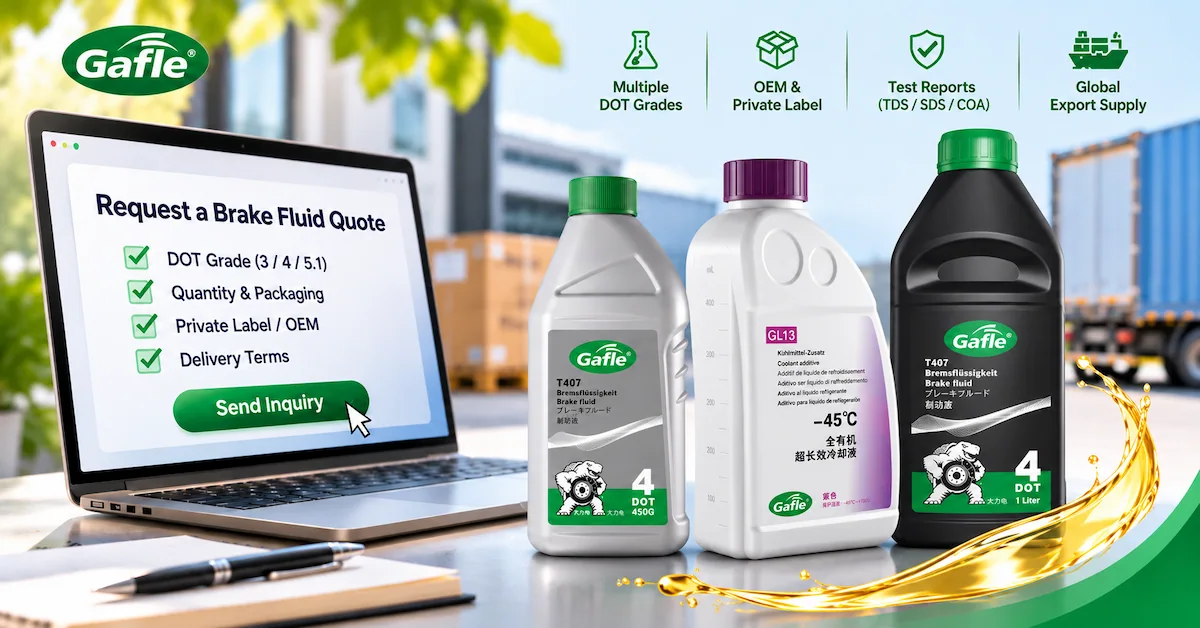
Quick Answer: To request brake fluid quote information that a manufacturer can actually price, identify your destination market, required fluid grade, application, test documents, packaging format, branding, quantity by SKU, delivery basis and target schedule. Ask the supplier to distinguish an indicative estimate from a final offer tied to an approved formula and bottle configuration. For GAFLE, start with the brake fluid product collection and send a structured inquiry through its contact page.
An importer can ask five manufacturers for a DOT 4 price and receive five numbers that do not describe the same purchase. One offer may refer to a standard-label bottle collected at the factory; another may include private-label printing, tamper-evident packaging, testing documents and freight to a port. Neither number is useful until the formula, unit of sale and commercial basis are aligned.
This guide is built for automotive-fluid importers, parts wholesalers, maintenance-chain buyers and private-label brand owners who are ready to contact a supplier. It is deliberately different from a general explanation of brake-fluid grades or a broad wholesale distribution strategy: the focus is what to send, what to ask back and how to approve a quotation without preventable technical or cost errors.
GAFLE · BRAKE FLUID QUOTATION
Start with your exact product and order requirements
Explore GAFLE Brake Fluid Products →Request Your Brake Fluid Quotation →1. Who Should Request a Manufacturer Quotation—and Who Needs a Different Answer?
A direct manufacturer RFQ is useful when you have a definable business project: a wholesale container order, a workshop-chain supply program, an importer launch, an established distributor's reorder or a private-label range. You do not need every design detail finalized, but you should be able to describe your market, intended product, likely purchase quantity and what remains undecided.
If you are a vehicle owner trying to top up one reservoir, a wholesale quotation is usually the wrong starting point. Check the vehicle manufacturer's instructions and buy the specified compatible fluid through a suitable retail or service channel. Brake fluid is safety-critical; a supplier quotation is not vehicle-fitment approval.
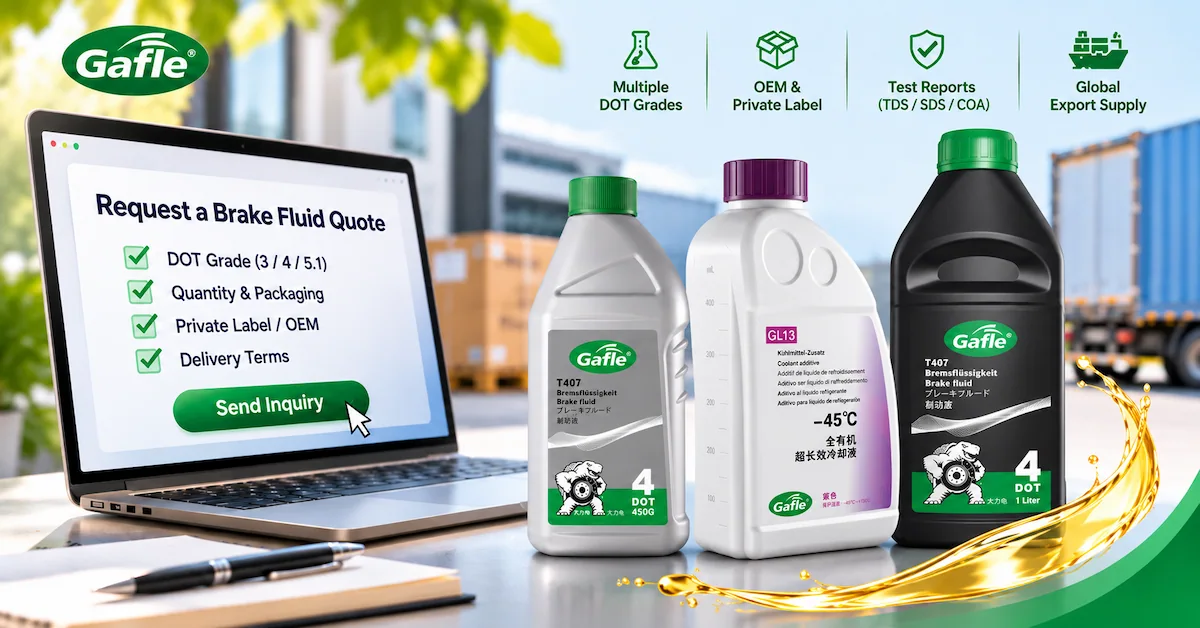
For serious B2B inquiries, assign both a commercial contact and, where available, a technical reviewer. Procurement may negotiate price, but quality or engineering should approve the specification and supporting evidence. This simple division prevents buyers from approving attractive artwork or cheap cartons before the underlying fluid has been qualified.
2. The 10 Fields Every Brake Fluid RFQ Should Include
A manufacturer can respond more efficiently when all essential decisions appear in one email or spreadsheet. Use the following as a one-page checklist; mark unknown items “to be confirmed” rather than inventing a target.
| RFQ field | What the buyer should provide | What to request from the manufacturer |
|---|---|---|
| 1. Destination market | Import country, distribution channel and intended users | Applicable market information and document availability |
| 2. Fluid grade | DOT 3, DOT 4, DOT 5.1 or exact other requirement | Identifiable product code and formula-specific grade evidence |
| 3. Vehicle/system scope | Passenger car, commercial vehicle, motorcycle or other hydraulic system; OEM instruction where known | Compatibility questions, exclusions and required verification |
| 4. Technical standard | Applicable FMVSS, SAE, ISO or local requirement, including the relevant edition | TDS and test evidence for the quoted formulation |
| 5. Packaging | Target fill volume, bottle/can, cap, seal, carton and pallet preference | Available standard packs, custom options and packaging specifications |
| 6. Branding | GAFLE brand or private label; languages, artwork and barcode needs | Label workflow, proofing stages, setup conditions |
| 7. Quantity mix | Trial units and first-order quantity by grade and pack, plus annual forecast | MOQ for each formula/package/artwork variation |
| 8. Quality file | Required SDS, TDS, test report, example COA and traceability | Document list, issuance responsibility and batch-release scope |
| 9. Delivery | Destination, preferred Incoterm and requested dispatch/arrival window | Price basis, schedule assumptions and freight exclusions |
| 10. Commercial details | Currency, payment preference, quote deadline and decision contact | Offer validity, payment proposal and itemized quotation |
An incomplete RFQ is not automatically a bad inquiry. It becomes risky when an assumption is hidden. For example, “DOT 4, 10,000 bottles” is not a purchase specification if the bottle volume, target country and label version are unspecified.
3. Choose the Product Before Comparing the Price
The first qualification gate is chemical and technical suitability. A quotation for DOT 3 is not interchangeable with one for DOT 4 or DOT 5.1 simply because all are called brake fluid. The correct fluid depends on the manufacturer's instructions for the vehicle and its hydraulic system. In particular, silicone-based DOT 5 must not be confused with non-silicone DOT 5.1; mineral-oil hydraulic systems are a separate category.
For context, FMVSS No. 116 identifies minimum equilibrium reflux boiling point (dry ERBP) and wet ERBP requirements. Selected thresholds include 205°C dry/140°C wet for DOT 3 and 230°C dry/155°C wet for DOT 4. These are standard limits, not GAFLE's measured values or proof of approval for an individual vehicle. Compare supplier measurements and declared conformance only after the relevant application requirements have been confirmed.
| Product family | Appropriate first sourcing question | Example GAFLE starting page |
|---|---|---|
| DOT 3 | Which documented customer applications require or permit DOT 3? | DOT 3 category |
| DOT 4 | What are the actual test results and specified market applications? | DOT407 product |
| DOT 5.1 / specialty | Is there a documented demand and exact specification? | Brake fluid collection |
| Private-label selection | Can a validated existing formula meet the brief before custom development? | GAFLE private-label guide |
GAFLE publishes brake-fluid products and categories, including DOT 3, DOT 4 and DOT 5.1 directions. A catalogue listing is a useful point of contact, but it does not establish that any listed SKU is approved for all vehicles or already carries the documents required in your destination market. Request the latest specification for the exact product quoted.
4. Why Bottle Size and Private-Label Artwork Change Your Quote
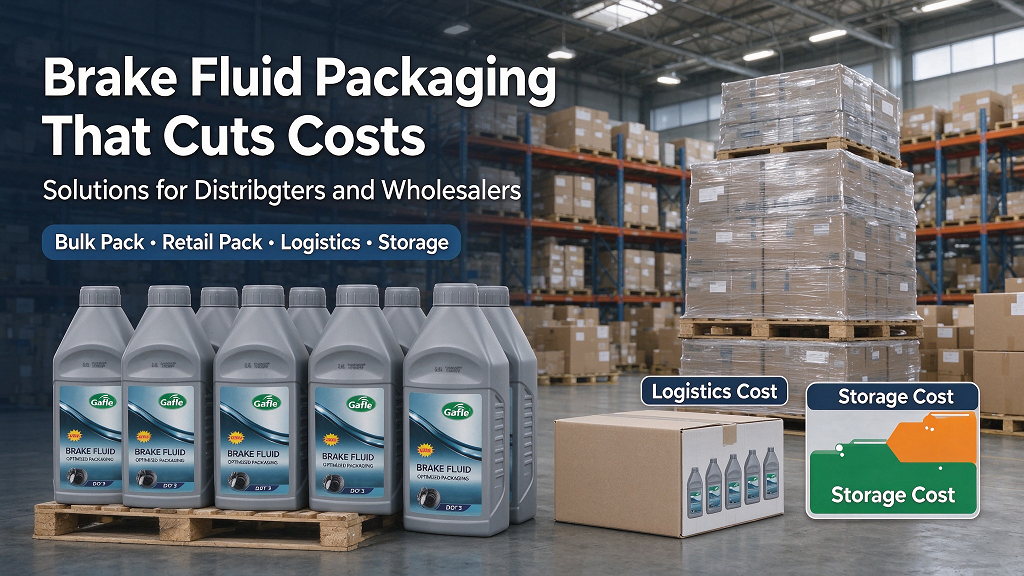
A manufacturer is not pricing fluid alone. A finished order may include bottle procurement, cap and liner, filling, leak-control checks, tamper-evident features, printed labels, cartons, palletization and documentation. Every customized element may affect the feasible minimum run and unit cost.
Compare three clearly separated packaging cases: standard GAFLE branding, existing formulation with a buyer's private label, and new formula or nonstandard package development. The last case may require a different review process, additional validation and a different commercial timeline. Do not assume a fixed MOQ or guaranteed delivery time from general promotional claims.
For U.S.-regulated applications, FMVSS No. 116 includes requirements for certain container seals, tamper-evident closures and labeling. Other destination markets can impose different requirements. Ask who reviews label wording, language versions and safety statements before mass printing.
A useful private-label inquiry specifies the number of unique artworks as carefully as the number of bottles. Ten thousand units in one standard format may be commercially very different from ten thousand units split between four sizes, two formulas and three languages. If artwork has not been prepared, ask whether a trial can use a standard pack while a custom brand is developed.
GAFLE · BRAKE FLUID QUOTATION
Start with your exact product and order requirements
Discuss OEM / Private Label Packaging →5. Request Documents That Make the Price Meaningful
A quotation cannot substitute for a technical review. The supplier should identify which documents it can supply for the exact grade, formula and destination market. A generic brochure may describe the company well but will not necessarily support an application or compliance claim.
| Document | Role in buyer approval | Check before accepting it |
|---|---|---|
| Technical Data Sheet (TDS) | Formula-specific performance profile | Product code, revision, units, test methods and claims |
| Safety Data Sheet (SDS) | Safety and handling information | Correct material and relevant language/market version |
| Test report / conformity evidence | Substantiates specified performance claims | Sample identity, method, results, report date and scope |
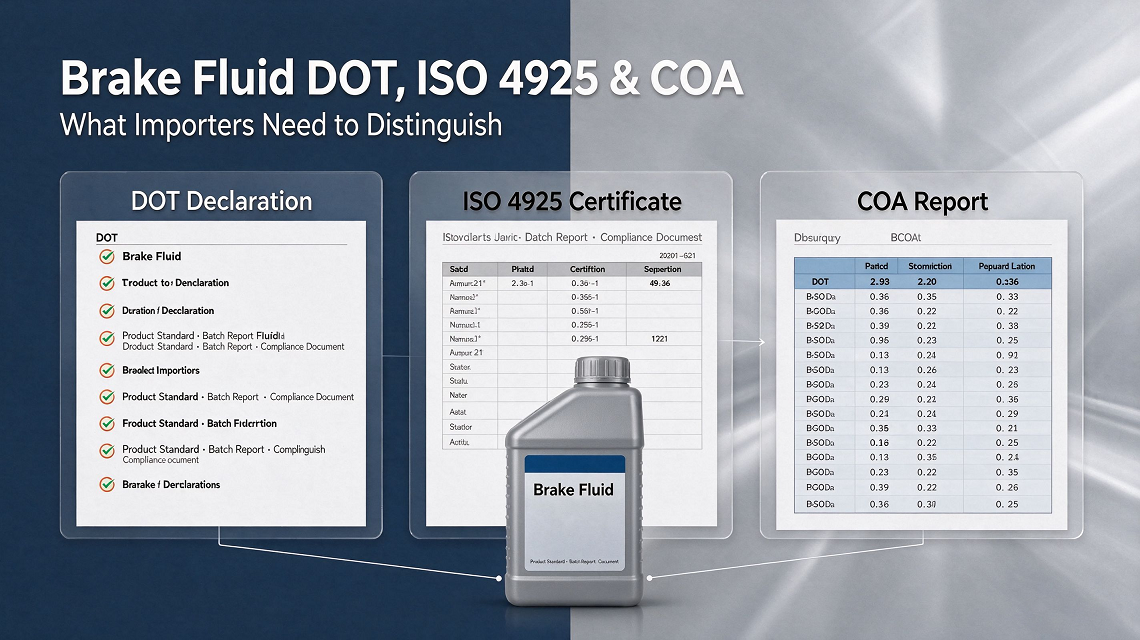
| Certificate of Analysis (COA) | Records suitable quality results for a defined lot | Lot number, release criteria and traceability |
| Packaging sample or drawing | Confirms finished-goods configuration | Bottle, seal, cap, artwork, pack and barcode |
| Quality-system certificate | Describes certified organizational scope | Legal entity, site, scope and validity |
The document request should distinguish typical properties, guaranteed specification limits and results from an actual batch. They are not interchangeable. If a laboratory report belongs to an older formulation revision, ask whether it supports the proposed commercial batch. Similarly, a quality-management certificate does not automatically mean an individual brake-fluid product has vehicle-maker approval.
For a first order, decide which checks must pass before a binding purchase order and which batch records should accompany shipment. This reduces the chance of a later dispute about what the quotation actually promised.
6. How to Compare Two Brake Fluid Quotes Fairly
Once technical suitability is established, normalize the commercial terms. An EXW quotation and a CIF quotation cannot be compared by bottle price alone. Neither can a quote for a plain generic bottle be treated as equivalent to one that includes customized seals, labels, cartons and testing.
| Quote comparison item | Supplier A | Supplier B | Your acceptance rule |
|---|---|---|---|
| Formula / grade | Enter product code | Enter product code | Same approved requirement |
| Pack size and closure | Enter configuration | Enter configuration | Same fill and seal specification |
| Branding and languages | Enter included work | Enter included work | Same approved artwork scope |
| Quantity and MOQ | Enter per SKU | Enter per SKU | Order mix can actually be produced |
| Quality documents | List included evidence | List included evidence | Meets your technical gate |
| Incoterm and destination | Named place and term | Named place and term | Compare on normalized landed basis |
| Lead time and validity | Dates and conditions | Dates and conditions | Fits launch or reorder plan |
| Payment / exclusions | Charges and milestones | Charges and milestones | No hidden mandatory additions |
Illustrative cost logic: total landed cost per saleable bottle includes the quoted product and packaging cost, allocated freight and insurance, import charges, clearance and local logistics, plus any agreed inspection and setup expenses. Divide by accepted saleable units, not necessarily the number originally ordered. This is a cost framework, not a promised market price or margin.
Before treating a quotation as firm, confirm whether freight, raw-material conditions, currency and artwork approval can change the offer. Record the quotation's expiry date and the steps needed to convert it into a confirmed order.
7. A Six-Step Process From First Message to Approved Quotation
Step 1 — Send a brief RFQ. Provide the ten fields above and mark genuinely unknown information. Attach a specification or vehicle-maker requirement where relevant.
Step 2 — Receive a product shortlist. Ask GAFLE to identify an existing product code or clarify whether technical development is required. Do not accept an unsupported universal-fit claim.
Step 3 — Review the quality file. Have the technical reviewer compare the proposed TDS and available test evidence against the destination market and intended use.
Step 4 — Confirm the finished package. Align fill volume, tamper-evident seal, language, label proof, carton and available branding options.
Step 5 — Normalize the commercial offer. Request an itemized SKU-level price, MOQ, Incoterm with named place, schedule assumptions, quote validity and payment terms.
Step 6 — Approve samples before scaling. Confirm technical and packaging samples, agreed acceptance criteria and the change-control process. The first mass-production order should refer to those approved specifications.
This procedure does not guarantee a particular quote turnaround or production lead time. It helps both teams identify open decisions so the supplier can respond with a more useful proposal.
8. Copy-and-Send RFQ: Request a Brake Fluid Quote From GAFLE
Subject: Brake Fluid Quotation Request — [Country] — [DOT Grade] — [Quantity]
Dear GAFLE Sales Team,
We are a [distributor/importer/private-label brand/workshop group] serving [country or region]. We would like a quotation for brake fluid meeting the following project requirements:
- Product / grade: [DOT 3, DOT 4, DOT 5.1 or specified standard]; exact vehicle/system requirement: [details].
- Destination and market: [country, channels, required label languages].
- Technical evidence: Please confirm available TDS, SDS, relevant standard test reports and a sample COA.
- Packaging: [fill volume, bottle/can material, cap, seal, carton and pallet requirement].
- Brand: [GAFLE brand / our private label]; artwork status: [ready / needs development].
- First order by SKU: [SKU A quantity], [SKU B quantity]; annual forecast: [estimated volume].
- Delivery: [preferred Incoterm and named destination]; requested timeframe: [date or flexible].
- Commercial details: Please quote currency, unit price by SKU, MOQ by formula and artwork, setup charges, offer validity, payment terms and sample availability.
If any of the requested items is not available, please identify the closest existing formulation and the additional technical review required. We would appreciate an itemized proposal and the appropriate contact for our quality team.
Kind regards,
[Your name / company / email / phone]
GAFLE · BRAKE FLUID QUOTATION
Start with your exact product and order requirements
Send Your RFQ to GAFLE →This template is intended to be customized, not sent with empty brackets. If the specification is uncertain, state your target application and ask for a technical review before requesting final pricing.
9. Mistakes That Slow Down Quotation Approval
The most common obstacle is missing scope, not necessarily slow supplier communication. A quote request that only says “best price DOT 4” leaves critical decisions unanswered. Other avoidable problems include asking one price for multiple packaging versions; confusing a standard minimum performance value with a product's actual test result; requesting a private-label price without specifying the number of language and artwork variations; and comparing shipments under different Incoterms.
Another mistake is treating a sample quotation as an unconditional supply commitment. Pricing may depend on a finalized label, approved packaging component, fixed product specification and a valid shipment window. Ask the supplier to identify these conditions rather than relying on an assumed MOQ, price or lead time.
Finally, never make the entire negotiation a race to the lowest bottle price. For brake fluid, wrong-fluid selection, unsupported compliance statements or poor sealing can create consequences far beyond the apparent purchase-price saving. Pass technical and regulatory checks first; compare commercial terms second.
10. Frequently Asked Questions
1. How do I request brake fluid quote information from GAFLE?
Use the GAFLE contact page. Send your destination, required grade, expected order quantity, packaging choice, branding plan and requested delivery basis. Include technical evidence requirements so the team can identify an appropriate product and quote scope.
2. Can I get a quote before knowing the exact DOT grade?
You can request an initial technical discussion or indicative proposal, but a final product quotation should identify the exact approved grade and intended application. Follow the vehicle or system manufacturer's requirements.
3. What is the minimum order quantity for brake fluid?
No universal MOQ is confirmed for every GAFLE formula and package. Request MOQ separately for each formula, fill volume and artwork version. Trial or standard packaging possibilities are subject to quotation.
4. Does GAFLE offer private-label brake fluid?
GAFLE publicly describes OEM and private-label brake-fluid services. The exact product, packaging options, artwork process, testing and commercial feasibility must be confirmed for the individual project.
5. Can I order DOT 3 and DOT 4 together?
Ask for a mixed-SKU quotation specifying the quantity, pack and label version for each grade. Whether they can be combined into one order or shipment depends on production and commercial arrangements, not merely the total bottle count.
6. What documents should accompany a brake fluid quote?
Depending on the destination and purchase agreement, ask for the current product TDS, SDS, relevant test/conformity evidence, a sample batch COA and documentation for the packaging and quality system. Confirm what will actually accompany the shipment.
7. Why might two DOT 4 quotations differ significantly?
The offers could involve different tested formulations, bottle sizes, closure systems, artwork, MOQ, documents, Incoterms or freight scope. Make the products and commercial terms comparable before drawing conclusions about price.
8. How should I ask for a price in my own currency?
Specify the requested currency, named Incoterm, destination, payment preferences and quotation validity. Confirm any exchange-rate assumptions and whether the offer can change before order confirmation.
9. Can the supplier guarantee compatibility with every vehicle?
A responsible supplier should confirm the relevant technical standard and support specific claims with evidence. No general DOT grade automatically establishes universal vehicle compatibility. Manufacturer instructions take precedence.
10. What happens after I accept the quotation?
The next steps should be agreed in writing: approved formula and packaging, sample/first-article sign-off, purchase order, quality release, export documentation, dispatch and any change-control requirements for future orders. Actual terms depend on the contract.
Conclusion
To request brake fluid quote information that supports a real purchasing decision, send a complete but concise RFQ covering grade, market, application, technical evidence, packaging, branding, quantity, delivery and commercial terms. Separate unknown technical questions from confirmed requirements, and compare offers only after both suppliers are pricing the same approved configuration. This approach reduces unnecessary revisions and makes sample approval, production and repeat orders easier to control.
FORK's brake fluid range, DOT407 product page and private-label information provide starting points for a tailored inquiry. When your buying brief is ready, contact GAFLE to request a documented brake fluid quotation, including the specifications and order details your technical and procurement teams need to approve.