A purchasing email may contain only five words: “Need purple DOT 5 fluid.” That is not enough for a quotation. Silicone DOT5 Brake Fluid has its own chemistry and its own use case; the decimal in DOT 5.1 does not describe the same liquid. Before discussing price, confirm that the vehicle paperwork actually names DOT 5 silicone base fluid. A conversion needs equally clear engineering approval covering the parts touched by the fluid and the workshop procedure.
Consider what “purple fluid” leaves unanswered. Is the machine a preserved military vehicle, an older motorcycle, a show car, or a special hydraulic installation? Which year and brake option? What is in the circuit now? The reservoir wording, current manual, service history, replaced seals and hoses, destination market, pack size, and expected volume belong beside the request. Color helps catch a mix-up; it never approves an application.
The pages below follow the same route a cautious importer, restorer, private-label team, or fleet engineer would use at the buying desk. First identify the circuit. Then read the governing document, examine the test file, and qualify the package and supply route. ABS, racing, bulk delivery, and OEM artwork enter later, once the fluid identity is no longer a guess.
Commercial boundary: Catalogue check, September 19, 2026: GAFLE publicly listed DOT 3, DOT 4, DOT 5.1, OEM, modified/racing, and energy-vehicle ranges; a dedicated silicone DOT 5 SKU was absent. Read that boundary literally. This article is not proof of stock, manufacture, qualification, certification, or approval for any vehicle. Its photographs show general GAFLE facilities and processes. The sensible first contact is therefore a feasibility and current-availability check.
The sixty-second Silicone DOT5 Brake Fluid buying answer
Buy from the system instruction. The phrase to find is “DOT 5 silicone base.” Check the current manual, reservoir cap, drawing, or approved-fluid list. See DOT 3, DOT 4, DOT 5.1, petroleum fluid, or a proprietary mineral oil instead? Route the enquiry elsewhere. Similar bottle names cannot bridge that difference.
Once system permission is established, compare the offered formula against the applicable market rule and any OEM or military requirement. Confirm dry and wet ERBP, viscosity, corrosion, stability, cup and stroking performance, color, label text, package sealing, batch identity, and change control. A high number on a technical data sheet is not a substitute for the complete conformity package.
| Decision gate | Evidence to obtain | Proceed when | Stop when |
|---|---|---|---|
| System identity | Make, model, year, brake configuration, reservoir marking, current manual | The controlled instruction names DOT 5 silicone base fluid | The request says only “classic car,” “military vehicle,” or “purple fluid” |
| Chemistry history | Last fluid used, conversion records, component replacements, contamination findings | The circuit identity and condition are known | Unknown fluid remains in a system proposed for topping up |
| Product evidence | Specification, dated laboratory report, sample COA, label, SDS, lot traceability | Product identity and claimed conformity are demonstrable | Only a marketing sheet or one boiling-point value is supplied |
| Application approval | OEM instruction or documented engineering approval for the exact system | The evidence applies to the model and configuration being serviced | Suitability is inferred from another vehicle, year, or component family |
| Supply control | Approved formula code, release tests, package, label market, change notice | The commercial lot can be tied to the approved candidate | Sample, TDS, quotation, and shipment use different identities |
The practical rule is short: no document, no substitution; no lot evidence, no release. That sounds strict until the alternative is considered. One mistaken top-up can create an uncertain mixture throughout a safety-critical circuit, after which a complete inspection and maker-directed recovery may cost far more than the fluid.
The U.S. rule: what “silicone base” identifies
Two entries in 49 CFR 571.116, FMVSS No. 116 settle the name: at least 70% by weight diorgano polysiloxane for a silicone-base brake fluid; “non-silicone base” for DOT 5.1. Compare performance only after making that split.
FMVSS No. 116 is a performance and packaging rule, not a vehicle application catalogue. It establishes minimum tests and the information that a manufacturer and packager must provide. A conforming product still needs to be correct for the vehicle. The regulation itself reinforces that point by requiring the container warning to follow the vehicle manufacturer's recommendations when adding fluid.
For the U.S. artwork checklist, note: purple liquid; “DOT 5 SILICONE BASE” grade wording; and, from 177 mL upward, a resealable closure with an impervious inner seal plus tamper evidence. Leave room for the conformity statement, packager and distributor details, lot and packaging date, grade, minimum wet boiling point in Fahrenheit, and required warnings. Missing one item turns a finished-looking label back into a draft.
Those details matter in an OEM or private-label program. Artwork cannot be completed from a generic bottle mockup. Destination, pack size, responsible companies, claim language, batch-coding space, wet-boiling-point statement, warnings, label permanence, and seal construction all belong in the technical file before printing begins.
Searches and early enquiries often use Silicone-Based DOT5 Brake Fluid. Keep that phrase for discovery; use the destination market's exact grade language on the controlled specification and label.
DOT 5.1: a decimal, but a different chemistry
This is not software numbering: 5.1 did not replace 5. Commercial DOT 5.1 products are normally glycol-ether fluids in the non-silicone group, whereas DOT 5 here is silicone based. Read the complete grade name. Ranking the numbers, or mixing both fluids because each starts with five, defeats the warning built into that name.
There is a useful workshop check in Continental's official ATE announcement. It describes Super DOT 5.1 as glycol ether based, warns against mixing it with silicone DOT 5, and sends the technician back to the OEM recommendation. That is the right response when a comparison chart makes unlike fluids look close.
| Category | Chemistry identity | U.S. color requirement | Selection principle | Do not infer |
|---|---|---|---|---|
| DOT 3 | Non-silicone DOT brake fluid | Colorless to amber | Use where the vehicle permits DOT 3 | Permission to add DOT 5 silicone |
| DOT 4 | Non-silicone DOT brake fluid | Colorless to amber | Use to the vehicle and fluid specification | Compatibility with silicone because both are DOT grades |
| DOT 5 silicone base | At least 70% by weight diorgano polysiloxane under FMVSS 116 | Purple | Use only in a system specifying or formally approving it | Universal classic-car, motorcycle, military, ABS, or racing suitability |
| DOT 5.1 non-silicone base | Glycol-ether-based high-performance DOT category in typical commercial use | Colorless to amber | Often specified where low-temperature hydraulic response matters; follow OEM instruction | Any silicone content from the number 5 |
| Hydraulic system mineral oil | Separate mineral-oil category | Green | Only for a circuit built and specified for that fluid | That mineral oil and silicone DOT 5 are interchangeable |
A color check can catch an obvious container error, but it cannot release a product. Dye can be absent, faded, contaminated, or viewed under poor lighting. More importantly, a purple sample does not establish conformity, and a purple reservoir does not reveal whether the circuit was previously filled correctly. Always connect product code, sealed container, batch record, test evidence, and system instruction.
Where valid DOT 5 applications actually appear
Keep two Harley-Davidson records together. The official 2005 Harley-Davidson VRSCSE procedure points to DOT 5 silicone hydraulic brake fluid, part 99902-77. Another company document publishes instructions covering motorcycles that use either DOT 4 or DOT 5, sending the mechanic to the model's manual and master-cylinder cover. Together they support a narrow conclusion: model evidence, yes; a brand-wide shortcut, no.
Military buying has its own paper trail. DLA's QPL record for MIL-PRF-46176 uses the identifiers BFS and NATO H-547 for silicone automotive all-weather brake fluid. MIL-PRF-46176B covers hydraulic braking across an ambient range of +55°C to -55°C. Even so, the platform manual and contract decide whether that route applies; a military paint scheme certainly does not.
Classic and show-car demand exists, yet vehicle age is not an approval. Wilwood's official DOT 5 product notice describes classic and show-car positioning, then narrows use to custom vehicles and vehicles that are OE-specified for DOT 5. It also says Wilwood does not recommend DOT 5 for racing. That is more useful than the familiar slogan that silicone fluid is “best for classics,” because it keeps the decision attached to hardware and intended duty.
The phrase Silicone DOT5 Brake Fluid for Automotive Applications should therefore introduce an application review, not a claim of fleet-wide fit.
| Requested application | Evidence seen in official or manufacturer material | What must still be verified | Safe purchasing position |
|---|---|---|---|
| Older motorcycle | Some model-specific Harley-Davidson instructions name DOT 5 silicone | Model, year, market, brake or clutch circuit, reservoir marking, latest service data | Approve by exact model documentation, never by brand alone |
| Military ground vehicle | MIL-PRF-46176 defines a silicone BFS procurement route | Platform technical manual, current fluid code, revision, qualified-product requirement | Supply to the contract and platform specification |
| Restored classic or show car | Component suppliers market DOT 5 for selected OE-specified or engineered systems | Original requirement, rebuilt-component materials, previous fluid, conversion history | Treat conversion as engineering work, not preventive maintenance |
| Modern ABS or stability-controlled vehicle | Many current service documents specify DOT 4 or DOT 5.1-type non-silicone fluids | Exact OEM grade, viscosity class, hydraulic-control-unit procedure, scan-tool bleeding needs | Do not propose silicone DOT 5 without explicit system approval |
| Race or track car | Wilwood specifically does not recommend its DOT 5 fluid for racing | Brake supplier, series rules, thermal duty, pedal-feel and bleeding requirements | Use the competition system's named fluid, not a silicone assumption |
| Trailer brake system | Tie Down Engineering's manufacturer bulletin forbids DOT 5 in its own actuators, brakes, and solenoids | Actuator and brake manufacturer requirements for the exact installation | Do not generalize from another trailer system |
Before requesting supply, record the exact model or equipment serial range, production year, market, brake option, ABS status, reservoir wording, controlling document revision, current fluid, modification history, and every replaced wetted component. Photographs support that file but do not control it. If the existing chemistry is unknown, do not top up; obtain the maker-approved inspection and recovery procedure.
A conversion is a brake-system project, not a drain-and-fill shortcut
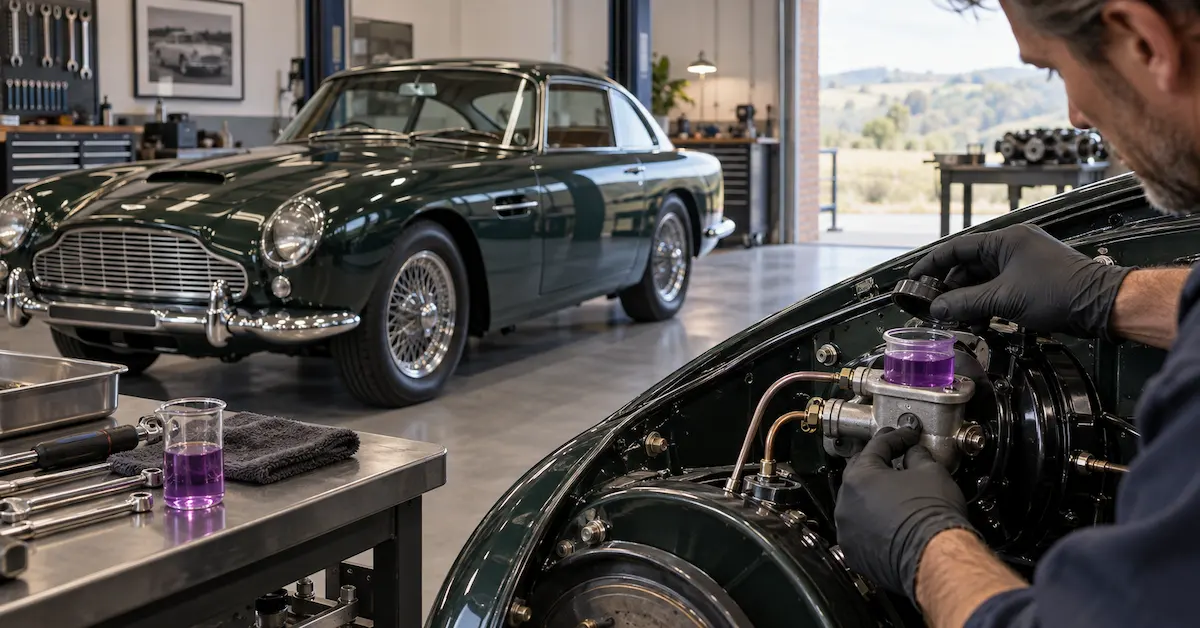
Many requests described as purchases are really conversion proposals. Long storage and prized paintwork explain the interest; they say nothing about behavior inside the hydraulics. Glycol-to-silicone work changes chemistry rather than merely renewing fluid. The system owner needs component evidence, an approved scope, and a record of who accepted the change.
Residual glycol fluid cannot be wished away. It can remain in wheel cylinders, calipers, low points, hoses, proportioning valves, pressure switches, pumps, modulators, and master-cylinder cavities. A simple reservoir suction followed by a refill does not establish a clean silicone system. Neither does repeated bleeding without an approved endpoint. The conversion plan may require complete disassembly, component replacement, cleaning with specified materials, drying, inspection, controlled filling, careful bleeding, leak testing, low-speed functional checks, and a later reinspection. Only the responsible technical authority can set that scope.
Elastomer compatibility deserves its own sign-off. FMVSS No. 116 includes defined cup and stroking tests, but a finished vehicle may contain materials and geometries beyond the referee components in the federal procedure. The current federal text addresses several elastomer families while its specified tests use the common SBR cups. Therefore, regulatory conformity is essential evidence, not proof for every seal in every modified system.
Workshop segregation must be planned too.Use clearly identified fluid dispensers, bleed hoses, adapters, catch bottles, and pressure or vacuum equipment. A tool that recently handled DOT 3 or DOT 4 can defeat an otherwise careful conversion. Record who performed the work, product and lot used, parts changed, procedure followed, test results, and a permanent notice for future technicians. Without that record, the next owner may unknowingly add the wrong chemistry.
ABS suitability is system-specific, not a one-line internet rule
Internet answers tend to swing between “all ABS” and “no ABS.” Both skip the machine in front of the technician. The control unit has its own valves, passages, seals, cold-response needs, air behavior, and bleeding sequence. Ask a narrower question: does the documentation for this exact circuit name or approve DOT 5 silicone fluid?
Current evidence gives buyers a conservative route. The U.S. Department of Defense's active MIL-PRF-32701 covers a polyglycol fluid primarily intended for fully hydraulic anti-lock braking systems and states that it is incompatible with the silicone fluid specified by MIL-PRF-46176. Modern Harley-Davidson ABS service information identifies DOT 4 and requires its diagnostic bleeding process when the circuit has been opened. Those are defined examples, not a new universal prohibition, but they show why the default for an undocumented modern ABS request should be “verify before quotation.”
Low-temperature viscosity is part of the picture, not the whole picture. The current federal DOT 5 grade table sets a maximum of 900 mm²/s at -40°C. A fluid meeting that limit may still lack approval for a particular modulator. Valve response, air handling, control logic, bleeding, and the OEM's own validation remain decisive.
| ABS question | Useful evidence | Weak shortcut | Procurement action |
|---|---|---|---|
| Which fluid does the exact vehicle specify? | Current owner/service manual, reservoir cap, technical bulletin | A forum list covering a model family | Quote only the specified chemistry and grade |
| Can the hydraulic control unit be bled conventionally? | OEM procedure and required scan or diagnostic tool | Clear fluid at the wheel bleeder | Include service capability in application approval |
| Does the candidate meet the required cold response? | Named viscosity method, temperature, limit, lot result, system validation | “Low viscosity” on the front label | Compare like-for-like data and OEM requirement |
| Is DOT 5 approved for this modulator and seal set? | Written OEM or system-owner approval and representative validation | Another ABS vehicle reportedly used it | Stop without exact-system evidence |
Build the compliance file around the right standard
When “FMVSS 116” appears on a quotation, write four notes in the margin: scope, revision date, test evidence, and certifying party. The U.S. rule covers motor-vehicle brake-fluid performance as well as pack and label controls. A military order may also call up MIL-PRF-46176, a particular contract revision, a qualification route, inspection terms, and military packaging. None of that paperwork gives permission to ignore the vehicle instruction.
The evidence hierarchy should be visible. At the top are current legal requirements, the exact vehicle or system instruction, and the purchase specification. Below those sit controlled laboratory reports, qualification records where required, representative component or system validation, and batch release results. A supplier declaration can connect these pieces, but it cannot replace missing test data. A marketing page, marketplace certificate image, or undated table belongs at the bottom of the hierarchy.
Buyers should also distinguish qualification from self-certification. NHTSA does not issue a consumer-style “DOT approval” for each brake-fluid brand. FMVSS No. 116 requires the manufacturer to certify conformity. In contrast, military procurement may invoke a qualified-products database or other contract-specific qualification route. Ask for the precise status that applies; do not convert “meets DOT 5” into “DOT approved,” and do not convert a commercial FMVSS test report into military qualification.
| Document in the file | What it contributes | Evidence to request | What it does not prove by itself |
|---|---|---|---|
| U.S. federal rule: 49 CFR 571.116 / FMVSS No. 116 | Where DOT 5 begins; performance floors; color; seal, certification, marking, label and warning controls | Full dated report mapped to the current sections, conformity statement, package and artwork review | Approval for a particular vehicle or conversion |
| Military silicone route: MIL-PRF-46176 | Military BFS performance and procurement route, including all-weather intent | Contract revision, qualification status if invoked, reports, lot acceptance and packaging documents | Use in every military or surplus vehicle |
| Military polyglycol route: MIL-PRF-32701 | Separate polyglycol fluid primarily intended for fully hydraulic military ABS; states incompatibility with MIL-PRF-46176 silicone fluid | Exact platform and contract requirement before selecting either route | A ban on silicone fluid in every ABS design worldwide |
| OEM owner and service information | Fluid grade, service interval, bleeding method, warnings, model and component applicability | Current document number, revision, market and exact configuration | Suitability of a third-party product not named or approved |
| Supplier TDS, SDS and COA | Product identity, declared properties, handling information and batch results | Matching formula/revision and lot codes across all documents | Complete regulatory conformity when tests are omitted |
Read the DOT 5 performance table as a minimum, not a sales claim
FMVSS No. 116 sets DOT 5 minimums for equilibrium reflux boiling point and wet ERBP, a viscosity window, and a much broader suite of tests. The headline numbers are an efficient first screen: at least 260°C dry ERBP, at least 180°C wet ERBP, no more than 900 mm²/s at -40°C, and no less than 1.5 mm²/s at 100°C. A product that misses a minimum cannot be rescued by strong performance elsewhere.
Yet passing those four values is not the whole standard. Review stability, corrosion, low-temperature fluidity and appearance, water tolerance, compatibility, resistance to oxidation, effects on cups, stroking properties, color, container sealing, and label durability. Some FMVSS procedures treat DOT 5 silicone base differently from non-silicone fluids. A laboratory report should identify the actual clause and method rather than replacing the required procedure with a convenient house test.
The wording High Performance Silicone DOT5 Brake Fluid has value only after the baseline is closed. Ask which property exceeds the applicable minimum, by how much, on which dated lot, using what method, and why that margin matters to the intended system. There is no single “high performance” number.
| FMVSS 116 checkpoint | DOT 5 baseline or purpose | Buyer verification | Common misread |
|---|---|---|---|
| Dry ERBP | 260°C (500°F) or above | Full method, duplicate result, correction and identified sample | Treating a nominal 260°C label as a complete report |
| Wet ERBP | Minimum 180°C / 356°F after the specified humidification procedure | Conditioning and test details plus label value in the required market unit | Substituting an arbitrary water percentage or ageing method |
| Kinematic viscosity | Maximum 900 mm²/s at -40°C; minimum 1.5 mm²/s at 100°C | Method, temperatures, units, calibration and lot result | Calling the fluid low viscosity without the temperature |
| Corrosion and oxidation | Controls effects on specified metals, fluid condition, deposits and cups | Before/after data, observations, limits, photographs where useful | Assuming silicone chemistry makes corrosion testing unnecessary |
| Cup and stroking tests | Evaluates defined elastomer and operating effects | Dimensions, hardness, condition, leakage, deposits and system operation | Extending referee-component results to every modified seal |
| Package and label | Purple fluid; sealed, tamper-evident package; required identity and warnings | Filled production pack, artwork, closure specification and label test | Approving laboratory liquid while ignoring the retail pack |
High boiling point helps only after compatibility is settled
A buyer searching for High Boiling Point Silicone DOT5 Brake Fluid usually wants margin against vapor formation during heat exposure. That is a legitimate requirement. It should be expressed as dry and wet ERBP limits tied to the controlling standard and, where necessary, an OEM requirement. The supplier should state typical values separately from guaranteed release limits; a best development result should never be presented as every-lot performance.
Thermal margin does not authorize a chemistry change. A 270°C silicone candidate is not an upgrade for a vehicle specifying DOT 4 simply because its dry number is higher. The vehicle may depend on a non-silicone fluid's material behavior, service procedure, low-temperature response, and validated interaction with the hydraulic control unit. Conversely, a system specifying silicone DOT 5 should not receive DOT 5.1 simply because a glycol product publishes a higher dry ERBP.
Duty cycle should be written into the RFQ: storage duration, normal ambient range, expected caliper or fluid temperatures, hill descents, towing, repeated stops, vehicle mass, and maintenance practice. Do not import racing logic into a preserved show vehicle or military storage program. Wilwood's manufacturer statement against using its DOT 5 product in racing is a useful reminder that grade and application are different questions.
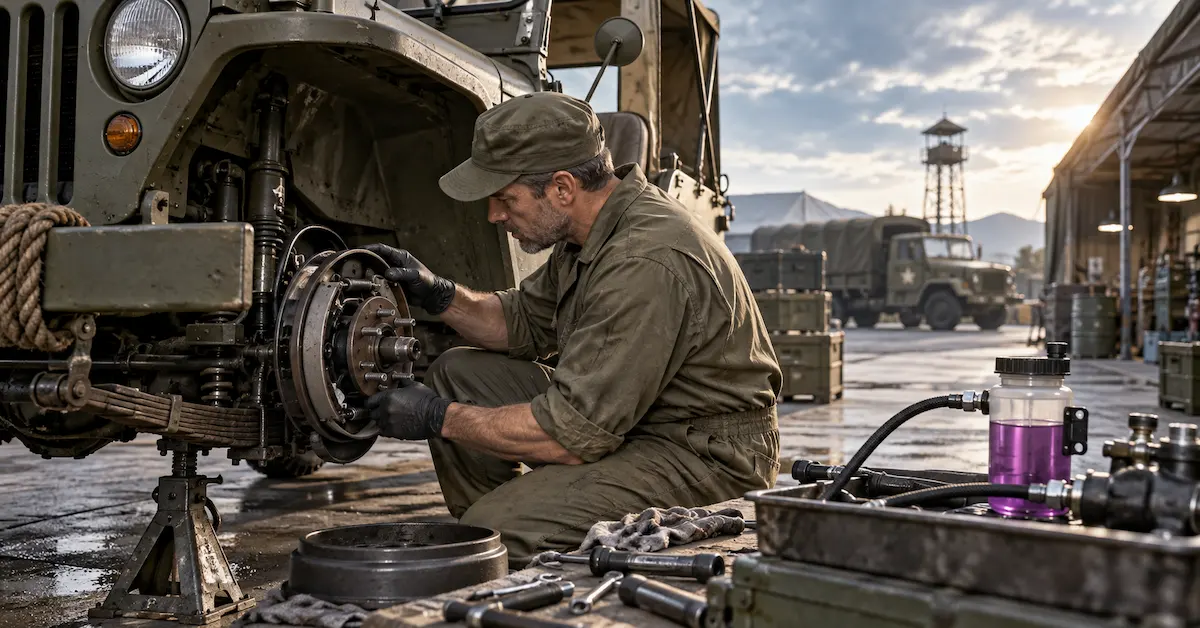
Seal, hose, metal and coating compatibility need named evidence
Brake-fluid compatibility is not a yes-or-no property of a base chemistry. It is a relationship among a particular formula, material, temperature, exposure time, mechanical condition, and acceptance limit. A product can pass the referee tests required by FMVSS No. 116 while a modified vehicle contains a seal compound, hose liner, adhesive, pressure sensor, coating, or repair material outside that test set. That does not invalidate the federal test; it explains why application validation sits beside it.
Ask the system owner for the bill of materials or, at minimum, the material families and component part numbers. The test plan may examine volume and dimensional change, hardness, tensile behavior, surface condition, cracking, stickiness, leakage, piston return, hose condition, coating appearance, and deposits after controlled exposure. Test new and appropriately aged components when the duty requires it. Record fluid-to-material ratio, temperature, duration, agitation, and measurement method so that a future change can be compared honestly.
A catalogue name can hide half a century of history. An original seal soaked in glycol fluid since the 1970s is a different test subject from today's replacement, even when both are sold for the same cylinder. Rebuild kits change compounds; old cleaner and unidentified residue add more uncertainty. A conversion plan may therefore call for new rubber parts and flexible hoses followed by validation of that actual replacement set. The service authority, not a general buying article, decides the work for a particular vehicle.
Paint behavior is often cited as a silicone advantage. Some product manufacturers position DOT 5 as less damaging to painted finishes than glycol fluid. Even so, clean any spill promptly using the vehicle and product instructions. “Paint friendly” is not a license to leave brake fluid on a coating, and it is not a reason to choose a fluid that the hydraulic system does not permit.
Water, air and maintenance still need control
Describing silicone DOT 5 as non-hygroscopic does not mean water cannot enter or that service is unnecessary. The scope of SAE J1705 calls for extreme caution to prevent water entry because it may lead to brake failure; it does not support a “fill for life” promise. FMVSS No. 116 also includes wet ERBP, water-tolerance, and corrosion procedures. Use those results together with the vehicle maker's inspection and replacement schedule.
Handling matters as well. Shaking, high-shear transfer, rushed pouring, or the wrong bleeding equipment can retain air and produce a poor pedal. Ask the supplier how transfer and filling limit entrained air, then follow the exact system bleeding procedure. Some ABS circuits require a diagnostic tool; other systems use conventional steps. Keep service tools clean and dedicated, and never return used fluid to the original container.
Qualify the supplier and the manufacturing route separately
Ask a proposed Silicone DOT5 Brake Fluid Supplier a plain ownership question: who can release this lot, and who can stop it? The answer reveals whether the seller formulates, contracts the filling, exports, distributes, or only trades the material. Any of those roles can work when responsibilities are visible. The quotation should name the formula owner, plant, release laboratory, certifying party, packager, and deviation authority.
For a prospective Silicone DOT5 Brake Fluid Manufacturer, begin with a line walk for the proposed formula. Experience blending DOT 3, DOT 4, or DOT 5.1 says little about silicone segregation. Follow the material from approved raw inputs through vessels, hoses, transfer, filling, testing, quarantine, and retention. Then examine cleaning limits or dedicated-equipment rules, outside-laboratory control, in-process checks, and the change record.
A framed quality certificate at reception is a starting clue, not an SKU certificate. Check its company name, plant address, scope, issuer, validity, and covered operation, then trace those controls to the proposed formula and line. For GAFLE, the immediate question is even earlier: can a silicone DOT 5 project be evaluated at all? General brake-fluid experience cannot answer that product-specific question.
| Audit area | Question to ask | Useful evidence | Red flag |
|---|---|---|---|
| Legal identity and role | Who formulates, blends, tests, certifies, fills, exports, and handles claims? | Company registrations, site list, contracts and responsibility matrix | The seller will not identify the manufacturing site |
| Formula control | How are silicone base, additives, dye, tolerances and revisions controlled? | Controlled bill of materials, specifications, batch record and change process | Raw materials may change without customer notice |
| Contamination control | Is equipment dedicated or is cleaning effectiveness validated between chemistries? | Line map, cleaning instruction, verification limits and records | Shared equipment has no residue acceptance criterion |
| Laboratory competence | Which FMVSS and contract tests are in-house, and who controls outside work? | Method list, equipment, calibration, staff competence, external-lab scope | One generic COA is used for every customer and batch |
| Batch release | Which tests release each lot and which are periodic? | Approved control plan, sample COA, out-of-specification process | Shipment can leave before test completion |
| Traceability and change | Can a bottle be traced to inputs, processing, results, pack components and release? | Lot genealogy, retain sample, complaint and change-notice records | Lot code identifies only the filling day |
OEM and private-label work needs technical gates before artwork
An OEM Silicone DOT5 Brake Fluid enquiry should begin with a product requirement document, not a logo file. Define destination countries, intended vehicles, governing standard, target and release properties, prohibited claims, package sizes, closure and seal, label languages, annual volume, order pattern, shelf-life expectations, validation samples, and approvals. State whether the buyer requires an existing qualified formula, a private-label version of an established product, or new development. Those are different projects.
The first gate is feasibility: can the factory legitimately formulate, handle, test, package, and document silicone DOT 5 for the requested market? The second is technical agreement: formula code, limits, test plan, materials and application evidence. The third is sample approval under a controlled identity. Only then should the parties lock packaging components and artwork. A pilot lot verifies scale-up, filling, seal integrity, label application, coding, carton performance, and traceability. The first commercial lot receives an enhanced review before routine supply begins.
Claims require a claim matrix. “DOT 5 silicone base” needs complete conformity support. “MIL-PRF-46176” needs the status and evidence required by the contract. “For classic cars,” “for military vehicles,” “ABS compatible,” “racing,” “paint safe,” “never change,” and “mixes with all fluids” are not harmless decoration; each can overstate application or performance. Remove any claim that cannot be tied to the exact formula and a defined use.
Make change control contractual. Require prior written notice for formula, raw-material supplier, additive package, production site, vessel, transfer or filling line, test method, laboratory, package resin, closure, liner, label stock, coding system, or regulatory-status changes. Define which changes need document review, comparison testing, a new pilot, or full requalification. An “equivalent material” should be treated as a proposal, not an automatic factory substitution.
Bulk supply adds identity, cleanliness and repacking risk
A Bulk Silicone DOT5 Brake Fluid Supplier must protect the same qualified formula through larger containers, transfer, transport, receiving, and any downstream repacking. “Bulk” should be defined. It may mean cartons of retail bottles, pails, drums, intermediate bulk containers, or a dedicated tank movement. The feasible format depends on product stability, container compatibility, contamination risk, transport rules, destination operations, and the supplier's validated capability.
Before connecting a hose, read its previous-cargo and cleaning log. Do the same for reusable containers, pumps, manifolds, filling heads, and the receiving tank. Glycol fluid, mineral oil, water, cleaner, dirt, or even a different silicone formula may invalidate the transfer unless a validated limit says otherwise. Put residue limits, sample points, first-flush disposition, line clearance, seal numbers, tamper checks, and filled-versus-released quantity in the batch record.
Repacking transfers responsibility. The repacker must preserve formula identity, use compatible packaging, apply correct market labels, assign traceable codes, prevent contamination and air entrainment, retain samples, and connect each finished unit to the incoming lot. The original bulk COA does not prove that every repacked bottle is correct after an uncontrolled transfer. Audit the repacking site as part of the supply chain.
Transport planning should include package orientation, pallet pattern, closure torque, induction or inner seal, drop and leak risk, temperature exposure, sunlight where relevant, carton strength, container inspection, and receiving quarantine. Record container or truck identity and seal number. On arrival, compare documents and codes before breaking the seal; investigate leakage, damaged closures, wrong color, missing labels, or unexplained quantity variance before release.
A copy-ready RFQ that produces comparable answers
The following structure keeps the first supplier response useful. Replace every bracket with a fact. Where information is unknown, say so and ask for a feasibility review rather than inventing a value. Send the same controlled version to every bidder, then log clarifications and revisions. Price comparison begins only after the technical offers describe the same product, evidence, package, and delivery basis.
| RFQ field | Buyer entry | Supplier response required | Approval check |
|---|---|---|---|
| Application identity | [Make/model/year/market/brake option/ABS or non-ABS] | State whether the proposed product is supported for that exact application | No family-wide assumption |
| Controlling fluid document | [Manual/drawing/contract/code/revision; attach copy] | Map offered formula and evidence to each stated requirement | Current revision and exact code match |
| Regulatory and qualification route | [FMVSS 116/current market rules/MIL-PRF clause/other] | Supply current reports, certification and qualification status as applicable | No “DOT approved” substitution for evidence |
| Performance and materials | [Methods, limits, temperatures, seal/hose/component list] | Report results, methods, laboratory, sample identity and exceptions | All critical characteristics closed |
| Project type | [Existing approved formula/private label/new development/conversion study] | Identify technical route, samples, pilot, timing and customer approvals | No stock claim before feasibility confirmation |
| Package and label | [Size/material/closure/inner seal/language/destination/brand] | Confirm compatibility, tamper evidence, required text and coding | Filled-pack approval before artwork release |
| Volume and logistics | [Sample/pilot/order/annual forecast/destination/incoterm/timing] | MOQ, lead time, pack-out, pallet, shipment and storage conditions | Feasible format and traceable lot quantity |
| Quality documents | [TDS/SDS/report/COA/retain/change notice/complaint needs] | Provide sample documents and proposed release control plan | One formula and revision across the file |
Three cases show why the same product name leads to different decisions
Case 1: a 2005 motorcycle with a clear DOT 5 instruction
A distributor receives an enquiry for a documented 2005 Harley-Davidson model whose official procedure names the manufacturer's DOT 5 product. It records model, market, manual revision, reservoir marking, circuit condition, and service quantity; it does not extend the answer to every Harley. Candidate evidence and workshop practice are checked against that exact model.
Case 2: a preserved military vehicle with an obsolete stock number
A restorer sends a photograph of an old military BFS can. The buyer instead identifies the platform, technical manual, modification state, required MIL-PRF revision, qualification route, pack, and service history. A system still specifying BFS follows that requirement; a platform converted to a polyglycol ABS fluid does not. Configuration defeats nostalgia.
Case 3: a classic-car brand wants a universal private label
A restoration brand proposes one purple bottle for “all classic cars.” Review finds original glycol systems, converted cars, replacement cylinders, retrofit calipers, and ABS restomods. The label is narrowed to DOT 5 silicone base fluid for systems that specify it; universal compatibility, racing, and maintenance-free claims are removed before packaging work.
Comparison mistakes that should stop approval
Reject these shortcuts: DOT 5.1 is not a newer silicone DOT 5; purple color does not prove conformity; vehicle age or military origin does not establish the fluid; a higher dry ERBP cannot override compatibility; non-hygroscopic does not mean maintenance-free; FMVSS conformity is certification, not a universal application approval; a general factory certificate does not prove an SKU; a clean-looking drain does not prove a complete conversion; and neither a photograph nor another ABS model closes the system-specific evidence gap.
Questions buyers usually ask before an RFQ
Does the decimal make DOT 5.1 an updated DOT 5?
It does not. DOT 5 in this guide is silicone base; DOT 5.1 is expressly non-silicone and commonly glycol ether based. Keep them separate, and use whichever grade the vehicle documentation names.
May a workshop mix DOT 5 with DOT 3 or DOT 4?
Treat that combination as a contamination event, not a blend. If the wrong chemistry went in, follow the maker's recovery procedure and take the vehicle out of service when appropriate. Adding more of either fluid cannot repair an uncertain circuit.
Does an old registration date make a car suitable?
Age alone tells the buyer very little. Some classic or custom systems name silicone fluid; others retain glycol fluid, and replacement cylinders or hoses may carry their own instructions. Read the current hardware file instead of approving by decade or paint value.
Which motorcycles use silicone DOT 5?
Some older Harley-Davidson model documentation provides clear examples. Harley-Davidson's own instructions also show that different motorcycles use DOT 4 or DOT 5 and direct technicians to the exact manual and master-cylinder cover. Check model, year, market, and circuit.
What decides whether DOT 5 belongs in an ABS vehicle?
Look for written permission covering the exact vehicle and hydraulic control unit. Many modern ABS circuits call for non-silicone DOT 4 or DOT 5.1-type fluid and a diagnostic bleeding routine. A broad internet yes or no cannot replace that model-specific answer.
Does a 260°C minimum make silicone DOT 5 a racing fluid?
Do not assume so from the 260°C minimum dry ERBP. Wilwood explicitly says it does not recommend its DOT 5 product for racing. Use the brake-system supplier's named competition fluid and the applicable series rules.
Does DOT 5 protect paint?
Some manufacturers position silicone DOT 5 as less harmful to painted finishes than glycol fluids. That characteristic does not override brake-system compatibility. Clean spills promptly using the product and vehicle instructions and verify any coating claim for the offered formula.
What color should U.S.-market DOT 5 silicone fluid be?
FMVSS No. 116 specifies purple. Color is an identification control, not a substitute for the sealed label, lot code, conformity evidence, and vehicle instruction.
What minimum boiling points apply under FMVSS No. 116?
DOT 5 has a minimum dry ERBP of 260°C and a minimum wet ERBP of 180°C. Those are only two parts of the regulation. Require the remaining stability, corrosion, material, stroking, low-temperature, packaging, and labeling evidence as applicable.
Does DOT 5 brake fluid last forever?
No universal lifetime can be promised. Follow the vehicle or system inspection and replacement schedule. Service history, contamination, free water, component condition, temperature and storage all affect the maintenance decision.
What should a first enquiry contain?
Send the exact vehicle or equipment identity, fluid code and document revision, brake configuration, ABS status, current fluid and conversion history, target specification, destination market, package, quantity, annual forecast, evidence list, and schedule. Mark unknown fields clearly.
Can GAFLE quote a silicone DOT 5 product immediately?
The public catalogue reviewed for this article does not confirm a silicone DOT 5 SKU. Submit a technical inquiry so feasibility, current availability, test evidence, manufacturing controls, package and project timing can be assessed. An enquiry is not confirmation of supply or approval.
The final approval rule for Silicone DOT5 Brake Fluid
Approve Silicone DOT5 Brake Fluid only when four identities agree: the exact brake system permits it, the offered formula meets the applicable technical and market requirements, the production route can preserve that formula, and the delivered lot is traceable to the approved evidence. Vehicle age, purple color, a high dry boiling point, or a general factory certificate cannot replace any of those links.
For an OEM, private-label, or bulk project, the best first message is a complete system and RFQ file. GAFLE can then determine whether a technical and supply review is possible without implying that an unlisted product already exists. That honest gate protects the buyer's brand, the service technician, and the braking system at the same time.