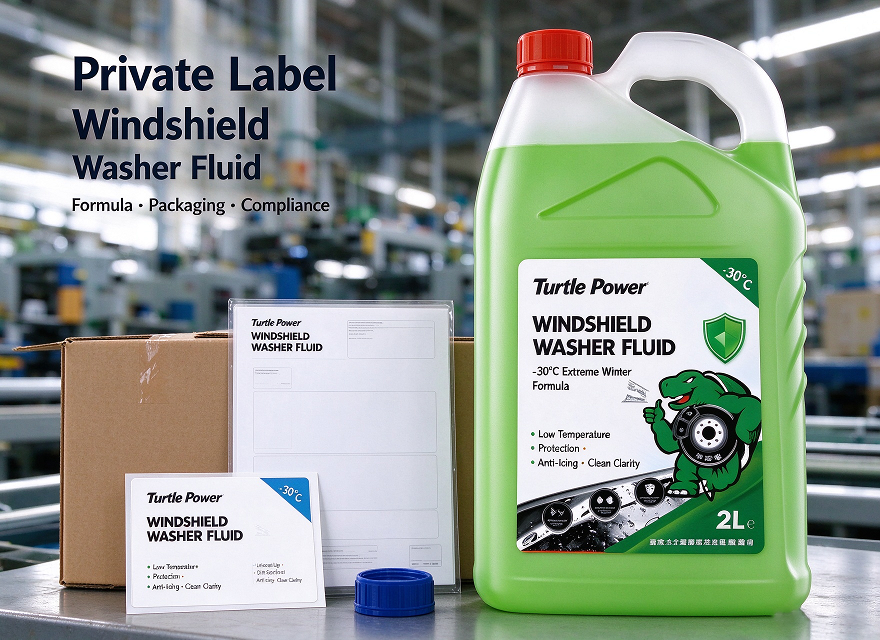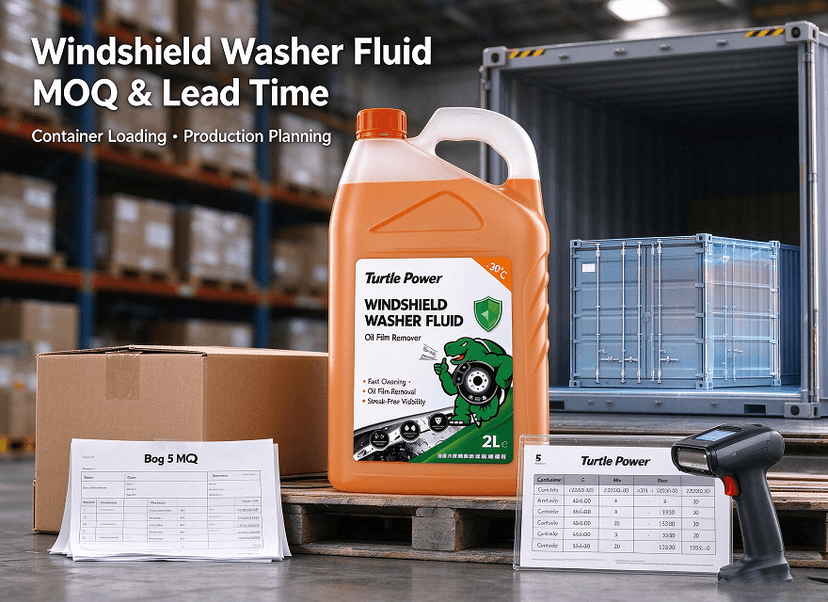
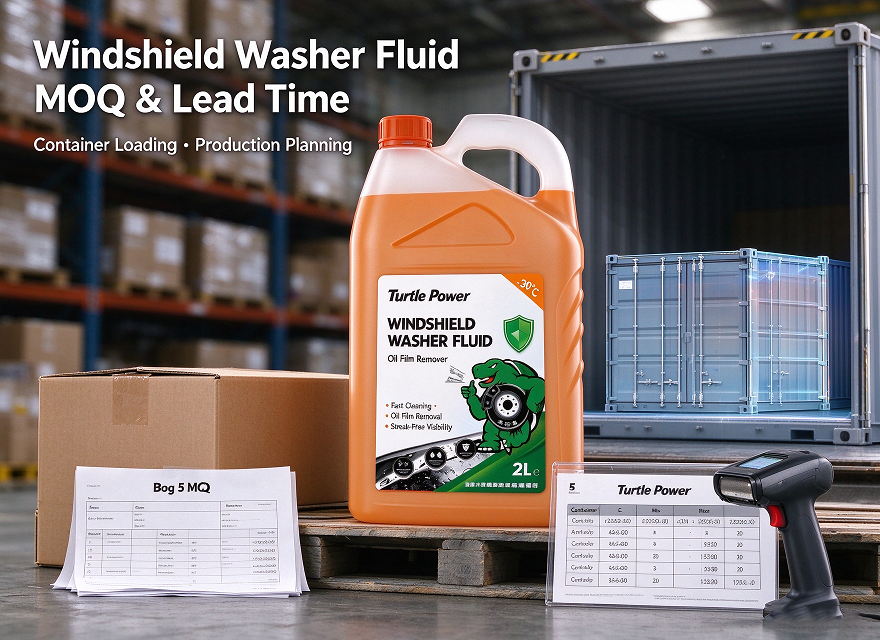
Bulk washer fluid looks like a simple commodity purchase until the first order actually runs late. The usual pattern is familiar: the buyer compares prices, picks the cheapest quote, then discovers that the bottle needs a new mould, that the label file was not print ready, and that the container cannot be loaded to the planned weight. By the time production starts, the selling season has already begun. GAFLE factory ships washer fluid to importers and distributors in many markets, and the planning points below are the ones that prevent this pattern.
What actually sets the MOQ
MOQ in washer fluid is set by packaging economics, because the liquid itself has almost no minimum while bottles, caps, labels and cartons each carry their own batch size. A blending tank can produce a few hundred litres without difficulty, so the constraint is never the chemistry. It is the components.
Bottles are usually produced or purchased in defined runs, and a factory holding stock of a common mould can support a small order while a special colour or shape cannot. Caps follow the same logic. Labels are printed on rolls with a setup charge and a minimum run length, and cartons have their own printing plate cost and minimum quantity.
The factory therefore reconciles four minimums into one practical number, and expresses it in finished cartons or pallets. This is why a washer fluid MOQ quoted in litres is usually a rough translation, and why changing a bottle size after the quote can invalidate the number you planned around.
Container loading and unit cost
Container loading quantity is the number that quietly decides your unit cost, since weight limits, pallet patterns and carton dimensions interact in ways a simple volume calculation misses. Washer fluid is dense, so a twenty foot container may reach its weight limit before it runs out of volume. Ready-to-use fluid in one gallon jugs is the classic example: the load is heavy, and the pallet pattern determines how much of the floor space is usable.
Two levers usually improve the economics. The first is carton dimension: a carton designed around the pallet footprint rather than around a round number of bottles can add several percent to the loaded quantity. The second is pack size mix: combining large industrial packs with retail packs in the same container frequently improves utilization, provided each SKU still meets its own minimum.
Buyers should ask for the loading plan in writing before confirming the order. A supplier who cannot state how many cartons per pallet, pallets per container and total net weight is not ready to quote a landed cost.
The six stages of real lead time
Real lead time is a chain of six stages, and only one of them is the filling operation that suppliers usually quote. The chain runs from specification confirmation, through artwork approval, packaging procurement, production scheduling, filling and quality inspection, to document preparation and container loading.
Specification confirmation is fast if the buyer arrives with decisions already made, and slow if freeze point, solvent system and pack sizes are still being debated. Artwork approval is the stage that consumes the most calendar time in practice, because label copy changes often travel through several people inside the buyer's organisation.
Packaging procurement is short for stock moulds and long for anything custom. Production scheduling depends on the factory's existing commitments, not on the size of your order alone. Filling is genuinely quick for a standard SKU. Inspection and documentation take a few days and should never be compressed, because that is where a bad batch is caught.
What actually causes delay
Delays usually come from artwork revision, mould availability and peak season scheduling rather than from production itself, and each of those can be controlled in advance. Artwork revision is entirely within the buyer's control: freeze the label copy before the quotation is issued, and the largest single delay disappears.
Mould availability is a decision that can be made early. If the schedule is tight, accept an existing mould for the first order and develop the custom shape for the second.
Peak season is predictable. Winter fluid demand concentrates in a narrow window, and factories fill their capacity months ahead. A buyer who confirms a winter programme in early autumn is competing for slots that were reserved in summer. Booking earlier, or accepting a slightly later delivery window, costs less than expediting.
Payment terms and capacity reservation
Payment terms and capacity reservation belong in the same negotiation as price, because a production slot is a commitment on both sides. The common structure is a deposit with the balance against the copy of shipping documents, sometimes with a letter of credit for larger volumes.
What matters more than the percentage is what the deposit reserves. A deposit paid against a confirmed production slot, with a written date for artwork cut-off and loading, is worth more than a slightly lower price against an undefined schedule.
Buyers with a repeat programme should also discuss rolling forecasts. A factory that knows the next three quarters' volumes can hold packaging stock and shorten each subsequent order, which usually beats negotiating a few cents off the first container.
The sequence for a first bulk order
A first bulk order should follow a fixed sequence, from specification lock to sample approval to container booking, so that no stage is started before its inputs exist. Lock the freeze point, the solvent system and the pack sizes first, in writing. Then request samples of the actual finished product in the actual bottle, not a liquid sample alone.
Approve artwork on the real bottle shape next, checking label fit and text legibility at the shoulder curve. Only after that should packaging be ordered and the production slot confirmed. Book the container once the loading date is fixed, and request the document set in parallel rather than after loading.
Following this order does not make the project slower; it removes the loop where a late artwork change forces a re-print and a re-scheduled slot.
FAQ
Q1: What is a typical MOQ for bulk windshield washer fluid? A1: It varies by packaging. With an existing bottle mould and standard label, a first order can start from one pallet per SKU. Custom moulds or special label sizes raise the MOQ substantially.
Q2: How many bottles fit in a 20ft container? A2: It depends on pack size and weight. Washer fluid is dense, so the weight limit often binds before the volume does, and the exact figure should come from the supplier's loading plan for your specific carton.
Q3: How long does a bulk order take from confirmation? A3: Commonly four to six weeks for a first order with existing packaging, and longer when new moulds or new label sizes are involved.
Q4: Can I get samples before placing a bulk order? A4: Yes. Request finished product samples in the intended bottle, and confirm whether sample cost and freight are chargeable before shipping.
Q5: What payment terms are usual for a first container? A5: A deposit at order confirmation with the balance against shipping documents is the most common structure. Larger or repeat orders sometimes move to a letter of credit.
Q6: Can I mix several SKUs in one container to reach the MOQ? A6: Usually yes, provided each SKU meets its own packaging minimum and the mixed loading plan still fits the container weight and volume limits.
Welcome to contact GAFLE for more information & cooperation!
peter
ZHEJIANG GAFLE AUTO CHEMICL CO.,LTD
Tel:86-579-8222 1665
Fax:86-579-8246 4690
Cel/Wechart:86-13335993986
E-mail:peter@gafle.net
Web:www.gafle.net