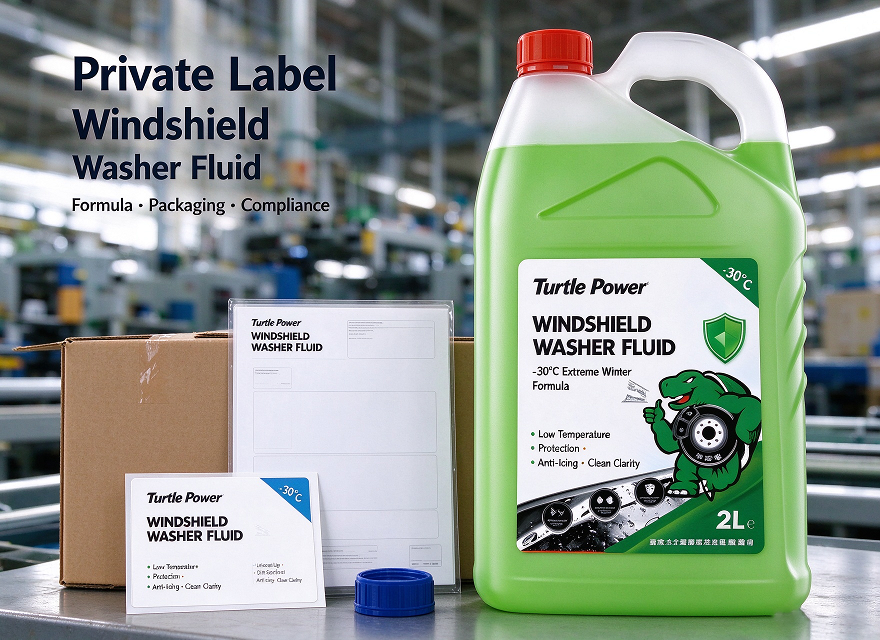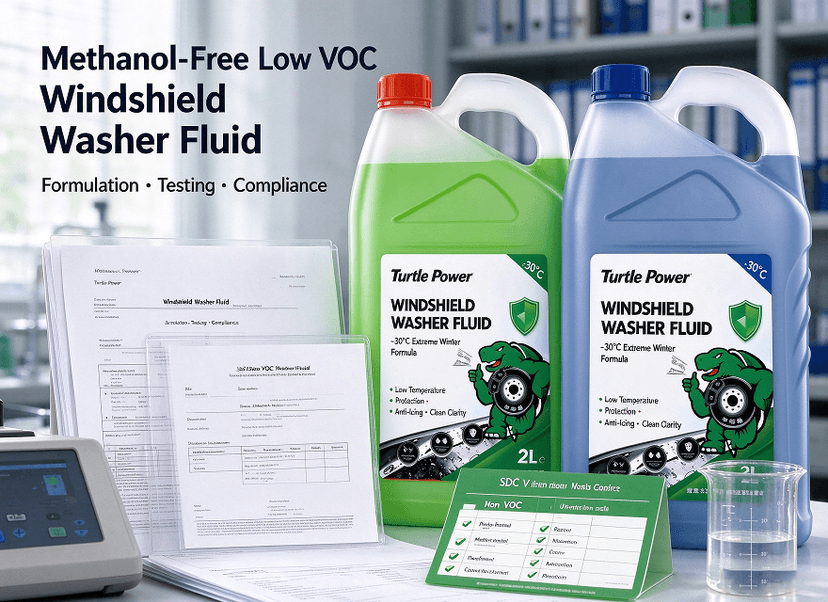
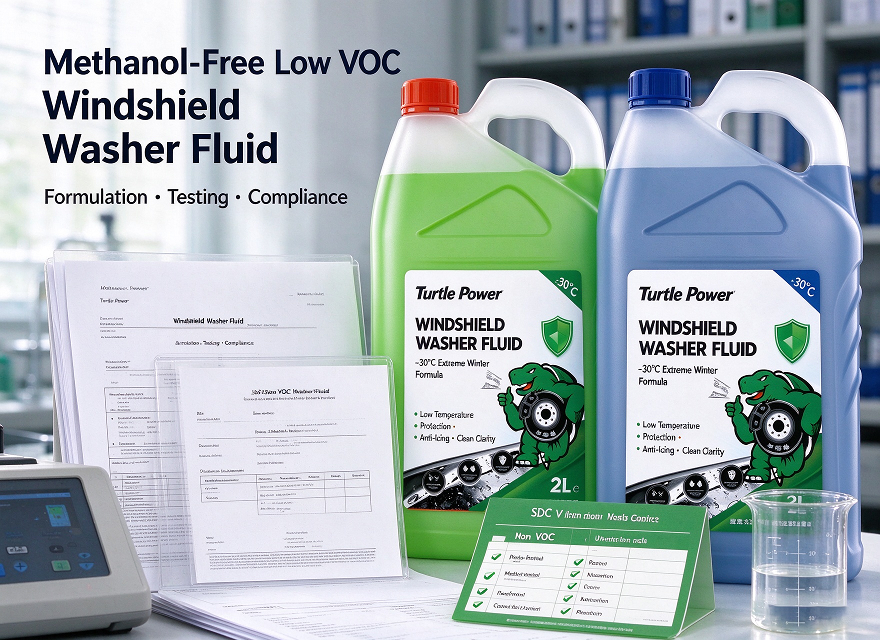
The conversation around windshield washer fluid has changed. Ten years ago buyers asked one question, which was how low the freeze point could go for the lowest price. Today the questions are about methanol content, VOC levels, biodegradability and whether the product can be sold into markets with strict chemical controls. This shift is not driven by consumer sentiment so much as by regulation, workplace safety and the procurement standards of large retail and fleet buyers. GAFLE factory formulates methanol-free and low VOC washer fluids for export, and the technical realities behind those labels are worth understanding before you specify a product.
Why methanol is being pushed out
Methanol's position in washer fluid is eroding, driven by occupational safety rules, import restrictions and retail procurement standards rather than by consumer preference. The health concern is real: methanol is toxic when ingested and can cause serious injury through repeated skin contact or inhalation in poorly ventilated workshops. Filling lines, bulk handling and even consumer misuse all create exposure pathways that regulators are unwilling to ignore.
Customs and market access add a second pressure. Some destinations require methanol content declarations, impose limits on the concentration allowed in consumer products, or treat high-methanol fluid as a more heavily regulated dangerous good. A product that clears customs smoothly today can become a documentation problem tomorrow if the classification tightens.
Retail procurement is the third force. Large chains increasingly publish restricted substance lists for car care products, and methanol frequently appears on them. A supplier unable to offer a compliant alternative loses the listing regardless of price.
Why it was used in the first place
Methanol became the default solvent because it is cheap, effective at depressing the freeze point and easy to blend, and those advantages are exactly why regulators now examine it closely. It mixes readily with water, dissolves many surfactant systems, evaporates quickly from the glass and delivers strong freeze protection per unit weight.
Those properties made it the natural choice for a cost-sensitive, high-volume commodity. Replacing it is therefore an economic problem as much as a technical one, and any buyer comparing a methanol-free quote with a conventional quote should expect a higher unit cost rather than assume the supplier is overcharging.
Building a methanol-free system that performs
A methanol-free product can match or exceed the performance of a methanol-based one, but only if the replacement solvent system is designed rather than substituted. Ethanol is the most common replacement: it is effective, widely available and supports a clean label story, though it is more expensive and its flash point affects transport classification. Isopropanol offers good solvency with a different hazard profile. Glycol-containing blends provide freeze protection with lower volatility but can leave a residue if the surfactant balance is wrong.
Substitution without redesign is where products fail. A formulator who simply swaps methanol for ethanol at the same percentage may find the freeze point no longer meets the claim, the evaporation rate changes the streak behaviour, and the surfactant that worked in a methanol system now separates in the new one. Each replacement requires a full stability, compatibility and performance check.
What low VOC actually means
Low VOC is a measured property with a defined test method, not a marketing phrase, and the number that matters depends on the regulation of the destination market. Volatile organic compounds are the solvents that evaporate into the atmosphere, and different jurisdictions define and limit them differently. Some regulate VOC content by weight per volume of product, others by the emission from the product in use.
For washer fluid, the practical implication is that a product can be low VOC under one market's definition and non-compliant under another. A manufacturer preparing an export order should therefore ask which regulation applies, then either select a formula that meets the strictest relevant limit or prepare separate formulas per market.
The measurement itself should be documented. Buyers who are asked by a retail quality team to prove a low VOC claim need a test report naming the method used, not a statement on a specification sheet.
Biodegradability and environmental claims
Biodegradability claims require specific test evidence, and a factory that cannot name the method it used is not in a position to print the claim. Ready biodegradability is measured under defined laboratory conditions over a defined period, and results apply to the ingredients tested rather than to the product as a whole in every environment.
This does not mean environmental positioning is impossible for washer fluid. It means the claim should be narrow and supportable: a specific surfactant system that has been tested, a specific statement about the absence of a restricted substance, a specific packaging reduction. Wide claims such as "fully eco friendly" invite challenge and, in several markets, regulatory action.
Cleaning performance and residue
Streaking and residue are formulation outcomes, and moving away from methanol makes the surfactant balance more important rather than less. Methanol evaporates fast and helps carry the surfactant away with it, so a product that relied on that behaviour can leave a film when the solvent changes.
The fix is usually a redesigned surfactant package, sometimes combined with a small amount of a low-residue co-solvent. Performance should be verified on real windscreens rather than glass plates alone, because modern windscreens carry coatings and sensors that behave differently from bare glass.
Buyers should test three things before approving a methanol-free formula: cleaning of oily road film, drying behaviour without visible streaks under direct sunlight, and compatibility with the plastics and elastomers in the washer circuit.
Documentation for regulated markets
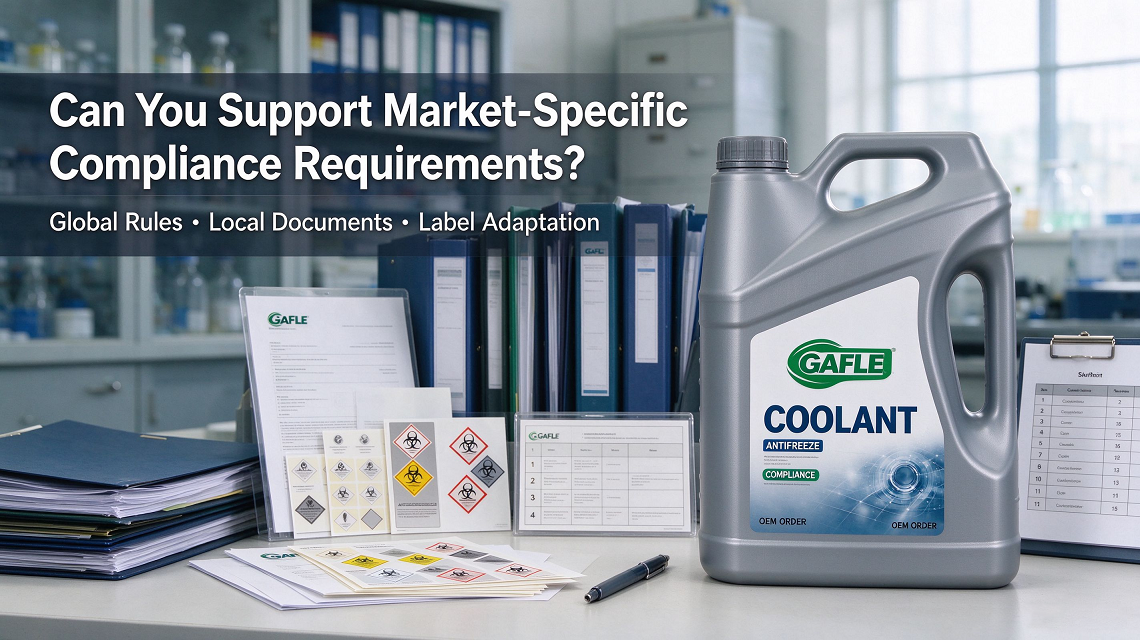
Documentation and labelling decide whether a green claim survives customs and retail audit, so the file set must be built before the first shipment. At minimum, the safety data sheet must reflect the actual solvent system and its hazard classification, and the technical data sheet must state the measured freeze point, VOC content where claimed, pH and shelf life.
Labels must carry hazard statements appropriate to the real composition, plus any market-specific wording required for consumer products. Where a low VOC or methanol-free claim appears, the substantiating test report should be filed alongside the batch records so it can be produced on request.
FAQ
Q1: Is methanol-free washer fluid as effective as conventional fluid? A1: Yes, when it is properly formulated. Freeze protection and cleaning performance can be matched, but the unit cost is usually higher because the replacement solvents cost more.
Q2: Can ethanol-based washer fluid be shipped as normal cargo? A2: Transport classification depends on the alcohol content and flash point. A correctly declared shipment is normally straightforward, but the classification must appear on the export documents.
Q3: What VOC limit applies to windshield washer fluid? A3: Limits differ by jurisdiction. Some markets regulate VOC content per volume of product, others regulate emissions in use. Confirm the applicable rule for your destination before fixing the formula.
Q4: Is biodegradable washer fluid available for private label? A4: Yes. Biodegradable surfactant systems exist, and the claim can be supported with test reports for the specific ingredients used.
Q5: Will a methanol-free formula streak more than a conventional one? A5: Not if the surfactant package is designed for the new solvent system. Streaking usually indicates an inherited formula that was not rebalanced.
Q6: Does a low VOC claim require third-party testing? A6: Retail and regulatory audits normally expect a test report naming the method. Internal statements alone are rarely accepted for a claim printed on a consumer label.
Welcome to contact GAFLE for more information & cooperation!
peter
ZHEJIANG GAFLE AUTO CHEMICL CO.,LTD
Tel:86-579-8222 1665
Fax:86-579-8246 4690
Cel/Wechart:86-13335993986
E-mail:peter@gafle.net
Web:www.gafle.net