Private label windshield washer fluid has quietly become one of the most requested projects in the automotive aftermarket. Distributors, retail chains, car care brands and even service station networks all want their own bottle on the shelf, and the reason is simple: washer fluid is consumed constantly, bought repeatedly and costs little to stock. But the gap between a successful private label line and a failed one rarely comes down to price. It comes down to how carefully the formula, packaging and documentation were defined before production started. This guide explains what a private label windshield washer fluid project actually involves, based on the working process used by GAFLE factory for overseas brand owners.
What private label windshield washer fluid really means
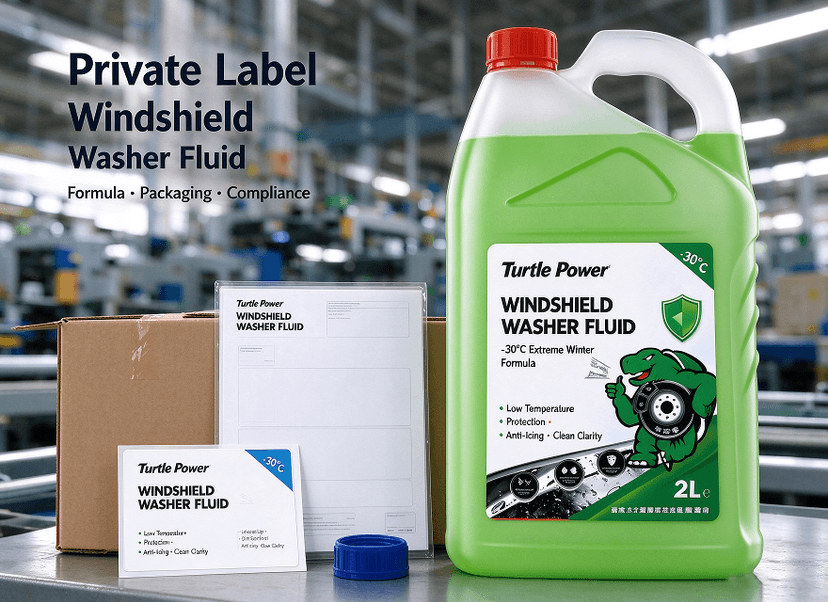
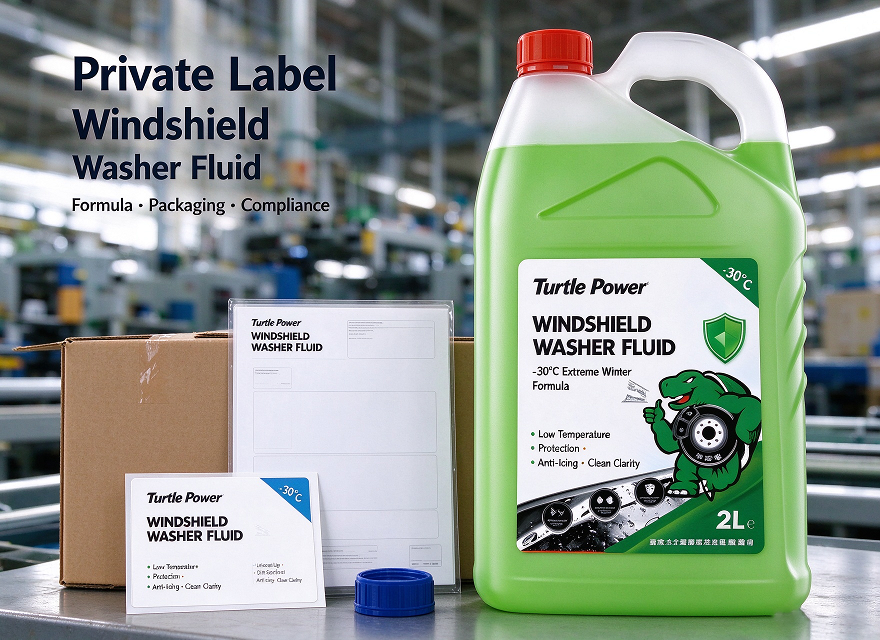
Private label windshield washer fluid means the liquid is produced by a specialized factory while the brand, label, bottle design and marketing belong to you. The manufacturer supplies the formula, the filling line, the quality control and the export documents; you supply the brand identity and the market. This is different from buying stock bottles and re-labelling them in a warehouse. In a proper private label project, the bottle, the cap, the label and often the outer carton are produced or sourced specifically against your artwork, and the batch records carry your brand name.
The distinction matters because it decides who is legally responsible for what. The factory remains responsible for formula consistency, filling accuracy and batch traceability; the brand owner is responsible for label content, market claims and product registration where local law requires it. Clarifying this split at the quotation stage prevents arguments later, especially when a shipment is stopped at customs over a missing hazard statement.
Why washer fluid is a smart first private label product
Washer fluid is one of the easiest categories for a new automotive brand to start with, because the product is light, cheap to test and driven by repeat seasonal demand. A private label coolant or brake fluid project usually starts at a much higher order volume, since those products carry heavier compliance expectations and larger pack sizes. Washer fluid can be launched in smaller volumes, tested in a few regional markets, and scaled once reorder rates are proven.
Seasonality also works in your favour. Winter fluid sells hard in cold markets from late autumn, summer and all-season fluid moves steadily the rest of the year, and deicing or bug-remover variants give you a reason to refresh the range twice annually. A brand that starts with one SKU in a 1 litre or 1 gallon bottle can add concentrate and low-temperature versions in the second season without rebuilding the supply chain.
Formula decisions your manufacturer will ask you to confirm
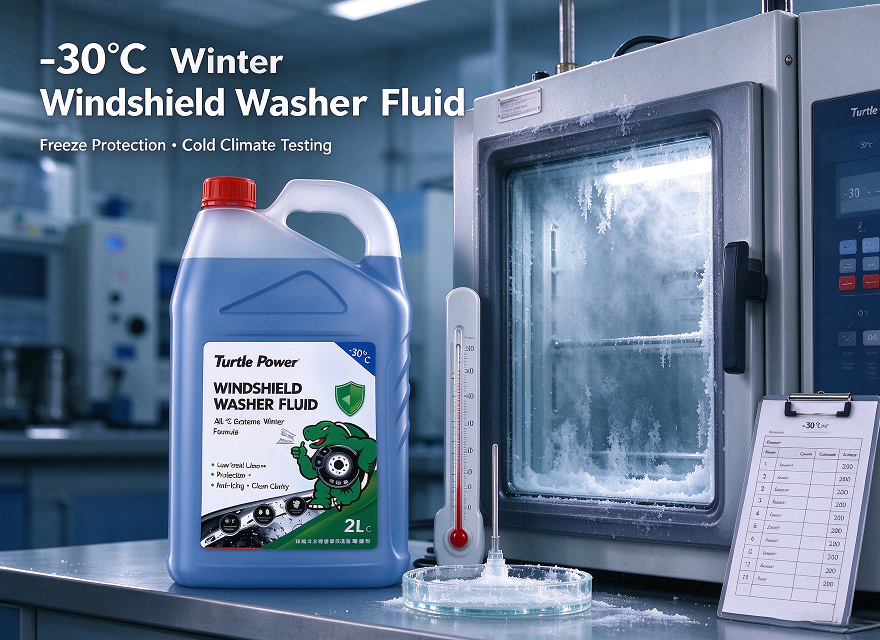
Your manufacturer will ask you to lock the freeze point grade and the alcohol system before anything else, since these two decisions define both performance and compliance. Freeze point is usually expressed in Celsius or Fahrenheit, and the grade you choose must match the climate of your selling region rather than the climate of your factory. A product sold in northern Europe or northern China needs genuine protection well below zero, while a product sold in a tropical market can be positioned as an all-season cleaner with a mild freeze margin.
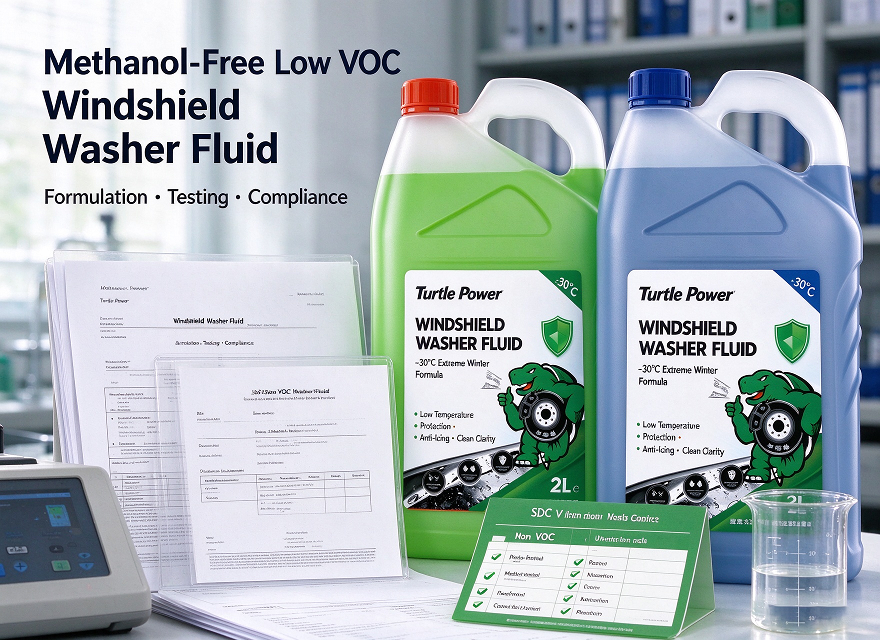
The alcohol system is the second decision. Methanol has historically been the cheapest way to reach low freeze points, but it is restricted or heavily scrutinised in several markets because of toxicity and workplace exposure rules. Ethanol, isopropanol and glycol-based systems cost more but support methanol-free and low VOC claims. If your market requires a specific claim on the label, tell the factory before formulation, not after the first container is loaded.
Functional positioning comes third. Standard cleaning fluid, streak-free formulas for modern windscreens, water-repellent variants, deicing fluids and bug-remover products all use different surfactant and solvent packages. Each variant needs its own stability and compatibility testing, so a range of four SKUs is not simply four labels on one liquid.
Packaging choices that decide your shelf appeal and your MOQ
Packaging is where most private label projects gain or lose money, because bottle mould availability, label size and carton printing all feed directly into your minimum order quantity. If you accept an existing bottle mould already running at the factory, your MOQ stays modest and the unit cost stays low. If you insist on a new shape, you pay for mould development and you commit to a much larger volume to justify it.
Label design has the same effect in a less obvious way. A label dimension that does not fit the existing bottle curvature will print with distortion, and a very large wrap-around label may need a different applicator setting. Send vector artwork early, ask for a physical labelled sample, and check how the text sits on the curved shoulder of the bottle rather than on a flat screen.
Outer carton printing is often worth the small extra cost. Retail buyers and distributors respond to a printed shipper, and a carton that carries the brand name, pack count and gross weight also reduces receiving errors in the warehouse. Just confirm the carton configuration against the pallet plan before printing, because a badly sized shipper can cut your container loading quantity by ten percent or more.
MOQ, tooling and lead time in a real project
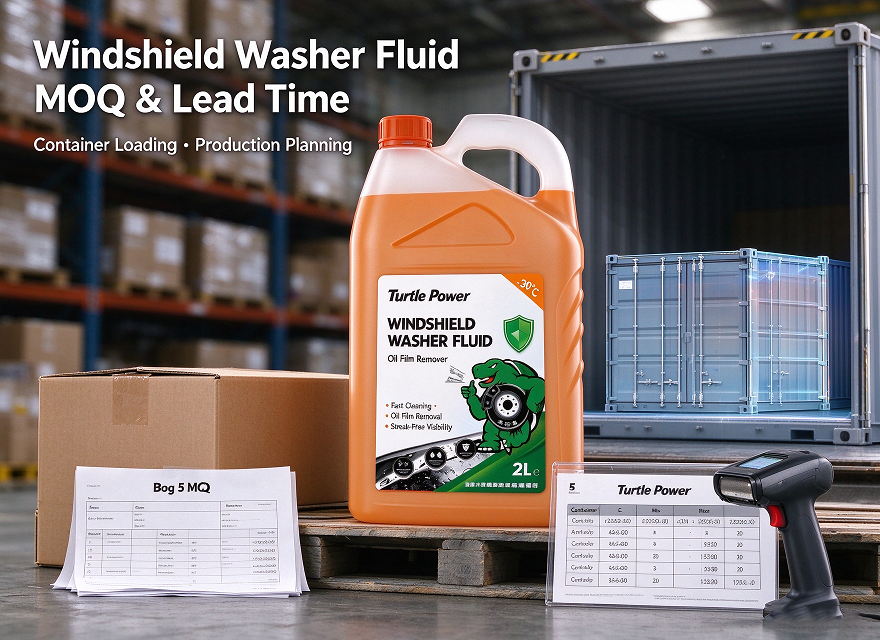
Real private label lead time is not a single number, it is the sum of artwork approval, mould availability, filling schedule and inspection before loading. A factory that quotes you fifteen days is usually quoting only the filling stage. Add artwork rounds, label printing, bottle procurement and inspection, and the realistic figure from confirmation to container loading is closer to four to six weeks for a first order.
MOQ behaves the same way. The liquid itself has almost no minimum; the packaging does. Bottle and cap orders, label print runs and carton printing each carry their own economic batch size, and the factory has to reconcile them into one workable number. This is why a private label washer fluid MOQ is normally expressed in finished cartons or pallets rather than in litres, and why changing bottle size late in the project can force a re-quote.
Tooling cost should be separated clearly on the quotation. Ask for three lines: mould or set-up charge, printing plate charge and sample charge. A supplier that folds all three into a vague "development fee" is difficult to compare against another supplier, and difficult to reclaim if the project stalls.
Documents and quality control to request from the factory
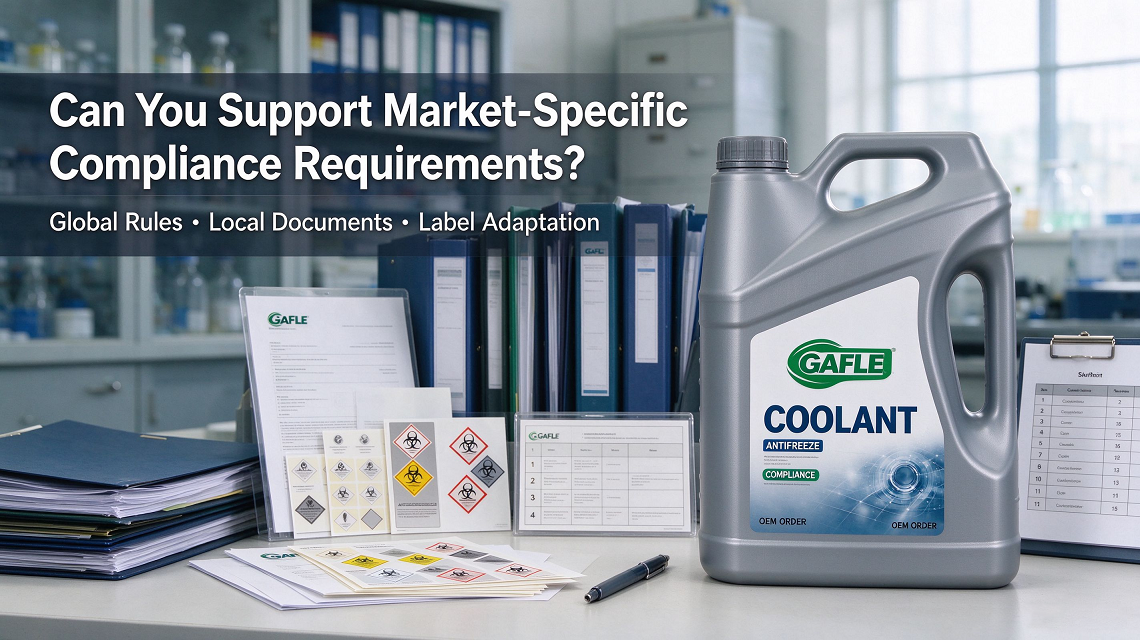
A serious factory will hand over SDS, TDS, COA and batch test records without argument, and the way a supplier answers document questions tells you more than any price list. The safety data sheet must match the formula you actually buy, in the language your market requires, with correct hazard classification for the alcohol content. The technical data sheet should state freeze point, pH range, density, appearance, shelf life and recommended storage conditions.
Batch traceability is the part buyers forget. Ask how the factory links a filled bottle to its production batch, and whether a retained sample is kept for the shelf life period. If a customer complains about residue or a damaged pump three months after delivery, the retained sample is the only way to establish whether the fault came from the liquid, the packaging or the vehicle.
For regulated markets, also request the export document set in advance: commercial invoice, packing list, certificate of origin and, where applicable, dangerous goods classification for alcohol-based fluid. Discovering that your product needs a transport classification after booking the container is an expensive way to learn.
How to compare private label washer fluid suppliers
Compare suppliers on five axes, not one: formula transparency, packaging flexibility, MOQ realism, documentation and communication speed. Formula transparency means the supplier can explain what is in the liquid and why, and can adjust it without pretending the request is unreasonable. Packaging flexibility means they can work with your existing mould or offer a sensible alternative with a clear cost. MOQ realism means the number they quote survives contact with label printing and carton procurement.
Documentation and communication decide the long term. A manufacturer that replies to a technical question in one working day and sends revised artwork comments in writing is worth a slightly higher unit price, because your own customers will judge your brand by how fast you resolve their problems. Ask for two reference customers in a comparable market before you commit to a first container.
FAQ
Q1: What is the minimum order quantity for private label windshield washer fluid? A1: It depends mainly on packaging. With an existing bottle mould and a standard label, a first order can start from one pallet or a small number of cartons per SKU. A new bottle shape or a new label size raises the MOQ significantly.
Q2: Can I use my own bottle design for a private label project? A2: Yes, but a new mould involves tooling cost and a higher committed volume. Many brand owners start with an existing mould and move to a custom shape once the product is selling steadily.
Q3: How long does a first private label washer fluid order take? A3: Commonly four to six weeks from artwork confirmation to container loading. Existing moulds and pre-approved artwork shorten this; new moulds, new label sizes and peak season scheduling extend it.
Q4: Can the factory produce a methanol-free version for markets with restrictions? A4: Yes. Methanol-free systems based on ethanol, isopropanol or glycol blends are available, and they usually cost more per litre than a methanol-based formula.
Q5: Will the factory provide SDS and COA for my brand? A5: A professional manufacturer provides SDS and TDS matched to the formula, plus a COA for every production batch, and can add your brand details to the documents.
Q6: Can I order several freeze point grades in one shipment? A6: Usually yes. Mixed SKUs are common in private label orders, provided each SKU meets its own packaging minimum.
Q7: Does a private label washer fluid project require product liability insurance? A7: Requirements vary by market. Most distributors ask for evidence of coverage, so confirm with your insurer and with the factory before the first shipment.
Welcome to contact GAFLE for more information & cooperation!
peter
ZHEJIANG GAFLE AUTO CHEMICL CO.,LTD
Tel:86-579-8222 1665
Fax:86-579-8246 4690
Cel/Wechart:86-13335993986
E-mail:peter@gafle.net
Web:www.gafle.net