Navigating Brake Fluid Manufacturer Certification: What Sourcing Teams Must Verify
Brake fluid is rarely treated as an off-the-shelf commodity by experienced chassis engineers, yet procurement teams occasionally underestimate the liability baked into every drum or tote. When evaluating chemical blending partners, verifying a brake fluid manufacturer certification is far more than a standard vendor-onboarding checkbox. Because hydraulic braking relies directly on fluid incompressibility across broad operating temperatures, an unverified formulation can lead to seal degradation, vapor lock, or non-compliance with regional transport authorities. Sourcing managers must look past sales brochures and dissect the exact regulatory and quality frameworks under which a plant operates.
The Regulatory Baseline: FMVSS 116 and Global Standards
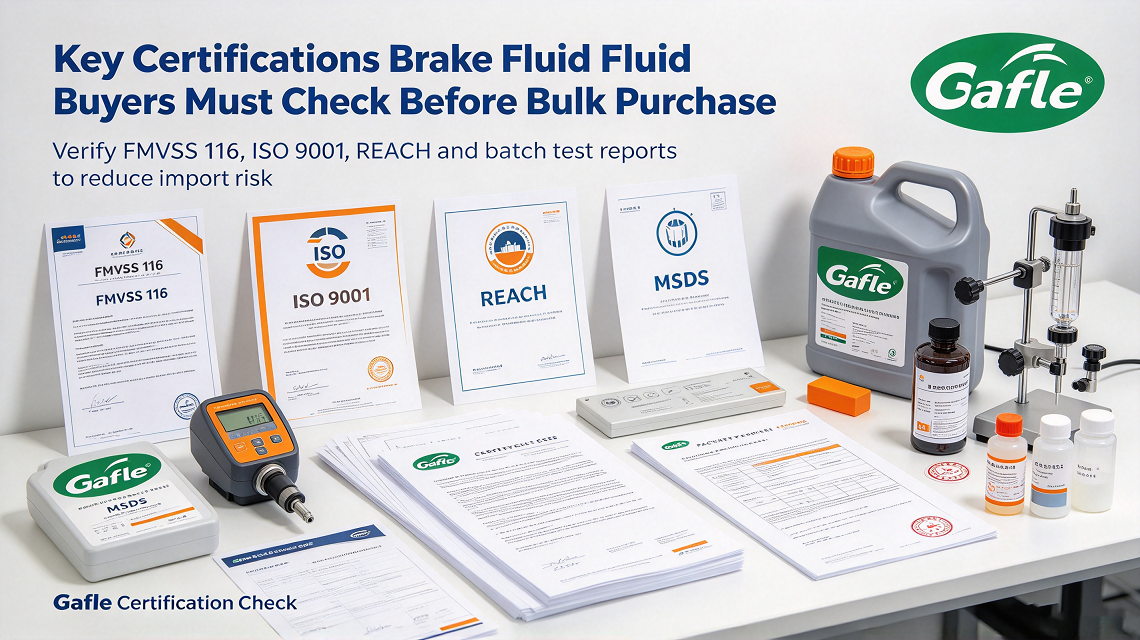
In the North American market, federal law dictates that any brake fluid sold for highway use must meet the Department of Transportation (DOT) specifications outlined in 49 CFR § 571.116. Producing compliant FMVSS 116 brake fluid is not simply a matter of hitting target dry boiling points; it governs a wide array of physical and chemical traits. Blenders must balance Equilibrium Reflux Boiling Point (ERBP), Wet ERBP, high- and low-temperature kinematic viscosity (notably at -40°C), pH balance, and corrosion inhibition across multiple alloys, including cast iron, aluminum, and brass.
Outside the United States, equivalent standards like ISO 4925 and SAE J1703 / J1704 apply. A legitimate manufacturer should demonstrate compliance across all relevant benchmarks. While FMVSS 116 is self-certified by manufacturers under US National Highway Traffic Safety Administration (NHTSA) rules, self-certification places the legal and financial burden squarely on the supply chain. If an auditor or automotive OEM requests validation, the manufacturing partner must provide exhaustive historical test logs, not merely a signature on an invoice.
Quality Management: What Being ISO Certified Really Means in Chemical Blending
Most chemical toll blenders will advertise that their facility is ISO certified. For an automotive component or fluid buyer, however, the specific standard matters tremendously. An ISO 9001 registration shows that basic document control and quality management procedures exist, but it does not account for the defect-prevention mechanisms demanded by tier suppliers.
If you are procuring fluid for factory-fill or commercial fleet distribution, aim for partners operating under IATF 16949. This standard introduces rigorous requirements around statistical process control, traceability of raw glycol ethers and borate esters, and formal contamination-control protocols. Water contamination is the natural enemy of polyglycol brake fluids; a blender lacking sealed storage, nitrogen blanketing on bulk tanks, and automated moisture monitoring can easily produce batches that fall below Wet ERBP specifications before the fluid ever reaches a packaging line.
Scrutinizing the Batch Test Certificate
Never accept a generic product data sheet in lieu of lot-specific documentation. Every inbound shipment should arrive with a comprehensive batch test certificate (often issued as a Certificate of Analysis, or CoA). When auditing these documents, engineers should look for actual quantitative analytical values rather than blanket 'pass' notations.
A credible test certificate should record:
- Equilibrium Reflux Boiling Point (ERBP): Validated dry boiling point ensuring the fresh formulation resists vapor lock during heavy braking.
- Wet ERBP: Tested after controlled humidification to reflect real-world aging in vented brake reservoirs.
- Kinematic Viscosity at -40°C: Critical for modern ABS and Electronic Stability Control (ESC) systems, where viscous fluid delays valve cycling.
- Moisture Content: Measured precisely via Karl Fischer titration, usually kept under 0.20% at the time of packaging.
- pH Level: Ensuring the fluid does not drift into an acidic state that attacks copper or steel brake lines.
One practical buyer warning: pay attention to whether the lab tests are performed in-house or outsourced. While third-party verification is valuable for periodic audits, a blender that cannot perform Karl Fischer titration and kinematic viscosity testing in their own quality control lab cannot react quickly to batch drifts during blending.
Common Pitfalls in Vendor Qualification
A frequent error among procurement teams is confusing packaging integrity with chemical compliance. A facility may have clean, automated blow-molding and filling lines, yet struggle with raw material variation. If a supplier changes their supply of corrosion inhibitor packages or relies on unvetted secondary glycol streams, the fluid may pass basic boiling tests while failing long-term elastomeric compatibility trials.
Make sure to request swell and hardness test data for standard rubber formulations (such as EPDM and SBR). Incompatible fluid chemistries will degrade internal caliper seals and master cylinder cups, creating slow hydraulic leaks that bench testing of pure fluid properties does not reveal.
Frequently Asked Questions
Is NHTSA approval the same as a brake fluid certification?
No. NHTSA does not issue 'approvals' or certificates for brake fluids. The agency sets the standard (FMVSS 116), and blenders self-certify. NHTSA enforces compliance through random spot purchases and lab testing. When a manufacturer claims to be 'DOT approved,' it simply means they claim their product complies with the regulation.
Can an ISO 9001 facility blend private-label DOT 4 fluid?
Yes, many do. However, the buyer must take on additional audit responsibilities to verify batch consistency, packaging seals, and traceability, as ISO 9001 does not mandate the specialized automotive process controls found in IATF 16949.
Next Steps for Sourcing Teams
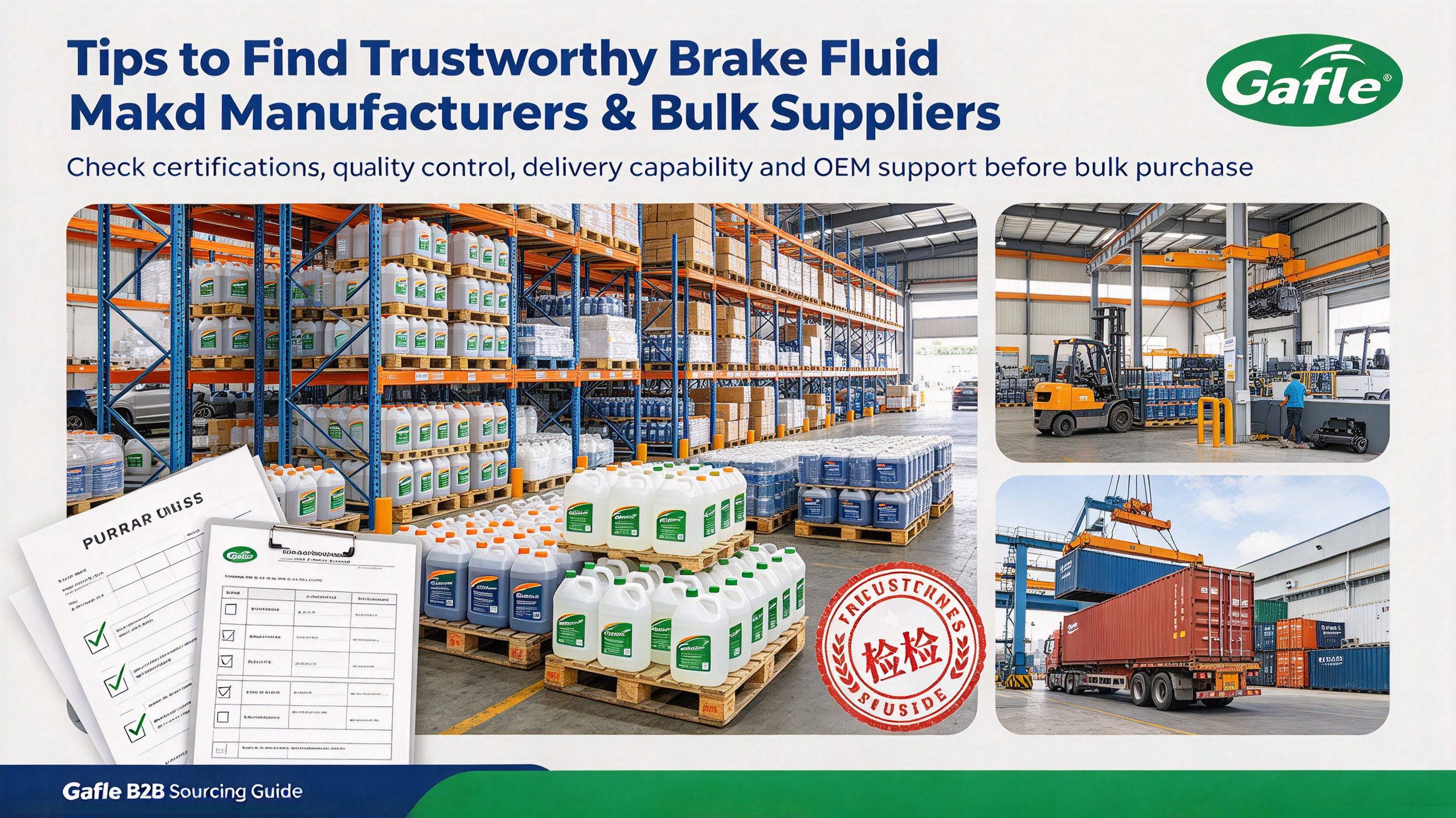
Before executing an agreement with a new supplier, request their three most recent lot release packages, including internal lab reports, raw material CoAs, and third-party laboratory audits. Cross-reference their stated metrics against the target DOT or ISO performance grade, and schedule an on-site or virtual walk-through focused entirely on raw material storage and moisture mitigation.
Welcome to contact GAFLE for more information & cooperation!
peter
ZHEJIANG GAFLE AUTO CHEMICL CO.,LTD
Tel:86-579-8222 1665
Fax:86-579-8246 4690
Cel/Wechart:86-13335993986
E-mail:peter@gafle.net
Web:www.gafle.net