logo

What Is the Best Brake Fluid for Different Automotive Applications?

logo

Published

Oct 21 2026

  • Buying Guide

Follow us

what-is-the-best-brake-fluid-for-different-automotive-applications
What Is the Best Brake Fluid for Different Automotive Applications?
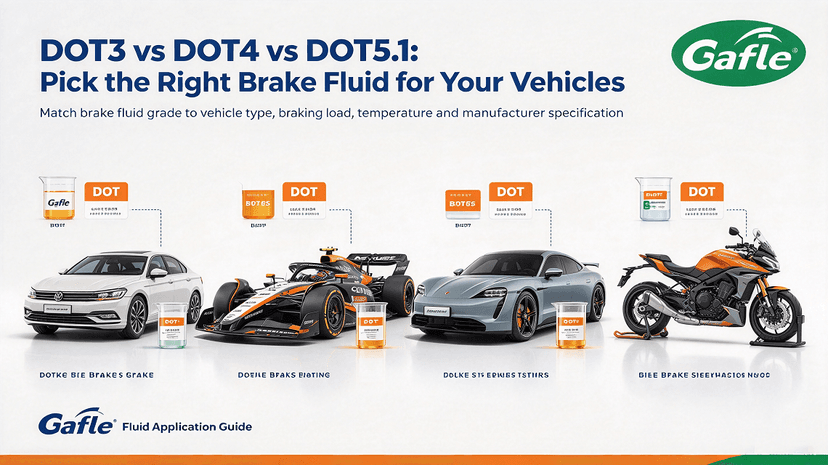
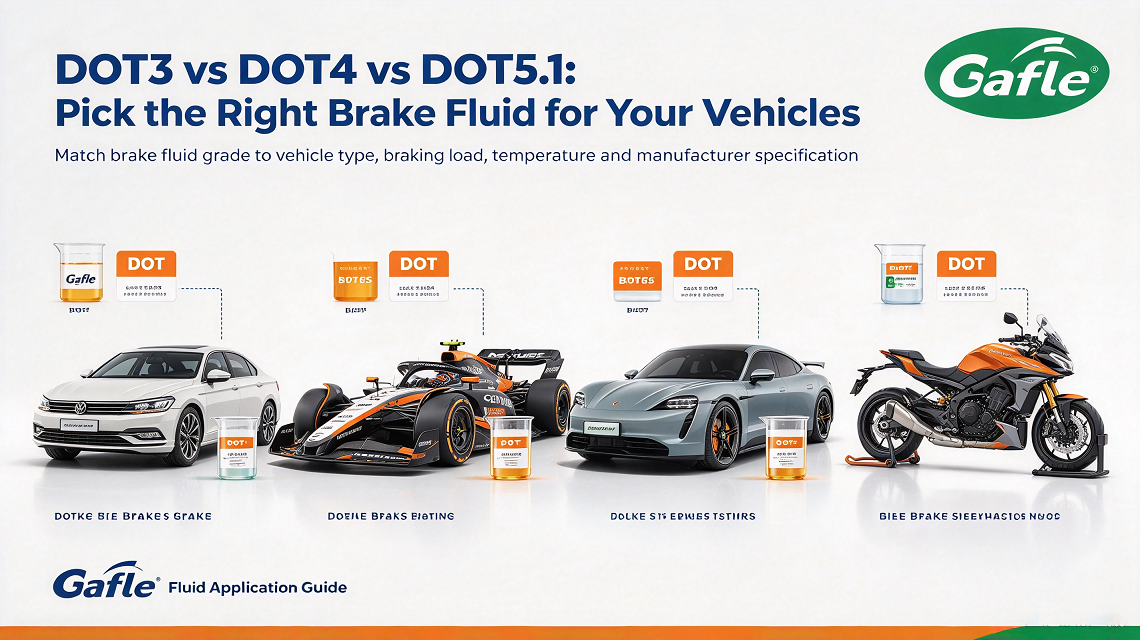
There is no single "best brake fluid" that fits all vehicles. The most suitable brake fluid depends on your vehicle type, braking load, working temperature and the official factory requirement.
Many car owners and auto shop staff simply buy DOT4 blindly, while ignoring that mismatched brake fluid will accelerate corrosion, reduce braking efficiency and bring hidden safety hazards. Understanding each DOT grade and its applicable scenarios helps you make the correct decision.
DOT grades are classified mainly based on boiling point performance, which is the core index of brake fluid safety.
DOT3, DOT4 and DOT5.1 are all glycol-based and hygroscopic. DOT5 is silicone-based, non-hygroscopic but incompatible with traditional glycol brake fluid systems. Boiling point directly reflects whether the fluid will vapor lock under high-temperature braking, which is the main cause of soft brake pedals.
For ordinary passenger cars and light commercial vehicles, DOT4 brake fluid is the most widely recommended option.
It has higher dry and wet boiling points than DOT3 and balances cost and performance well. Older cars originally specified for DOT3 can still use DOT3, but upgrading to qualified DOT4 is acceptable after full system flush. Daily city driving with normal braking intensity will not reach the temperature limit of standard DOT4 fluid.
Racing cars, modified performance vehicles and heavy-duty fleets need high-performance racing brake fluid.
Frequent hard braking generates massive heat inside calipers and brake lines. Standard DOT4 cannot handle continuous high-temperature conditions. Racing-grade brake fluid features extremely high dry boiling point to resist vapor lock during track driving. It also needs more frequent replacement because it absorbs moisture faster.
Electric vehicles put forward new special requirements for brake fluid.
Many EVs are equipped with regenerative braking and ESP hydraulic systems. Their brake fluid must keep stable viscosity in a wide temperature range and be compatible with electronic hydraulic modules. Some dedicated EV brake fluid formulas also reduce corrosion risk to new lightweight alloy parts.
Never mix different base types of brake fluid casually.
Mixing glycol fluid and silicone DOT5 will lead to separation and system failure. Even between DOT3 and DOT4, full bleeding and flushing is recommended if you switch, instead of direct topping up. Always check the vehicle service manual as the first priority.
The best brake fluid always matches your actual application.
Daily family cars prioritize stable DOT4; track vehicles choose racing high-boiling-point fluid; EV owners should select fluid certified for electric hydraulic brake systems. Do not overspend on racing fluid for daily commuter cars, which brings no extra benefit but raises maintenance cost.
Welcome to contact GAFLE for more information & cooperation!
peter
ZHEJIANG GAFLE AUTO CHEMICL CO.,LTD
Tel:86-579-8222 1665
Fax:86-579-8246 4690
Cel/Wechart:86-13335993986
E-mail:peter@gafle.net
Web:www.gafle.net
Featured Blogs
What is the lead time for bulk brake fluid orders?

What is the lead time for bulk brake fluid orders?

1. Deconstructing the Manufacturing Timeline 2. OEM Brake Fluid Production vs. Off-the-Shelf Bulk 3. Packaging: The Primary Bottleneck in Private Label Lead Times 4. Quality Control Testing and Release Schedules 5. Strategies to Mitigate and Stabilize Delivery Time 6. Frequently Asked Questions

Can you provide private label brake fluid?

Can you provide private label brake fluid?

1. Navigating the Private Label Brake Fluid Market: Sourcing, Formulations, and Compliance 2. DOT Standards and Chemical Formulations: What Buyers Must Verify 3. OEM vs. ODM: Structuring the Supply Contract 4. Packaging, Ingress, and Custom Label Regulations 5. Managing Branded Brake Fluid for Resellers 6. Common Sourcing Traps to Avoid 7. Frequently Asked Questions 8. Next Steps: Auditing Potential Blending Partners

What is the MOQ for bulk brake fluid orders?

What is the MOQ for bulk brake fluid orders?

1. Navigating Volume Tiers: What Is the MOQ for Bulk Brake Fluid Orders? 2. The Baseline Numbers: MOQ by Delivery Format 3. The Technical Drivers Behind Factory Minimums 4. Strategies to Manage High MOQs 5. A Critical Procurement Caution on Storage 6. Frequently Asked Questions 7. Evaluating Your Next Supply Step

What certifications should a brake fluid manufacturer have?

What certifications should a brake fluid manufacturer have?

1. Navigating Brake Fluid Manufacturer Certification: What Sourcing Teams Must Verify 2. The Regulatory Baseline: FMVSS 116 and Global Standards 3. Quality Management: What Being ISO Certified Really Means in Chemical Blending 4. Scrutinizing the Batch Test Certificate 5. Common Pitfalls in Vendor Qualification 6. Frequently Asked Questions 7. Next Steps for Sourcing Teams

What Is the Best Brake Fluid for Different Automotive Applications?

What Is the Best Brake Fluid for Different Automotive Applications?

1. There is no single "best brake fluid" that fits all vehicles. The most suitable brake fluid depends on your vehicle type, braking load, working temperature and the official factory requirement. 2. DOT grades are classified mainly based on boiling point performance, which is the core index of brake fluid safety. 3. For ordinary passenger cars and light commercial vehicles, DOT4 brake fluid is the most widely recommended option. 4. Racing cars, modified performance vehicles and heavy-duty fleets need high-performance racing brake fluid. 5. Electric vehicles put forward new special requirements for brake fluid. 6. Never mix different base types of brake fluid casually. 7. The best brake fluid always matches your actual application.

How to choose a reliable brake fluid supplier?

How to choose a reliable brake fluid supplier?

1. How to Choose a Reliable Brake Fluid Supplier for Long-Term Quality 2. Formulation Integrity: Blending vs. True Chemical Control 3. Critical Benchmarks for Factory Evaluation 4. Working with a Private Label Brake Fluid Factory 5. Common Pitfalls in Fluid Sourcing 6. Practical Steps for Buyer Audits 7. Frequently Asked Questions 8. Securing Your Supply Chain