Navigating Volume Tiers: What Is the MOQ for Bulk Brake Fluid Orders?
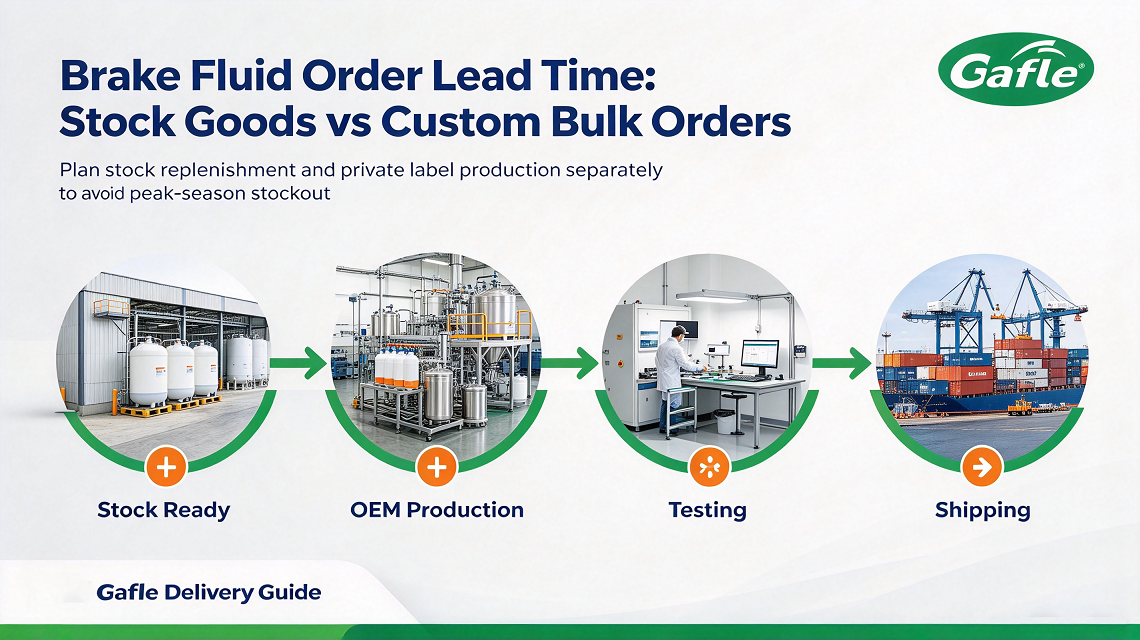
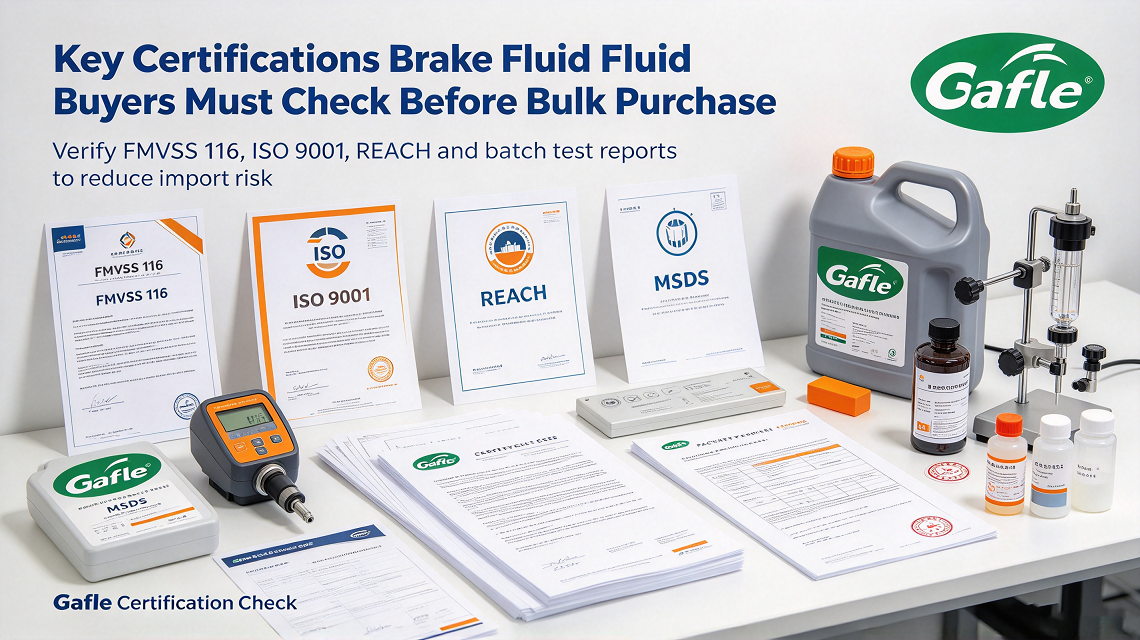
Procurement managers negotiating aftermarket chemical contracts quickly learn there is no universal baseline when determining what is the MOQ for bulk brake fluid orders. Depending on whether you are sourcing unpackaged fluid for an automated bottling line or contracting finished retail packaging, the minimum order quantity can range from a single 1,000-liter IBC tote to 20,000 consumer-ready bottles. The threshold is not set arbitrarily; it is driven almost entirely by blending batch hygiene, packaging machinery setup times, and the strict quality controls required under FMVSS No. 116 and SAE J1703 standards.
For operations teams planning their inventory turnover, knowing these operational breakpoints before approaching toll blenders prevents mismatched expectations and unnecessary storage liabilities.
The Baseline Numbers: MOQ by Delivery Format
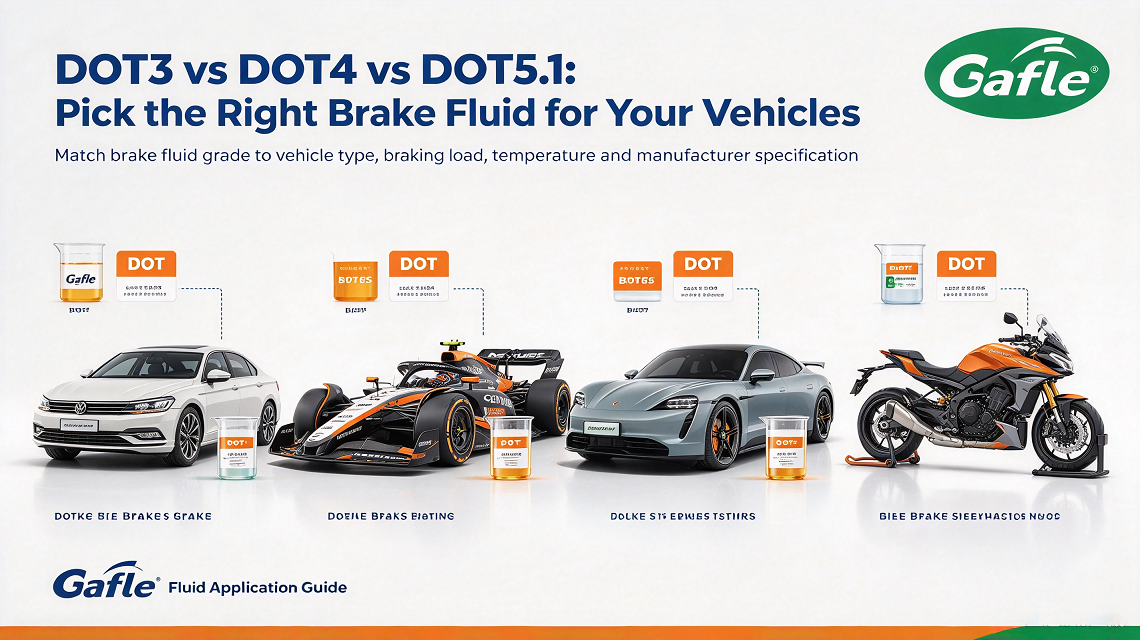
To evaluate a prospective supplier's brake fluid bulk MOQ, you have to separate raw liquid volume from containerization overhead. Brake fluids—predominantly glycol ethers, borate ester blends (DOT 4 and DOT 5.1), or silicone formulations (DOT 5)—require distinct handling depending on how they exit the plant.
1. Intermediate Bulk Containers (IBC Totes) and Drums
When purchasing unbottled bulk product for repacking or commercial workshop dispensing, the minimum order quantity typically scales around standard industrial packaging modules:
- Steel Drums (200L / 55-gallon): Most blenders require an order of at least 4 to 8 drums (one to two standard pallets), roughly equivalent to 800 to 1,600 liters. Smaller batch setups occasionally accept 2 drums, but you will pay a steep line-filling surcharge.
- IBC Totes (1,000L): A single tote (1,000 liters) is frequently the absolute lowest floor for an intermediate bulk container order. However, if the chemical plant must perform an off-schedule blend rather than drawing from an active holding tank, expect a minimum of two to three totes (2,000 to 3,000 liters) to justify the batch turnaround.
- ISO Tanks and Tanker Trucks: For high-volume automotive plants or major repackers, bulk tankers require ordering full capacity—generally 20,000 to 24,000 liters.
2. Private Label Bottled Goods (Retail & Workshop Packouts)
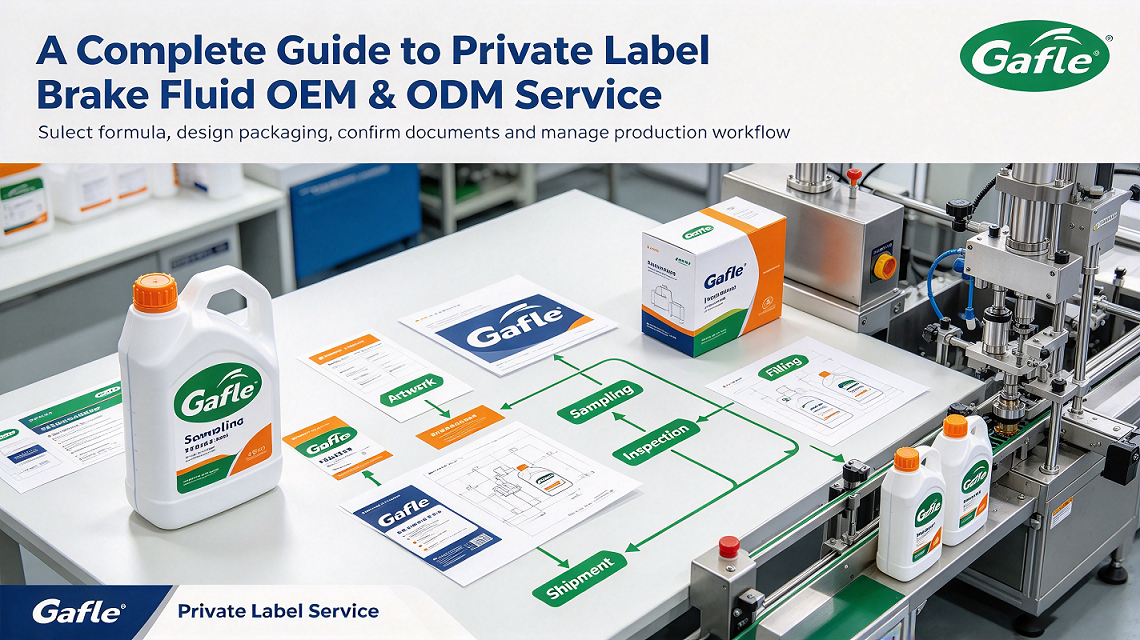
Sourcing private label brake fluid in consumer sizes (250ml, 500ml, 1L, or 1-gallon bottles) introduces a completely different set of manufacturing constraints. Here, fluid batch minimums intersect with packaging line changeovers and lithographic printing runs.
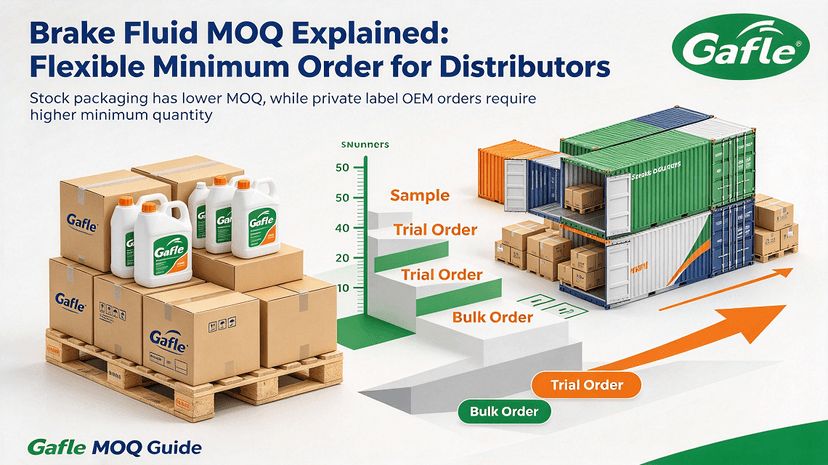
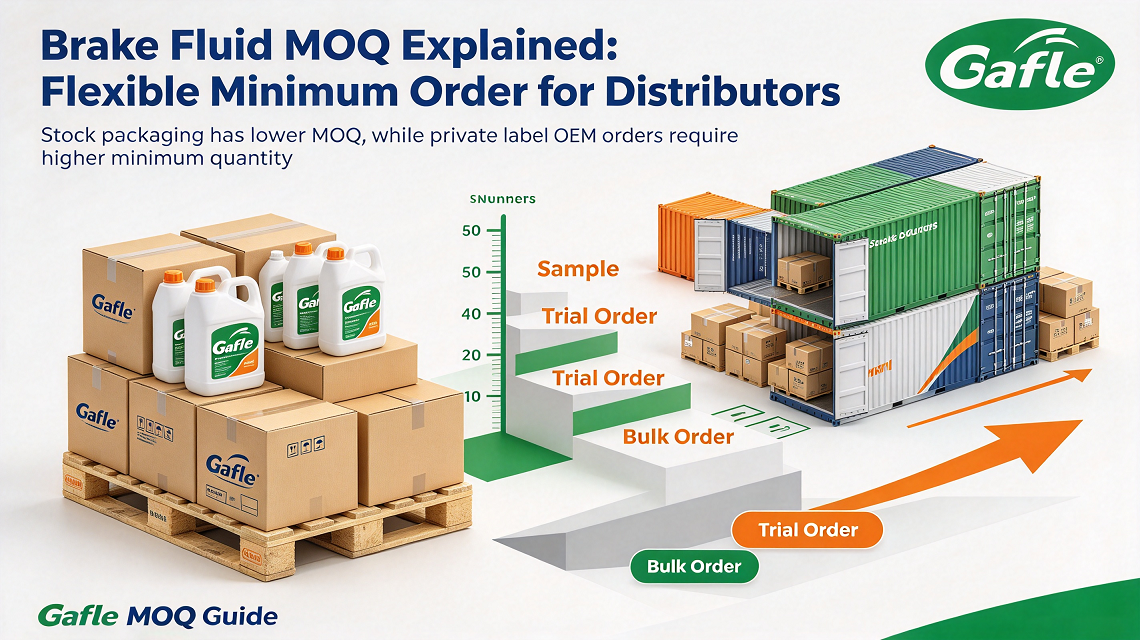
Generally, factory MOQs for contract-packaged bottles land between 3,000 and 10,000 units per stock keeping unit (SKU). If you choose a stock container shape that the plant already runs continuously, a supplier might let you split a 5,000-liter blend across two bottle sizes (e.g., 500ml and 1L). Conversely, if you mandate custom mold colors or specialized HDPE barrier bottles, the bottleneck shifts to the bottle blow-molder, easily pushing minimums past 15,000 units.
The Technical Drivers Behind Factory Minimums
Buyers often ask why blenders cannot simply run a flexible 300-liter batch of specialized DOT 4 Plus or racing-grade fluid. The friction lies in the nature of glycol-based hydraulic chemistries.
Brake fluid is aggressively hygroscopic; it absorbs atmospheric moisture rapidly, which degrades wet boiling points. Blending tanks must maintain nitrogen blanketing to prevent moisture ingress during processing. When transitioning a blending vessel from a high-borate ester DOT 4 to a standard DOT 3—or, even more critically, separating glycol lines from polydimethylsiloxane-based DOT 5—the flush-and-clean protocol consumes substantial solvent and downtime. If an order cannot absorb the material loss and labor cost of that line clearance, the run simply is not economically viable for the plant.
Strategies to Manage High MOQs
If your projected run rates do not immediately meet a manufacturer's preferred volume tier, several workarounds exist:
- Standardize on Stock Master Batch Formulations: Avoid demanding proprietary chemical modifications unless you have enterprise-level volume. Aligning your specification with the toller’s core commercial DOT 4 enables them to pull your volume from an existing, high-turnover bulk batch.
- Utilize Blanket Purchase Orders with Scheduled Call-Offs: Contract for a 10,000-unit annual commitment to hit price and production breaks, but negotiate warehouse hold agreements where 2,500-unit increments ship quarterly. Keep in mind that suppliers may charge storage fees if fluid sits beyond 60 to 90 days.
- Consolidate Private Label Packaging Runs: Standardize on one bottle footprint across markets. Using identical 500ml containers and merely swapping roll-fed label stock between regional variants often satisfies factory run minimums without forcing you to overstock single SKUs.
A Critical Procurement Caution on Storage
A low price per liter is meaningless if half the shipment exceeds acceptable moisture limits before reaching the customer. Storing intermediate bulk totes or unsealed drums across seasons in unconditioned regional warehouses exposes them to condensation and seal degradation. Unless you have climate-regulated warehousing and tight distribution turns, taking on an oversized minimum order quantity to save pennies per unit on hydraulic fluid often backfires into scrapped inventory during audit testing.
Frequently Asked Questions
Can I mix different DOT specifications to meet a single MOQ?
Usually, no. Because DOT 3, DOT 4, and DOT 5.1 require distinct chemical blending calculations and sometimes separate storage manifolds, they are treated as distinct manufacturing batches. However, you can often negotiate blended shipping freight if the facility manufactures both formulas concurrently.
Why are private label MOQs so much higher than unlabelled drums?
Packaging line changeovers—including bottle unscramblers, torque heads, inductive sealers, labelers, and case packers—require several hours of technician setup and calibration. Toll fillers offset this non-productive downtime by establishing minimum unit counts for finished goods.
Evaluating Your Next Supply Step
When building your sourcing RFQ, define not just your annual forecast, but your immediate fill-line or warehousing capacity. Clarify whether the prospective chemical supplier permits shared batch runs or requires self-contained manufacturing blocks. Balancing factory batch realities against your genuine shelf turnover ensures your inventory stays compliant, active, and cost-effective.
Welcome to contact GAFLE for more information & cooperation!
peter
ZHEJIANG GAFLE AUTO CHEMICL CO.,LTD
Tel:86-579-8222 1665
Fax:86-579-8246 4690
Cel/Wechart:86-13335993986
E-mail:peter@gafle.net
Web:www.gafle.net