Quick Answer — What should buyers verify first? A dependable brake fluid manufacturer does not prove quality with one impressive boiling-point figure or a successful hand-prepared sample. Procurement teams should verify the vehicle and destination-market specification, exact fluid formula, test methods and acceptance limits, moisture-control practices, sealed container design, and lot-specific traceability. Only when an approved sample can be reproduced in a pilot lot and successive commercial batches should a large OEM or wholesale order move ahead.
Manufacturing a hydraulic brake fluid is an exercise in controlling chemistry and variability. A batch may pass a headline dry boiling-point test but still need evidence for wet boiling behavior, low-temperature viscosity, corrosion, rubber compatibility and packaging integrity. That is why factory evaluation should resemble engineering process qualification—not a search for the cheapest bottle.
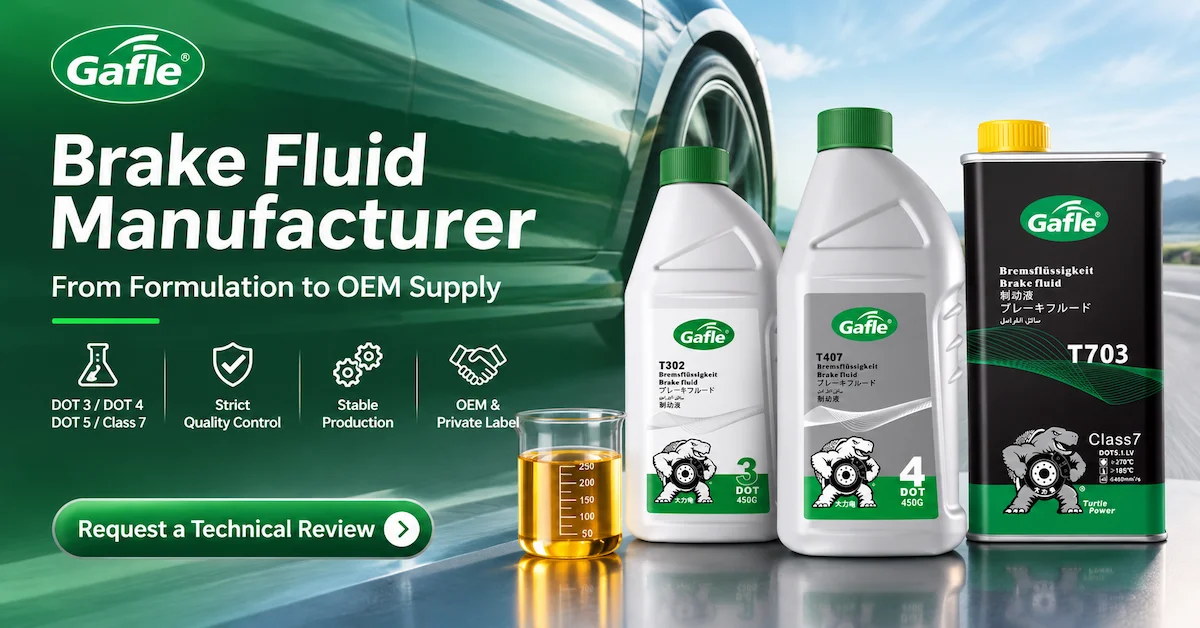
This article adapts the technical-first comparison, process-control, measured-validation and buyer-decision structure used in strong industrial engineering content. It applies the approach to GAFLE's published DOT product range without inventing factory-specific test results, unverified client case studies or fixed MOQ promises. It is designed for importers, automotive aftermarket distributors, technical buyers and private-label brand owners.
GAFLE TECHNICAL SOURCING
Start with the right documented formula
Explore GAFLE Brake Fluid Products ↗Request a Technical Review ↗Engineering Snapshot: What Must a Brake Fluid Factory Prove Before Mass Production?
The most useful supplier discussion starts with four interacting requirements, not one marketing claim. The table is a buyer-side evaluation framework, not a performance comparison of named factories.
| Qualification dimension | Technical or commercial question | Evidence to collect | Go/no-go rule |
|---|---|---|---|
| Grade and application | Which fluid chemistry, grade, standard and vehicle requirement must the SKU meet? | Approved requirement sheet, standard version, product specification | Reject an unsupported vehicle or grade claim |
| Process consistency | Can the same qualified formulation be made under controlled material and moisture conditions? | Formula revision, manufacturing records, contamination-control plan | Do not scale a sample without process evidence |
| Test and packaging integrity | Are laboratory results, sealing, labeling and lot codes linked to the shipped product? | TDS, qualification report, batch COA, bottle/closure and artwork approval | Hold any lot lacking traceability or required testing |
| Volume economics | Can the supplier repeat the exact approved SKU at the required order mix? | MOQ by variant, release time, shipping terms, complaint and change provisions | Compare costs only after critical technical gates pass |
Key Takeaways
- Engineering fit first: DOT grade, standard edition and vehicle requirements must match the intended application; “highest DOT number” is not a universal selection rule.
- Control the variation: raw-material identification, formula revision, moisture exposure, transfer equipment and filling conditions can affect the consistency of a finished lot.
- Test the actual product: a regulatory limit, typical catalogue value and batch COA are different evidence types and must never be conflated.
- Protect the supply chain: the buyer should approve the bottle, inner seal, artwork, lot code and document package alongside the fluid.
- Order by evidence: use a controlled sample-to-pilot-to-release route and demand written change notification for later shipments.
How Does a Brake Fluid Manufacturer Convert a Formula Into Repeatable Production?
A laboratory formula is only the starting point. A manufacturer has to receive the specified materials, control their identity and storage, reproduce the approved mixing sequence, limit exposure to contamination, fill compatible containers, verify conformity and preserve a traceable history for each shipment. Each transfer between stages creates a potential variation point.
Brake fluid is a safety-critical hydraulic medium. In a compatible braking system it transmits pressure while operating across changes in temperature, water exposure, pressure cycling, and contact with elastomers and metals. A supplier error may affect fluid performance or component compatibility; a packaging error may allow contamination; an incorrect application statement may lead a workshop to choose the wrong material. These concerns explain why a product that looks like an ordinary automotive consumable requires more demanding purchasing discipline.
For buyers, a manufacturer's commercial role goes beyond blending and filling. It must deliver a specified material to a specified market in an identifiable package, provide the documents necessary for technical and legal review, and maintain consistency as quantities grow. An exporter with a beautiful catalogue but no workable revision control may be less valuable than one that can demonstrate exactly how an approved formula moves through production, packaging, shipping, and reordering.
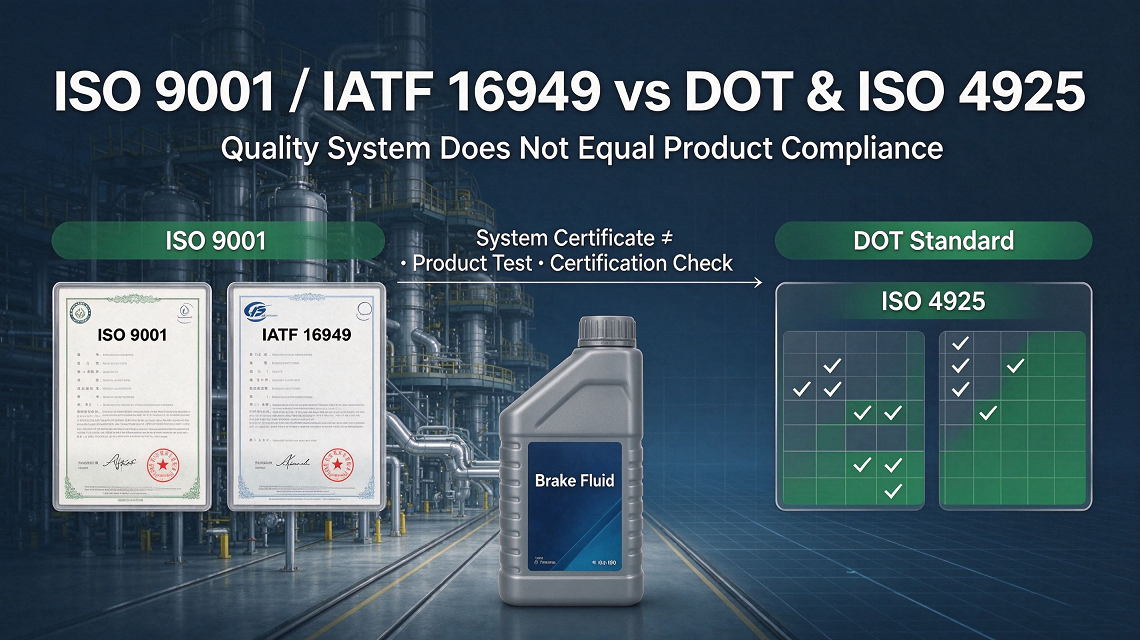
A practical distinction is between supplier selection and product qualification. Supplier selection asks whether the organization has the equipment, people, systems, and commercial capacity needed. Product qualification asks whether the particular formulation, specification, package, and batch meet the buyer's documented requirements. Both must pass. An ISO or IATF management-system certificate can be relevant to factory credibility, but it does not itself prove that a given fluid is approved for a particular vehicle or meets every cited product standard.
Commercial reliability comes from controlling inputs and operations. Non-silicone DOT brake-fluid formulations commonly use glycol-related base chemistries and additives selected for applicable performance requirements. The actual formulation belongs to the supplier's controlled technical file; a buyer should not assume all brands or grades use the same ingredient combination. How the facility protects those materials from contamination can matter as much as the ingredient list.
The process review should cover material receipt, identification and storage, blend preparation, mixing conditions, transfer and filtration where relevant, sampling, approved bulk holding, filling, closure application, labeling, inspection and segregation of released versus unreleased lots. Moisture control is particularly important for many glycol-based products, but a generic claim of “dust-free” production does not establish every contaminant level or water-content result. Ask which parameters are controlled and how the evidence is recorded.
A buyer visiting a plant can ask a practical question at each operation: How do you know the correct material is here, how do you prevent a mix-up, and which record will identify this step in six months? This approach is more useful than counting the number of machines on a factory tour. It also helps distinguish manufacturing capability from purely commercial sourcing and relabeling services.
FORK's company introduction describes automated production and controlled manufacturing conditions, while its quality-control article discusses raw-material inspection, formula control and batch testing. These are useful starting points for a supplier conversation. They should be backed by current project-specific records when deciding on a significant order.
Manufacturing control points and their buyer-visible outputs
| Process step | Potential deviation | Control evidence that a buyer can request |
|---|---|---|
| Incoming material receipt | Wrong base fluid or unqualified additive | Approved-supplier record, incoming lot ID and acceptance status |
| Formula weighing and blending | Dosing or revision error | Controlled formula, batch sheet, weighing verification and mixing record |
| Bulk storage and transfer | Moisture, residue or cross-contact | Storage and line-cleaning procedure, transfer records, quality sampling |
| Laboratory qualification | Incomplete or nonrepresentative testing | Tested sample ID, methods, acceptance limits and dated results |
| Filling, capping and labeling | Damaged seal, wrong label or missing lot code | Approved pack specification, closure check, artwork revision, coding inspection |
| Finished-goods release | Unapproved lot shipped | Signed release status and traceable lot-specific document |
An importer does not need access to the manufacturer's confidential ingredient percentages to audit the system. It needs to establish that the formula is controlled and that any substitution or change receives a documented technical review before the buyer's approved product is affected.
Which Technical Performance Limits Matter Most for DOT Brake Fluid?
The brake-fluid grade is a technical starting point. Under FMVSS No. 116 (49 CFR §571.116), selected minimum dry equilibrium reflux boiling point (ERBP), wet ERBP and maximum low-temperature viscosity requirements differ by grade. The table gives regulatory category limits, not GAFLE product test results.
| Selected FMVSS No. 116 criterion | DOT 3 | DOT 4 | DOT 5.1 non-silicone |
|---|---|---|---|
| Minimum dry ERBP | 205°C | 230°C | 260°C |
| ERBP Minimum Act | 140°C | 155°C | 180°C |
| Maximum viscosity at −40°C | 1,500 mm²/s | 1,800 mm²/s | 900 mm²/s |
| Broad fluid family | Non-silicone | Non-silicone | Non-silicone; distinct from silicone DOT 5 |
The full regulation includes additional provisions for pH, high-temperature and chemical stability, corrosion, fluidity, water tolerance, compatibility, rubber effects, packaging and labeling. A nominal DOT grade alone cannot establish specific automaker approval or justify a substitution contrary to a vehicle manufacturer's service instructions.
What do dry and wet boiling points actually prove?
Dry ERBP represents an equilibrium-reflux boiling measurement under defined conditions for the tested fluid. Wet ERBP evaluates a conditioned sample after the standard's prescribed moisture exposure. Both matter, but neither can be read as a promise that a vehicle will never experience vapor-related braking problems: brake-system condition, service history and operating temperature all influence real-world performance.
For a factory audit, ask whether the listed value is a statutory minimum, an internal release target, a typical TDS number, a contractual minimum or an actual test result. These are not interchangeable. The same applies to viscosity. A supplier advertising “DOT 4 LV” should document the relevant SAE/ISO low-viscosity class and method. LV is not a separate DOT designation under FMVSS No. 116.
Why can compatibility outweigh an impressive boiling point?
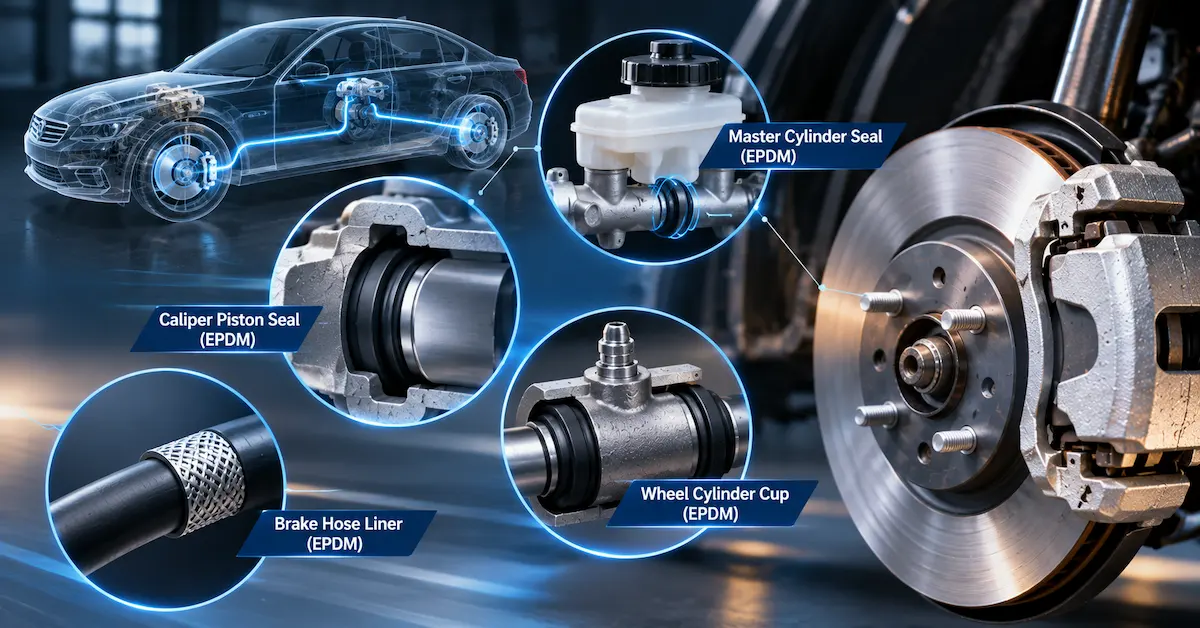
A fluid is in contact with multiple materials and seals. Corrosion and elastomer tests help establish whether the proposed formulation can satisfy the applicable requirements under laboratory conditions. A high boiling point cannot compensate for missing compatibility evidence, wrong chemistry or an unsuitable system application. Non-silicone DOT 5.1 is not silicone DOT 5, and mineral-oil hydraulic products are not ordinary substitutes for glycol-based brake fluids.
An engineering purchasing specification should therefore include the complete relevant test matrix and the exact acceptance limits—not only the most attractive marketing number.
Where Does Batch-to-Batch Variation Come From?
Variation does not necessarily indicate deliberate misconduct. It can arise when a laboratory-developed product is transferred to larger equipment or when an approved package is produced at a different pace. For a safety-critical automotive fluid, the point of quality management is to identify foreseeable variables and demonstrate how the plant detects and controls them.
Raw materials: Incoming lots may differ within their own specifications. The factory should approve suppliers, identify every delivered material and document any alternate source or additive package. An importer should ask whether a supplier substitution triggers a documented impact assessment.
Blending: Incorrect charging sequence, weighing, incomplete mixing or a mismatch between the laboratory recipe and plant batch instructions can create variation. Controls may include reviewed instructions, calibrated equipment, batch identification, sign-off and controlled sampling. No universal mixing time or temperature can responsibly be claimed for every formulation.
Moisture and cleanliness: Many non-silicone glycol-related brake fluids can absorb water. Open handling, bulk storage, repeated transfer, humid packaging conditions or unsuitable seals can add avoidable exposure. Appropriate controls depend on the actual facility, formula and risk assessment. It would be misleading to assume that every supplier uses nitrogen blanketing or a particular humidity threshold without site evidence.
Sampling and testing: Even a good process can be mischaracterized by unclear sample identity, wrong test version, reporting mistakes or failure to distinguish qualification testing from routine lot release. The buyer should know the test plan before interpreting a COA.
Packaging: A correct fluid in the wrong bottle, a leaking closure or a label showing the wrong product grade can still create a nonconforming shipment. Packaging and artwork revisions must be traceable in the same way as the formulation.
| Variation source | Potential commercial consequence | Practical qualification question |
|---|---|---|
| Material substitution | Changed performance or requalification need | Who authorizes alternative inputs? |
| Mix or batch-instruction drift | Inconsistent physical properties | Which parameters are recorded and reviewed? |
| Moisture exposure | Changed condition of packaged fluid | How is open handling and filling controlled? |
| Test-method mismatch | False comparability across reports | Which edition, units and methods are used? |
| Wrong cap, artwork or code | Regulatory, leak or traceability problems | Are every formula and package revision approved together? |
A serious brake fluid manufacturer should be able to discuss these failure modes in concrete process terms without exposing proprietary formulation secrets. For a buyer, the objective is observable controls, clear ownership and usable records.
How Can a Factory Control Moisture and Packaging Risks?
Moisture control starts before the cap is closed. Buyers should inspect the full route from raw-material storage to bulk holding, transfer, filling and final closure. Ask when the fluid is exposed to ambient conditions, how containers are kept dry and clean, and what happens when a transfer or filling interruption occurs.
A package should be qualified as a technical component. A cap that appears secure is not necessarily equivalent to a validated closure and inner seal. Under applicable FMVSS No. 116 rules, brake-fluid containers with a capacity of 177 mL or more require a resealable closure with an inner seal impervious to the fluid and a tamper-proof feature. The same rule includes important safety and identification labeling provisions for U.S. applications. Importers targeting other countries must check the local rules and cannot simply assume a U.S. label is sufficient.
A packaging validation file may include the bottle material, closure type, inner seal, cap application checks, labeled fill quantity, transport protection, batch code, language/version control and approved physical sample. The technical review should document which checks are carried out for every lot and which have been established through qualification or periodic audit.
A large-volume workshop pack may reduce packaging cost per liter, but repeated opening can be a practical risk if consumption is slow. A smaller sealed retail unit may be preferable for some channels. Neither option is universally better: the correct format depends on the distributor's turnover, the vehicle service application and agreed requirements.
The most useful question is not whether the bottle looks premium. It is whether the fluid, closure, label and traceability are still the same controlled product that the buyer approved. A contract should name the packaging specifications rather than relying only on a photograph.
What Laboratory Evidence Demonstrates Actual Manufacturing Consistency?
A technical report should answer: What was tested, according to which method, on which formulation or batch, on what date, and against which acceptance limit? If any of these elements is missing, the buyer may have a performance claim but not sufficient evidence for product qualification. This applies to independent reports and factory-issued reports alike. Where an import program requires accredited or third-party testing, confirm the laboratory's relevant competence and report scope.
The distinction between minimum requirement, typical value, guaranteed product specification and actual batch result is crucial. A DOT 4 regulatory dry ERBP threshold of 230°C, for example, is not the same thing as a specific commercial product testing at exactly 230°C, nor is a website's “up to” claim necessarily a batch-release guarantee. Procurement should request numbers and conditions appropriate to the contract.
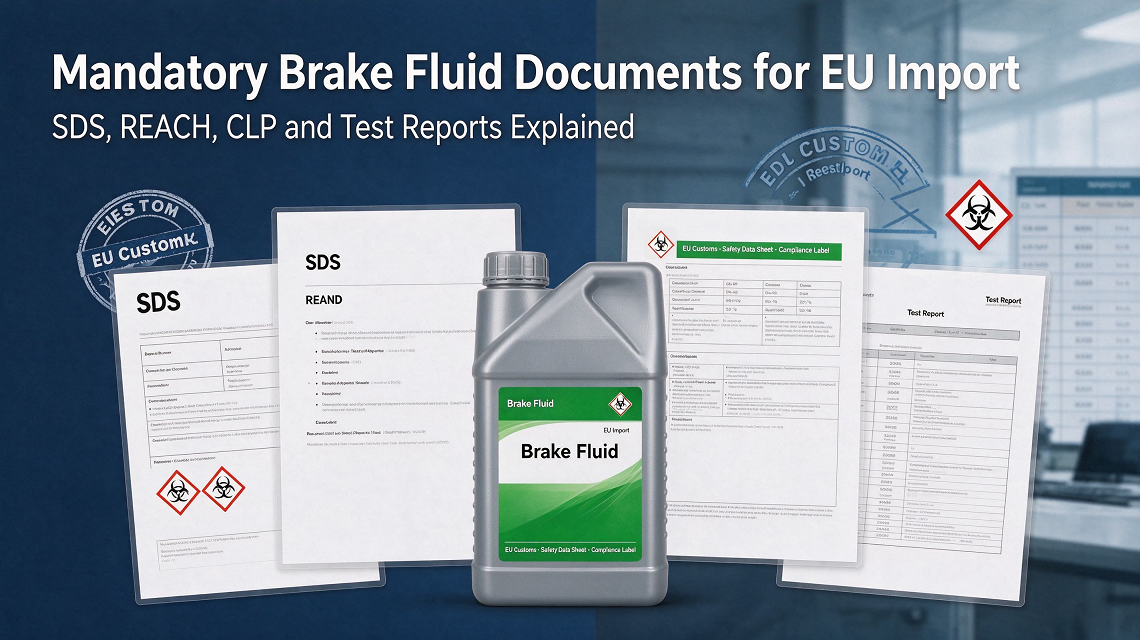
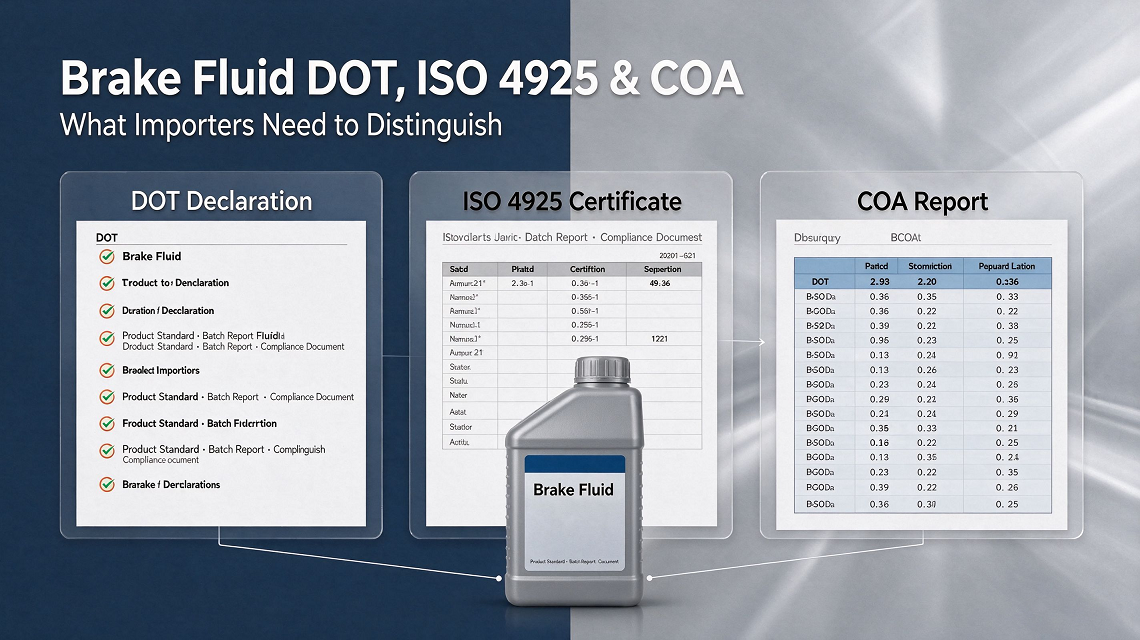
A TDS usually summarizes the product's intended characteristics and properties. An SDS addresses hazards and safe handling; it is not a substitute for performance testing. A COA reports lot-related quality information and must be checked against the contractual acceptance specification. Product-level approvals and current management-system certificates are additional document types with different purposes. Keeping them separate helps prevent a sales team from turning one generic certificate into an unsupported universal approval claim.
A practical document register records the file title, issuer, issue date, revision, formulation code, standard edition, expiry or review date if relevant, and person responsible for confirmation. This modest administrative step can prevent costly documentation mismatches during an import inspection or customer complaint.
Qualification evidence versus routine batch release
A qualification report can establish that a particular sample or controlled formulation met the applicable test program under the stated conditions. A production-lot COA provides test or conformity information for a specified commercial batch. Not every test is necessarily performed on every lot; the agreed control plan must distinguish routine release checks from periodic and change-related qualification. Buyers should never assume a COA covers the full standard unless the document actually establishes that scope.
| Document | Main purpose | Essential cross-check |
|---|---|---|
| Technical Data Sheet (TDS) | Identifies product characteristics and claims | Product ID, grade, limits, revision |
| Safety Data Sheet (SDS) | Communicates hazards and safe handling | Correct product and destination-market version |
| Qualification report | Provides evidence for defined tests | Sample identity, test methods, edition, results |
| Certificate of Analysis (COA) | Links released batch to agreed quality information | Lot number, acceptance limits, sign-off |
| Package and label approval | Defines the delivered configuration | Bottle/cap version, seal, print and language |
| Management-system certificate | Supports organizational quality-system evaluation | Legal entity, site, scope and current validity |
An importer who receives all six documents can still have an incomplete approval if the product codes do not agree. The quality of the system lies in the linkage, not the number of PDF attachments.
A Five-Step Buyer Workflow: From Formula Proposal to Repeatable Supply
The following process condenses the twelve evidence checks of the previous supplier-audit guide into five procurement decisions. It mirrors an engineering article's practical decision tree while remaining a recommended buyer workflow, not an undocumented claim that GAFLE follows these exact internal stages.
Step 1 — Define the application and freeze the product specification
Identify destination market, customer segment, applicable vehicle and brake-system requirements, targeted chemistry, DOT or other standard, test limits and intended packaging. Confirm that every supplier is quoting the same product definition. When no source supports a universal compatibility claim, remove that claim rather than extrapolating.
Control 1 — Define the Market, Application, and Commercial Scope. Prepare a requirements sheet identifying destination countries, intended vehicle populations, channel (workshops, retail, distributors or fleet maintenance), forecast volume, desired packaging, and the exact service requirements collected from vehicle documentation. A statement such as “brake fluid for Europe” or “for all SUVs” is not a technical specification. Name the grades, classes, and application constraints that matter to your actual customer base.
Approval evidence: a dated market-and-application requirements sheet signed by the technical buyer. Stop signal: a brand-wide compatibility claim with no model-specific source.
Control 2 — Freeze the Technical Specification Before Price Comparison. Issue a controlled product specification stating chemistry family, standard and edition, grade, required performance limits, test methods, allowed tolerances, packing conditions, and identification code. Define which values are legal minima, which are supplier guarantees, and which are typical marketing values. Ask competing factories to quote against the same specification, not loosely similar catalogue entries.
Approval evidence: one comparable specification for every supplier. Stop signal: quotations based on different grades or unspecified performance promises.
Step 2 — Validate the legal factory and its material controls
Verify the manufacturing entity, plant and relevant certification scope. Discuss whether the supplier actually blends and tests the product, fills supplied bulk fluid or outsources part of the process. Review raw-material and formula revision control, including how substitutions and changes are communicated to the customer.
Control 3 — Verify Manufacturer Identity and Scope. Confirm the legal manufacturer, production site, relevant quality-management scope, and whether the prospective partner actually blends the fluid, only fills it, or outsources part of the process. Evaluate the factory's relevant production equipment and personnel competence. Ask for copies of valid certificates showing the certified legal entity, location, scope and expiration date; follow up with the issuer where appropriate.
Approval evidence: matched company, plant and certificate information. Stop signal: documents naming unrelated organizations or missing production scope.
Control 4 — Review Formula and Raw-Material Change Control. Ask how the approved formula is identified, how base-fluid and additive inputs are qualified, and what happens if a raw-material supplier changes. A producer should be able to explain its formulation code, batch instructions, material acceptance process and rules for engineering change. Private-label customers also need clarity over intellectual property and whether a formula is exclusive, customer-owned, or selected from a standard range.
Approval evidence: approved formula code and documented change-notification rules. Stop signal: unilateral substitutions without evaluation or buyer notification.
Step 3 — Connect the sample to laboratory evidence
Require the candidate sample and all reports to identify the same formulation. Review methods, standard editions and agreed contractual acceptance values. If the recipe changes after testing, the qualification evidence must be evaluated for continued applicability.
Control 5 — Receive a Traceable Qualification Sample. The first sample should be traceable to the exact formula revision being quoted. Record its sample number, manufacture date, packaging, test results, and intended standard. If the factory sends a different sample after a failed test, require a documented reason and a new evaluation. The sample should be representative of production; a special laboratory blend cannot automatically stand in for a commercial production lot.
Approval evidence: sample identity linked to a TDS, test record and quotation. Stop signal: an attractive unlabeled bottle without a formula or sample reference.
Control 6 — Evaluate the Laboratory Evidence Package. Request the current technical data sheet (TDS), safety data sheet (SDS), applicable qualification test reports, and an example certificate of analysis (COA). Evaluate the complete relevant performance profile—not just the best dry boiling-point figure. Important areas may include wet ERBP, low-temperature viscosity, corrosion, rubber effects, stability, water tolerance and appearance. Decide which tests must be performed for every production batch and which belong to periodic qualification, consistent with the applicable standard and agreement.
Approval evidence: dated test reports with traceable sample identities, methods and limits. Stop signal: a general “internationally certified” sentence with no relevant report.
Step 4 — Validate the physical pack and a representative pilot lot
Approve bottle, seal, artwork and export-facing information; then agree on an appropriate pilot or preproduction run. A laboratory sample is useful for screening, but routine filling and handling should be assessed before expansion to large commercial quantities.
Control 7 — Approve Packaging as a Technical Component. For a moisture-sensitive hydraulic fluid, bottle, cap and inner seal are part of the product risk profile. Confirm container material compatibility, fill-volume tolerance, closure integrity, tamper evidence, carton protection, lot coding, storage recommendations and label durability. Under applicable FMVSS No. 116 provisions, specified brake-fluid containers of 177 mL or more require a resealable closure with an impervious inner seal and tamper-proof feature. Other jurisdictions may impose additional requirements.
Approval evidence: approved physical package, closure specification, test plan and artwork proof. Stop signal: artwork approved but seal design or mandatory warnings omitted.
Control 8 — Run an Agreed Pilot or Preproduction Lot. A laboratory sample demonstrates formulation feasibility; a representative pilot or preproduction run helps evaluate production transfer. Agree how it will be produced, sampled and assessed. Compare its results to the approved specification, evaluate labeling and filling consistency, and document defects or corrective actions before committing to larger quantities. The sample size and trial scope are project decisions, not universal industry numbers.
Approval evidence: pilot-run record, inspection findings and signed release decision. Stop signal: moving straight from a hand-prepared sample to a large order with no production validation.
Step 5 — Release, trace and reapprove each meaningful change
Review the batch-specific release package, shipped lot identification and destination-market documents. Define the nonconformity process and repeat-order change control. The second order should match the approved master specification unless a change has been reviewed and authorized.
Control 9 — Verify Batch Release, COA and Traceability. A production batch should connect raw-material lots, process records, finished-fluid tests, filling date and packaged-lot identifiers. Define the release decision maker and what the buyer receives with each shipment. A COA should identify the actual lot, test methods where applicable, results and conformity to agreed limits. A preprinted generic COA with no batch linkage is not enough. Record retained samples and investigation requirements if this is part of the quality agreement.
Approval evidence: signed lot-specific records and a traceable COA. Stop signal: sample documents that do not match the shipped product.
Control 10 — Approve Destination-Market Labels and Export Documents. The importing party and manufacturer should determine responsibilities for product classification, safety information, local language, required labels, packaging transport rules, customs description and export documentation. A label suitable for one market may not be suitable for another. Never copy a DOT compliance statement, a manufacturer approval or an environmental claim onto artwork without substantiation. Match each label revision to the product and packaging code.
Approval evidence: signed artwork, document checklist and shipment configuration. Stop signal: regulatory responsibility left undefined until the goods are ready to ship.
Control 11 — Agree on Complaints, Nonconformities and Corrective Action. Even an approved supplier needs a structured way to manage unexpected results. Define how the buyer reports suspected defects, how suspect stock is isolated, who investigates, which records must be provided, and how replacement, credit or corrective action is determined. Include responsibilities for notification when the supplier discovers an issue that could affect distributed product. Neither party should promise a particular remedy without a written agreement.
Approval evidence: complaint, escalation and corrective-action clauses. Stop signal: only informal verbal promises after shipment.
Control 12 — Reapprove Changes and Control Repeat Orders. Before the second and subsequent orders, confirm that the approved formulation, standard, bottle, cap, label, site and test limits remain current. Compare the reorder to the approved master specification and review the previous lot's performance, shipment quality and customer feedback. Significant changes should trigger a documented impact assessment and, where necessary, sampling or requalification. Reordering should not mean starting technical approval from zero, nor should it mean skipping verification entirely.
Approval evidence: version-controlled master file and change-history log. Stop signal: a new formula or package silently shipped under an old stock code.
SAMPLE TO BATCH VALIDATION
Turn a sample into an auditable supply program
View GAFLE Manufacturing Information ↗Discuss Testing and Batch Controls ↗SAMPLE TO BATCH VALIDATION
Turn a sample into an auditable supply program
View GAFLE Manufacturing Information ↗Discuss Testing and Batch Controls ↗Which Brake Fluid Grade and Product Range Should an Importer Shortlist?
Selecting a product family comes after the buyer understands the vehicle and market requirement. The following matrix is a planning aid. It does not grant product approvals or suggest that a higher DOT number is a universally superior substitute.
| Candidate range | Potential commercial role | Evidence that makes it shortlist-ready |
|---|---|---|
| DOT 3 | Proven applications where the manufacturer permits or requires it | Verified service requirements and relevant DOT test file |
| DOT 4 | Core aftermarket applications where specified | Complete DOT 4 qualification and package review |
| Low-viscosity DOT 4 | Specific systems with an additional low-viscosity requirement | Relevant class/viscosity data and application restrictions |
| DOT 5.1 non-silicone | Particular systems with documented higher-grade requirements | Correct chemistry, DOT 5.1 performance evidence and model fit |
| Motorsport or specialty formula | Approved specialist use with defined thermal demand | Actual measured performance, compatibility and customer application |
For GAFLE-related sourcing, start from the published brake fluid collection, then discuss exact candidate SKUs such as DOT3 and DOT407 with the technical sales team. Those pages identify commercial product options; they do not establish an automaker approval for every vehicle.
The purchase approval must refer to the current formula version, documentary scope, agreed packaging and target destination. The brand should resist describing an unverified product as compatible with every model or approved under a named vehicle-maker standard. A credible brake-fluid manufacturer can distinguish “conforms to the stated grade” from “the automaker has formally approved this exact formula.”
GAFLE PRODUCT SHORTLIST
Review DOT 3, DOT 4 and specialty requirements
Review GAFLE DOT407 ↗Ask About OEM Options ↗How Should OEM, ODM and Private-Label Projects Control Product Changes?
A manufacturer can support OEM production to a buyer's approved technical requirements, ODM development when new formulation or product-development work is agreed, and private-label packaging of a qualified product under the buyer's brand. The names are sometimes used loosely in sales conversations; the written contract should specify who owns the formula, who controls modifications, who approves claims and who is responsible for downstream market compliance.
OEM supply does not automatically mean that a vehicle manufacturer approves the brake fluid. In this context it often describes contract production for an automotive-fluid brand or distributor. A private-label customer might choose an existing DOT 4 formula and customize the package, while an ODM project might require additional testing, development time and documented acceptance work. Neither arrangement eliminates the need for grade verification or factory controls.
The main approval objects are the formulation, technical specification, sample, physical bottle and seal, label artwork, carton, market compliance file, and production release plan. Buyers should assign unique revisions to each. Do not let a design agency add “OEM approved,” “universal,” or “exceeds all international standards” simply to increase perceived value. Marketing claims must match the evidence for the exact product and destination.
GAFLE publicly describes OEM and ODM brake-fluid support and private-label packaging services. Available package options, project MOQ, sample timing, exclusivity and lead time should be confirmed directly for each order; they are not implied by the presence of those services on a website.
Why artwork and formula changes need separate authorization
A private-label importer might want a new language, cap, bottle color or QR code without altering the fluid. Those adjustments can still affect legal information, packaging integrity or traceability. A formulation change raises an additional technical qualification question. The agreement should state which modifications require buyer sign-off, new tests or a revised market file.
For technical purchasers, a useful deliverable is a one-page change-notification matrix: formula or ingredient supplier, production site, test method, bottle, cap, seal, label and carton each have an owner, approval rule and revision code. No packaging contractor or graphic designer should be permitted to add unsupported regulatory or vehicle approvals while the chemistry file remains unchanged.
An Illustrative Pilot-Lot Review: What a Good Validation Record Looks Like
The following is a hypothetical buyer-side exercise, not a GAFLE customer project, factory test result, disclosed order or verified cost-saving case study. It illustrates how an importer might transfer an approved DOT 4 candidate from sampling to routine distribution without inventing manufacturing performance figures.
Buyer challenge. A regional automotive-fluid distributor wants a private-label DOT 4 bottle for mixed workshop distribution. Its first supplier presentation includes an attractive mock-up, a typical boiling-point figure and a broad quality certificate. However, the sample ID does not appear on the technical report, and no signed seal specification is attached to the quotation. Those are not necessarily proof of a defective product, but they are insufficient grounds to commit to mass production.
Qualification action. The importer requests a controlled formula code, a representative sample, the current DOT 4 qualification file, a written specification and a packaging drawing. It reviews the destination-market label wording and separates typical TDS values from lot-release acceptance criteria. It also asks for a sample COA format showing how each shipment's lot code will connect to the manufacturer records.
Pilot validation. Before confirming a large order, the two sides agree on a representative pilot batch and what constitutes pass or fail. The technical buyer reviews the linked sample results, packaging inspection and release decision. If an item is out of specification or documentation is missing, the project pauses for investigation. Any corrective action is documented, and a revised sample is assessed if the change could affect performance or packaging suitability.
Commercial outcome criteria. Success would mean the buyer can approve the actual formulation and package, trace the trial material, receive the agreed records, and re-order the same controlled SKU under a written change procedure. No numerical savings, yield improvement or production time is claimed without measured company evidence.
| Review checkpoint | Example acceptance evidence | What a failure should trigger |
|---|---|---|
| Formula identity | Revision-linked specification and sample code | Technical clarification or resampling |
| Product testing | Traceable results and approved limits | Review of conformity and qualification scope |
| Packaging | Approved seal, artwork and finished pack | Package correction or requalification |
| Pilot run | Production and inspection records | Root-cause review, corrective action and repeat checks |
| Repeat-order control | Master SKU, COA template and change clauses | Hold shipment or formal change approval |
This evidence-based scenario is more helpful to an experienced buyer than an invented success story with precise cost reductions. Once GAFLE supplies a real, publishable project with permission, the scenario could be replaced with a genuine case supported by documents and measured results.
What Do MOQ, Lead Time and Landed Cost Actually Tell You?
Annual tonnage, warehouse size and the number of filling lines may indicate manufacturing scale, but they are not an accurate quote for your particular order. The relevant information is whether the supplier can make your chosen formula in your required package, at your requested quantity, within an agreed and repeatable release schedule. A plant's total capacity across brake fluid, coolant and other products must not be misrepresented as capacity dedicated to one DOT grade.
Ask for separate estimates of formula or grade MOQ, packaging MOQ, artwork printing MOQ, sample preparation time, production lead time after approvals, quality-release time and shipping readiness. A container order spread across five labels and three bottle sizes may create very different setup economics from the same total volume in one approved SKU. Repeat-order lead time can also differ from first-order timing because the first order includes artwork, samples and technical review.
Write explicit dependencies into the schedule: the clock for commercial production begins only when formula, artwork, packaging materials and purchase terms are approved. Leave room for retesting or rework rather than treating an unverified sales target as a guaranteed shipment date. The same discipline applies to any promise about free samples, tooling charges or flexible minimum orders. Obtain these terms in the written GAFLE quotation rather than guessing.
Price per bottle is easy to compare and easy to misuse. A real landed-cost model also includes formula and testing costs, bottle and closure, label and carton, printing setup, sample and inspection charges, inland freight, export processing, international freight, insurance, import duties, taxes where applicable, warehousing and local delivery. Add the cost of slow inventory, damaged packaging, label corrections and possible customer complaints.
A lower price may be commercially attractive when suppliers offer equivalent verified products and services. But if one quotation excludes a relevant test package or uses a different cap and seal, the offers are not truly comparable. The buyer should normalize the bill of materials, documented specifications, quality-release plan and delivery terms before drawing a price conclusion.
For brand owners, the most expensive failures are often indirect: delayed launch windows, workshops losing trust in the label, sales staff making unsupported compatibility claims, or the company being unable to trace a suspect lot. A supplier agreement that reduces these risks can be economically valuable even without the lowest initial unit cost.
| Cost or risk area | Hidden question | Practical control |
|---|---|---|
| Technical testing | Is testing included, and which tests? | Written methods, limits and document schedule |
| Package integrity | Is the quote based on the approved seal? | Locked bottle/cap specification and inspection |
| Multi-SKU MOQ | Is MOQ per grade, bottle or artwork? | Line-item quote for every variant |
| Delivery | When does the lead-time clock start? | Approval milestones and named Incoterm |
| Documentation | Are buyer-required reports and COAs supplied? | Contract document checklist |
| Nonconformity | Who pays for rejects or rework? | Agreed investigation and remedy procedure |
A fair quotation compares the same physical and technical product
If supplier A quotes a DOT 4 bottle with a documented qualification file, validated inner seal and batch documentation, while supplier B excludes those deliverables or proposes a different package, the apparent price difference is not yet a true cost comparison. Normalize the product definition, quality requirements, labels, MOQ by artwork version and shipping terms. Include the cost of trial samples, required testing, artwork corrections, warehouse handling and potential returns.
The most important commercial milestone is not simply the first shipment. It is a repeat order that can use the same formula and documented package without reopening every unresolved technical question. Consistent documents, clear change notification and timely quality response are part of the value a professional manufacturing partner provides.
Which Buyers Need This Level of Manufacturing Evidence?
An automotive-fluid importer entering a new region needs market documentation, compliant labeling, a rational DOT 3/DOT 4 assortment, and dependable export service. A private-label brand needs formula ownership and artwork approvals, controlled packaging, sampling, and production release. A distributor adding a second supplier needs comparable test limits and a requalification plan. A fleet-maintenance purchasing team needs traceable lots and documented vehicle requirements. Each buyer should use the same evidence-gate structure but adjust the commercial requirements to the project.
This guide is not a substitute for vehicle-maker service manuals, regulatory advice, independent laboratory testing where required, or qualified brake-system engineering. It is also not permission to use conventional DOT fluid in a hydraulic system that specifies mineral oil or another incompatible chemistry. Some heavy trucks use air service brakes; these vehicles do not consume ordinary DOT fluid in that air-brake circuit. Motorcycle brake and clutch circuits can have different fluid requirements. The exact system specification must come first.
The most productive purchasing team includes a technical approver, a quality owner, a purchasing owner, and an artwork or compliance reviewer. On a small project one person may hold multiple roles, but each approval still needs a dated record. This prevents commercial pressure from overriding unresolved technical questions.
Different segments value different parts of a manufacturer's capability. Automotive aftermarket distributors need compact and easy-to-explain portfolios with robust replenishment. Repair chains need consistent approved fluid and practical packaging. Private-label brand owners need controlled formulation and artwork. Vehicle or component engineering teams may require deeper testing and approval. Motorsport channels may focus on specific heat-performance evidence, while electric-vehicle service channels must confirm model-specific hydraulic requirements rather than assume a universal EV grade.
Climate is relevant to technical questions, but it is not a substitute for a vehicle specification. Cold markets may place more emphasis on particular low-temperature viscosity classes; hot and mountainous duty cycles can make thermal-performance evidence especially important; humid distribution conditions emphasize sealed packages and inventory handling. The buyer's content and label should explain actual tested properties, not promise that the product fits all climates or hydraulic systems.
These segments also suggest different landing-page and internal-link strategies. Product pages explain what a SKU is. Technical articles explain grades, standards and limitations. OEM service articles help buyers understand customization. A manufacturer audit guide ties those pages together and offers a high-intent next step: submit an RFQ with the necessary evidence list.
A large importer might need a technical conformity dossier and batch genealogy. A private-label brand may prioritize formula-control rights, packaging revisions and labeling proof. An aftermarket workshop chain may prefer fewer reliably documented grades in appropriate sealed sizes. Engineering buyers typically require the deepest evidence package and often apply their own internal approval protocols. All of these groups should base decisions on actual applications rather than marketing categories alone.
A Supplier Comparison Scorecard and RFQ That Buyers Can Use
Procurement scorecards are useful only after safety-critical requirements pass. A factory with a low price and fast response should not compensate for an unsupported grade claim or an incompatible fluid chemistry. First use pass/fail gates for product suitability, evidence authenticity and legal obligations. Then compare commercially acceptable suppliers using a weighted score.
| Qualification area | Illustrative weight | What earns a strong score |
|---|---|---|
| Technical conformity and evidence | 25 | Traceable reports, accurate claims and signed specification |
| Manufacturing and formula control | 20 | Defined production, material and revision systems |
| Batch quality and traceability | 20 | Documented release, lot coding and COA consistency |
| Packaging and market readiness | 15 | Approved seal, artwork, labeling and export file |
| Delivery and commercial terms | 10 | Clear MOQ, quote basis and realistic lead time |
| Communication and corrective action | 10 | Named owners, prompt evidence and complaint process |
| Total | 100 | Critical technical failures still disqualify the offer |
These scores are an illustrative buyer framework, not a published ranking of GAFLE or a prediction of search performance. Use the checklist to ask the same questions of each qualified candidate. Record unanswered items as open actions rather than assigning them optimistic scores.
A useful RFQ should make it easy for a factory to provide a precise offer. Include the target market, vehicle coverage, product grades and standards, required documentation, packaging, private-label scope, order volume, timing and delivery conditions. It should also state that compatibility and marketing claims require technical review before approval.
Subject: Brake Fluid OEM/Private-Label RFQ — [Country] / [Grades] / [Volume]
We are an automotive-fluid importer/distributor serving [market and customer segment]. We are evaluating a brake fluid manufacturer for a controlled [DOT 3 / DOT 4 / specified class] range. Please provide the exact proposed SKU and formulation revision, current TDS and SDS, applicable performance evidence, quality-system certificate scope, sample availability, batch COA example, bottle/cap/inner-seal options, packaging MOQ by version, trial-order and repeat-order lead time, and Incoterm-based quotation. Our initial volume is [quantity], with an estimated annual demand of [volume]. We will review vehicle and market requirements and sign off the formula, packaging and artwork before commercial production.
A buyer can attach the twelve-gate checklist and ask the supplier which documents are available immediately, which require a sample or project agreement, and which are not currently supported. That transparency makes qualification faster. It is better to receive an accurate “requires validation” answer than an easy but unsupported assurance.
Before sending the RFQ, compare the factory's publicly available pages with the specific project request. GAFLE's company profile and brake-fluid collection help identify starting capabilities and product categories. The GAFLE contact page is the appropriate route to confirm available specifications, latest TDS, sample terms, MOQ and the actual manufacturing/packaging plan.
GAFLE OEM / PRIVATE LABEL
Send your exact specification and packaging requirements
Browse Brake Fluid Portfolio ↗Request an OEM Quotation ↗Frequently Asked Questions About Brake Fluid Manufacturing and Batch Control
FAQ 1. What does a brake fluid manufacturer actually do?
A manufacturing partner may develop or select a formulation, qualify materials, blend and fill fluid, test batches, package products and provide supporting documents. The exact scope differs by supplier. Ask whether formulation, filling, testing and private-label services are performed at the claimed facility or through contracted parties.
FAQ 2. How do I choose a brake fluid manufacturer in China?
Start with a precise application and product specification. Verify the legal production site, relevant quality-system certificates, product test evidence, sample traceability, packaging integrity, commercial terms and corrective-action process. Compare only suppliers proposing equivalent technically qualified products.
FAQ 3. Is ISO 9001 or IATF 16949 enough to prove brake-fluid quality?
No. Management-system certifications can support assessment of the organization's processes, but they do not prove that a specific DOT 4 formulation meets every performance requirement or is approved by a vehicle manufacturer. Request the current certificate scope and product-specific test documents separately.
FAQ 4. What is the difference between a TDS and a COA?
A TDS describes the product's intended technical characteristics and specification information. A COA records relevant test results or conformity information for a particular lot or batch. Procurement should make sure both use compatible product codes and standards and that the COA is traceable to shipped goods.
FAQ 5. Can a manufacturer customize DOT 4 brake fluid for my private label?
Potentially. Private-label packaging of an existing qualified formula and new formula development are different projects. Ask the factory which option it offers, what test work or change approvals are needed, how the formulation and intellectual property are controlled, and which packaging designs are commercially available.
FAQ 6. What tests should I request before ordering bulk brake fluid?
Request the tests relevant to the exact grade and governing standard. Depending on the product, this may include dry and wet ERBP, viscosity, corrosion, rubber effects, stability and water tolerance. Confirm test methods, standard edition, acceptance limits and whether the data represent the approved formula or actual batch.
FAQ 7. Why are brake fluid inner seals and tamper features important?
Packaging helps protect the fluid from contamination and moisture exposure and supports traceability. Some destination markets, including U.S. applications under FMVSS No. 116, have explicit container-sealing and labeling provisions. Buyers should qualify the actual bottle, cap, inner seal and artwork—not merely the fluid inside.
FAQ 8. How much is the minimum order quantity for OEM brake fluid?
There is no responsible universal MOQ without a particular supplier, grade, container, artwork and order plan. MOQ may differ by formula, package size, printing design and trial versus repeat production. Ask for a written line-item quote for each planned SKU and label version.
FAQ 9. Can DOT 5.1 replace DOT 4 or DOT 3 automatically?
No. DOT 5.1 is non-silicone, whereas DOT 5 is silicone-based, and vehicle requirements still determine acceptable fluid. Do not substitute any grade based on its number alone. Follow the exact service manual and obtain product-specific compatibility information.
FAQ 10. What information should I send GAFLE for a manufacturing quotation?
Send your destination country, intended vehicle or aftermarket applications, requested fluid grade and standard, estimated purchase volume, expected repeat orders, packaging details, branding requirements and document list. Start with the company's brake-fluid product range and submit the specification through the GAFLE contact page for review.
Conclusion
Selecting a brake fluid manufacturer is an engineering and procurement exercise: confirm the intended vehicle and market requirement, define the fluid grade and acceptance limits, assess the formula and manufacturing controls, verify a representative sample, qualify the package, and demand traceable evidence for commercial batch release. These checks are especially important when moving from a promising laboratory sample to repeatable OEM or private-label bulk production.
The most useful lesson from process-focused engineering content is that quality needs to be explained through variables, controls, methods and evidence. A dry ERBP value by itself cannot prove wet-performance consistency, corrosion behavior or package integrity. A general factory certificate cannot establish automaker approval. Likewise, a low quote does not demonstrate that the supplier can maintain an unchanged formula, seal and artwork through future shipments.
For a practical starting point, review GAFLE's brake-fluid range, the DOT3 and DOT407 DOT 4 product pages and its OEM/ODM overview. Send the destination market, grade, target package, volume and required evidence package via GAFLE's inquiry page. The next step is a verified sample-to-pilot-to-batch approval plan that can support dependable repeat supply.